
Maximizing Plant Throughput in Mineral Processing
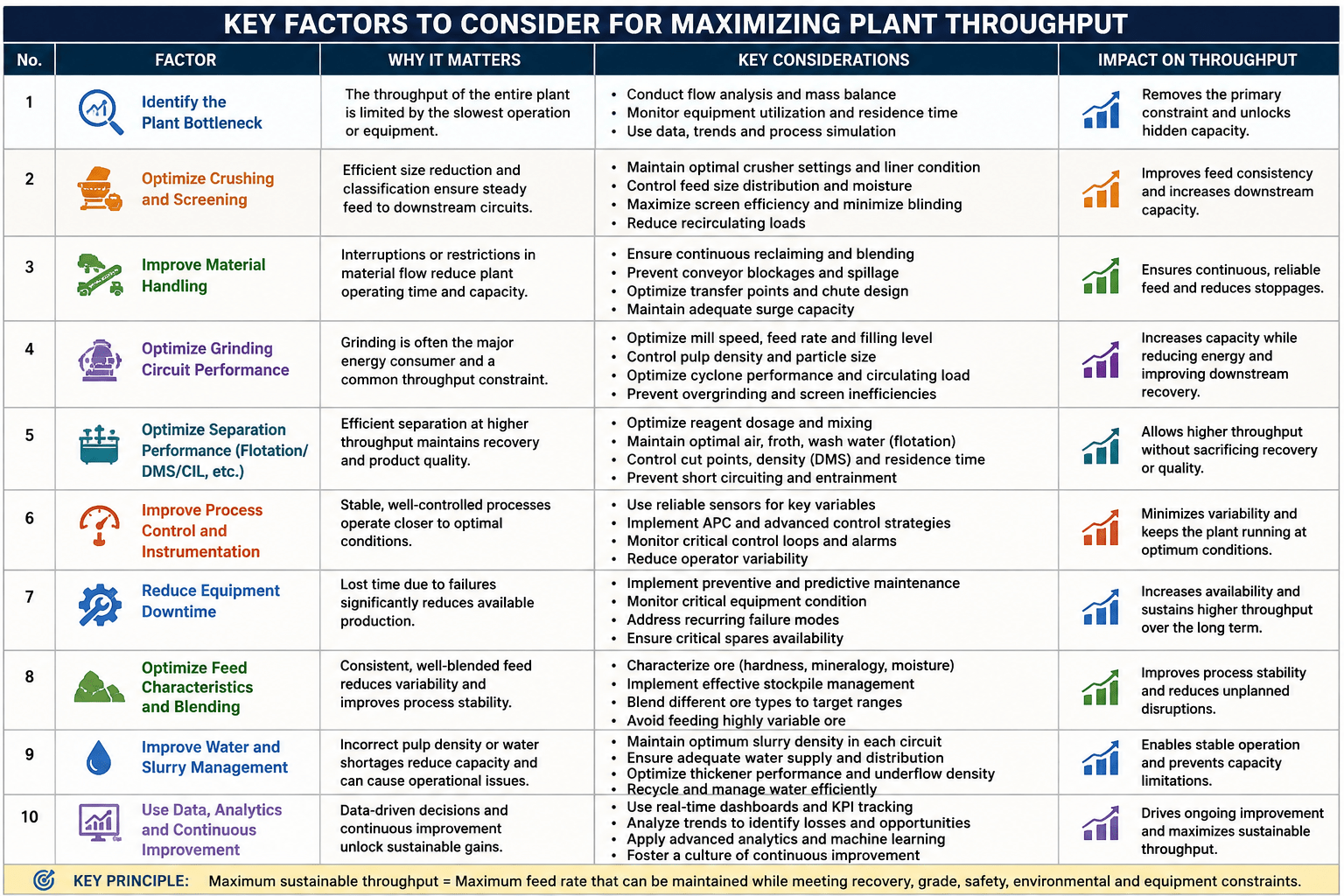
**Maximizing plant throughput** is not simply a matter of increasing feed rate. Sustainable throughput requires identifying and removing the constraints that limit the overall process while maintaining product quality, recovery, equipment reliability, and safety.
### Key Strategies
1. **Identify the Plant Bottleneck**
* Conduct a complete process flow analysis. * Determine which equipment or process step limits overall capacity. * Use mass-balance and process simulation to identify constraints. * Monitor throughput, utilization, residence time and equipment loading.
2. **Optimize Crushing and Screening**
* Maintain optimal crusher operating parameters.
* Control feed size distribution and moisture.
* Optimize screen efficiency and prevent blinding.
* Minimize recirculating loads and crusher downtime.
3. **Improve Material Handling**
* Ensure continuous feed to the processing plant.
* Optimize stockpile reclaiming and blending.
* Prevent conveyor blockages and transfer-point restrictions.
* Maintain adequate surge capacity between process stages.
4. **Optimize Grinding Capacity**
* Control mill feed rate, mill speed, density and particle size.
* Optimize cyclone operation and circulating load.
* Consider technologies such as HPGR where appropriate.
* Prevent overgrinding, which can consume capacity without improving recovery.
5. **Improve Process Control**
* Implement reliable instrumentation for flow, density, pressure, level and particle size.
* Use advanced process control (APC) to stabilize operation.
* Move from reactive operator intervention toward predictive control.
* Maintain operation close to optimum constraints without exceeding equipment limits.
6. **Reduce Equipment Downtime**
* Implement preventive and predictive maintenance.
* Monitor critical equipment condition continuously.
* Identify recurring failure modes.
* Maintain critical spares and reduce maintenance response times.
7. **Optimize Feed Characteristics**
* Characterize ore hardness, mineralogy, moisture and liberation.
* Develop appropriate ore-blending strategies.
* Avoid feeding highly variable ore directly into constrained circuits.
* Use real-time ore characterization where economically justified.
8. **Improve Water and Slurry Management**
* Maintain optimum slurry density throughout the circuit.
* Prevent water shortages and excessive dilution.
* Recycle process water where appropriate.
* Optimize pumps, pipelines and thickener performance.
9. **Use Real-Time Data and Analytics**
* Develop a plant-wide production dashboard.
* Track throughput against equipment constraints.
* Use historical data to identify lost production.
* Apply machine learning to predict bottlenecks and equipment failures.
10. **Measure the Right KPIs**
The most effective approach is therefore to treat throughput optimization as a **continuous improvement process** rather than simply pushing more tonnes through the plant.
**A useful principle is:**
> **Maximum sustainable throughput = Maximum feed rate that can be maintained while meeting recovery, grade, safety, environmental and equipment constraints.