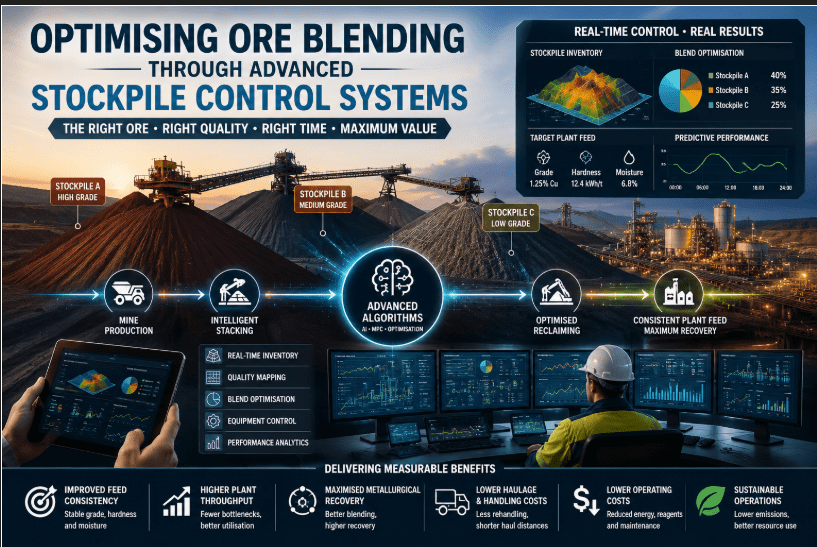
Improving Blended Stockpile Management Using Algorithms and Control Systems
Modern mineral processing plants face increasing pressure to maintain consistent feed quality despite highly variable ore sources. Blended stockpile management has evolved from simple stacking and reclaiming practices into an intelligent process that combines mathematical algorithms, real-time sensing, and automated control systems.
By optimising how ore is stacked, tracked, and reclaimed, plants can significantly reduce feed variability, improve plant stability, and maximise metal recovery.
## Why Stockpile Blending Matters
Ore delivered from different mining faces often varies in:
* Grade
* Mineralogy
* Hardness
* Moisture content
* Clay content
* Contaminants
* Particle size distribution
Without effective blending, these variations create unstable operating conditions, resulting in:
* Fluctuating plant throughput
* Reduced recovery
* Increased reagent consumption
* Higher energy costs
* Poor concentrate quality
* Equipment overloads
A well-managed stockpile acts as a buffer that smooths these fluctuations before the ore reaches the processing plant.
--- ## Digital Stockpile Management
Modern stockpile management combines several technologies:
* GPS-equipped haul trucks
* Drone surveying
* Laser scanning
* Belt weightometers
* Online analysers
* Mine planning software
* Process control systems
* Artificial Intelligence (AI)
These systems continuously update a digital representation (Digital Twin) of the stockpile, showing exactly where different ore qualities are stored.
--- # Core Algorithms Used ##
1. Linear Programming (LP)
Linear Programming determines the best combination of available ore blocks to satisfy production targets while minimising costs.
Typical optimisation objectives include:
* Target head grade
* Throughput constraints
* Mill power limits
* Recovery maximisation
* Transportation cost minimisation
Example: Objective:
Minimise Cost = Σ (Ore Tonnes × Mining Cost) Subject to:
* Feed Grade = 1.25 g/t Au * Throughput = 650 tph * Sulphur < 2% * Silica < 12% LP rapidly identifies the optimum blend from hundreds of ore sources.
-- ## 2. Mixed Integer Programming (MIP)
Some decisions are discrete rather than continuous.
Examples include:
* Which stockpile to reclaim
* Which conveyor to operate
* Which loader to dispatch
* Whether to open a new mining face Mixed Integer Programming incorporates these yes/no decisions while optimising the blend.
--- ## 3. Dynamic Optimisation
Ore properties change continuously throughout the day.
Dynamic optimisation recalculates blending plans every few minutes using:
* Live assay data
* Belt scale measurements
* Production schedules
* Plant performance
The system automatically adjusts reclaim rates to maintain a constant feed.
--- ## 4. Genetic Algorithms
Genetic Algorithms are particularly useful where numerous conflicting objectives exist.
Typical optimisation goals include:
* Maximise recovery
* Minimise hardness variation
* Minimise trucking distance
* Maintain constant feed grade
* Reduce stockpile depletion
These algorithms mimic natural selection, evolving increasingly better blending strategies over thousands of iterations.
--- ## 5. Machine Learning Algorithms
Machine learning models learn from historical plant performance.
Typical inputs include:
* Feed grade
* Ore hardness
* Moisture
* Clay content
* Crusher power
* Mill load
* Recovery
* Flotation performance
Models such as Random Forests, Gradient Boosting, Neural Networks, and XGBoost can predict:
* Recovery
* Throughput
* Energy consumption
* Product quality
* Best ore blend Instead of relying solely on laboratory assays, the system predicts future plant behaviour before the ore enters the mill.
--- # Real-Time Control Systems
Algorithms become truly valuable when integrated with automated control systems.
## Sensors Modern stockpiles utilise:
* Online XRF analysers
* Prompt Gamma Neutron Activation Analysis (PGNAA)
* Near-Infrared (NIR) sensors
* Moisture analysers
* Belt scales
* Conveyor speed sensors
* GPS truck tracking
* Drone photogrammetry
* Laser scanners
These continuously measure ore quality and stockpile geometry.
--- ## Supervisory Control (SCADA)
The SCADA system integrates data from all sensors and displays:
* Live stockpile volume
* Ore grade distribution
* Moisture maps
* Remaining tonnage
* Active reclaim locations
* Blend quality
* Production forecasts
Operators can visualise the entire stockpile in real time.
--- ## Advanced Process Control (APC)
APC systems automatically regulate reclaiming equipment.
Typical manipulated variables include:
* Feeder speeds
* Conveyor rates
* Vibrating feeder settings
* Apron feeder speeds
* Reclaimer travel speed
* Stacker position
The APC controller continuously adjusts these variables to maintain the target blend.
--- ## Model Predictive
Control (MPC) Model Predictive Control is one of the most effective approaches for stockpile blending.
Rather than reacting to changes after they occur, MPC predicts future ore quality over a specified time horizon.
Every few minutes, the controller:
1. Predicts future feed quality.
2. Calculates the optimal reclaim strategy.
3. Adjusts feeder rates.
4. Minimises deviations from the target blend.
5. Repeats the optimisation as new data becomes available.
This proactive approach reduces feed variability and enhances downstream process stability.
--- # Digital Twin Technology
A Digital Twin creates a virtual, continuously updated model of the stockpile. It combines information from:
* Mine block model
* Truck dispatch system
* Drone surveys
* Online analysers
* Plant data
* Geological database
* Production schedule
The Digital Twin can simulate different reclaim scenarios before implementation, allowing engineers to evaluate the impact on feed grade, throughput, recovery, and stockpile life.
--- # Artificial Intelligence for Autonomous Blending
AI systems can recommend or automatically execute blending decisions by integrating geological, operational, and metallurgical data. Capabilities include:
* Predicting feed variability several hours in advance.
* Detecting segregation within stockpiles.
* Recommending the optimal reclaim sequence.
* Forecasting crusher and mill performance.
* Anticipating recovery losses.
* Optimising stockpile life.
* Reducing rehandling and truck movements.
Reinforcement learning is particularly promising because the algorithm continuously improves its reclaim strategy based on operational outcomes, adapting to changing mining conditions.
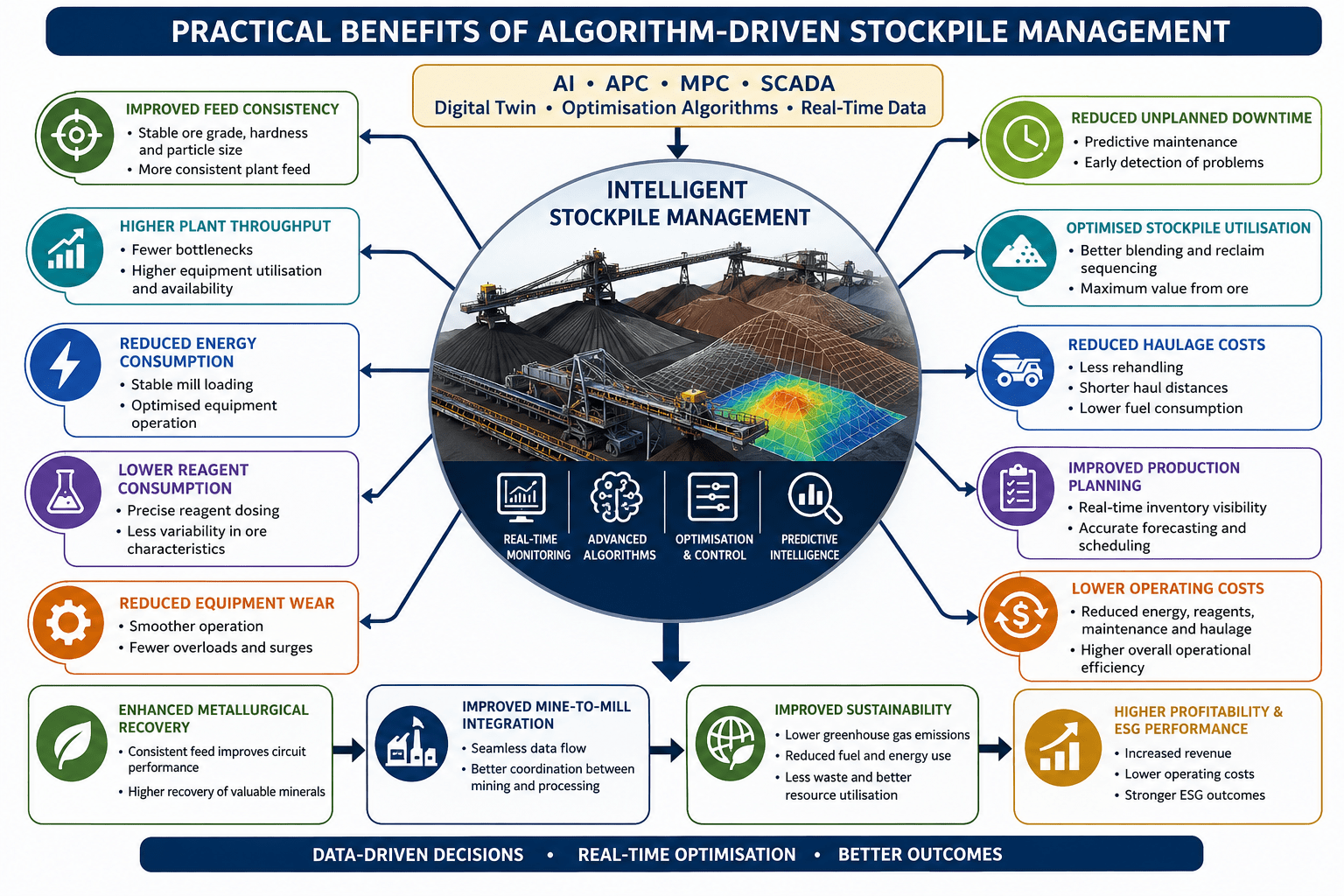
--- # Practical Benefits
Plants implementing algorithm-driven stockpile management can achieve:
--- # Implementation Roadmap
A phased implementation helps manage complexity and risk:
1. Characterise ore variability using geological and metallurgical data.
2. Install real-time sensing technologies such as belt analysers, moisture sensors, and stockpile scanning systems.
3. Develop a Digital Twin of the stockpile and integrate it with the mine planning model.
4. Implement optimisation algorithms (LP, MIP, or Genetic Algorithms) to generate blending plans.
5. Integrate optimisation outputs with SCADA and APC systems for automated execution.
6. Deploy Model Predictive Control to maintain target feed quality under changing conditions.
7. Introduce machine learning models to predict plant performance and continuously refine blending strategies.
8. Monitor key performance indicators and retrain models as new operational data becomes available.
## Conclusion
Improving blended stockpile management through advanced algorithms and control systems transforms the stockpile from a passive storage area into an active optimisation asset.
By integrating optimisation techniques such as Linear Programming, Mixed Integer Programming, Genetic Algorithms, Machine Learning, and Model Predictive Control with real-time sensing, SCADA, APC, and Digital Twin technologies, operations can deliver a more consistent plant feed, improve metallurgical performance, reduce operating costs, and increase overall profitability.
As mining operations continue to embrace digital transformation, intelligent stockpile management will become a cornerstone of efficient, resilient, and autonomous mineral processing plants.
Digital Stockpile Management
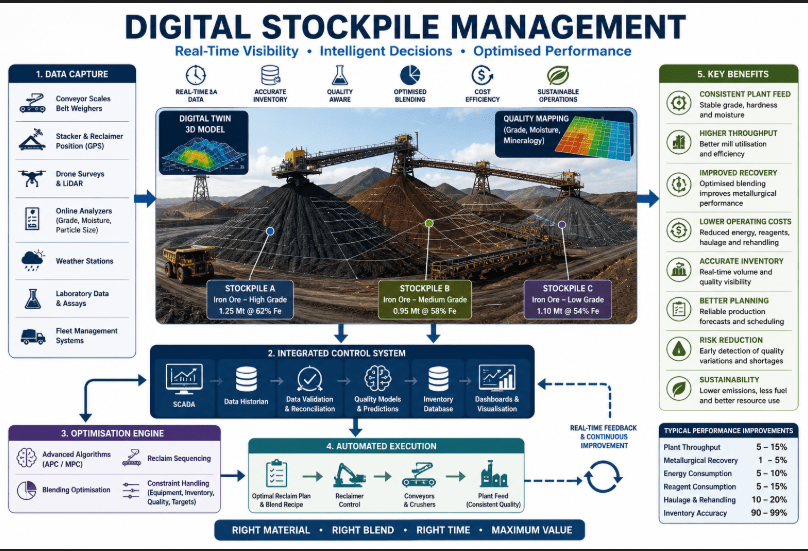
## Digital Stockpile Management
Digital Stockpile Management is the application of digital technologies, automation, and data analytics to monitor, model, and optimise the storage, blending, and reclaiming of ore stockpiles. Rather than relying on manual surveys and operator experience, digital systems create a real-time, data-driven representation of the stockpile, enabling mining and mineral processing operations to make informed decisions that improve feed consistency, maximise recovery, and reduce operating costs.
As ore bodies become more complex and plant performance targets become more demanding, digital stockpile management has become an essential component of modern mine-to-mill optimisation.
At the core of digital stockpile management is the integration of multiple data sources into a single digital platform. Geological block models provide information on ore grade, mineralogy, hardness, and contaminants before mining begins. GPS-enabled haul trucks record where each load is dumped, while drone photogrammetry, LiDAR scanning, and laser surveys generate accurate three-dimensional models of stockpile geometry and volume. Conveyor belt weightometers, moisture sensors, online elemental analysers such as X-ray fluorescence (XRF) and Prompt Gamma Neutron Activation Analysis (PGNAA), together with laboratory assays, continuously update the quality of material entering and leaving the stockpile.
These datasets are integrated into a central database that provides operators and engineers with a comprehensive, real-time view of stockpile inventory and ore characteristics.
One of the most significant advances in digital stockpile management is the creation of a **Digital Twin**. A Digital Twin is a continuously updated virtual model of the physical stockpile that reflects both its geometry and internal composition. It combines mine planning information, production schedules, truck dispatch records, sensor measurements, and processing plant feedback to estimate the location and quality of material within the stockpile. Engineers can use the Digital Twin to simulate different stacking and reclaiming strategies before implementing them, allowing them to evaluate their impact on plant feed grade, throughput, recovery, and stockpile life. This predictive capability reduces uncertainty and supports more effective operational planning. Digital stockpile management also enables advanced blending optimisation.
Mathematical algorithms, including Linear Programming (LP), Mixed Integer Programming (MIP), Genetic Algorithms, and Machine Learning models, analyse available ore sources and recommend the optimum blending strategy based on production objectives and operational constraints. These algorithms can simultaneously consider multiple variables such as target grade, hardness, moisture, contaminant levels, processing capacity, haulage distances, and stockpile availability. By automatically adjusting reclaim rates and blending proportions, plants can maintain a more consistent feed to the crushing, grinding, and concentration circuits, resulting in improved plant stability and higher metallurgical performance.
Automation and control systems play a critical role in executing these optimisation strategies. Supervisory Control and Data Acquisition (SCADA) systems collect real-time information from field instrumentation and display stockpile status through intuitive operator dashboards. Advanced Process Control (APC) systems automatically regulate feeder speeds, conveyor rates, stacker positions, and reclaimer movements to maintain the desired blend. More sophisticated installations employ Model Predictive
Control (MPC), which predicts future ore quality over a defined time horizon and proactively adjusts reclaim strategies before deviations occur. This predictive control approach significantly reduces feed variability and minimises process disturbances downstream. Artificial Intelligence (AI) is increasingly enhancing digital stockpile management by learning from historical operating data and identifying patterns that may not be obvious to human operators. Machine learning models can predict plant throughput, recovery, energy consumption, and product quality based on the planned stockpile blend.
Reinforcement learning algorithms can continuously refine reclaim strategies by evaluating previous outcomes and adapting to changing ore characteristics, equipment performance, and market requirements. As these models improve over time, they enable progressively higher levels of automation and decision support. The operational benefits of digital stockpile management are substantial. Improved blending reduces fluctuations in feed grade and ore hardness, leading to more stable crushing and grinding performance, better flotation or leaching efficiency, and lower reagent and energy consumption.
Accurate stockpile inventory measurements improve production planning, reduce ore losses, minimise rehandling, and support more reliable metallurgical accounting. Automated monitoring also enhances safety by reducing the need for personnel to access active stockpiles for manual surveys and inspections. As mining operations continue to embrace Industry 4.0 technologies, digital stockpile management is evolving into an intelligent, autonomous system that connects mine planning, material handling, and mineral processing into a seamless digital workflow.
By combining real-time sensing, Digital Twins, optimisation algorithms, AI, and advanced process control, mining companies can transform stockpiles from passive storage facilities into strategic assets that actively contribute to higher productivity, improved recovery, reduced operating costs, and more sustainable mineral processing operations. This integration represents a significant step towards fully autonomous mine-to-mill optimisation and the future of smart mining.
Core Algorithms Used in Digital Stockpile Management
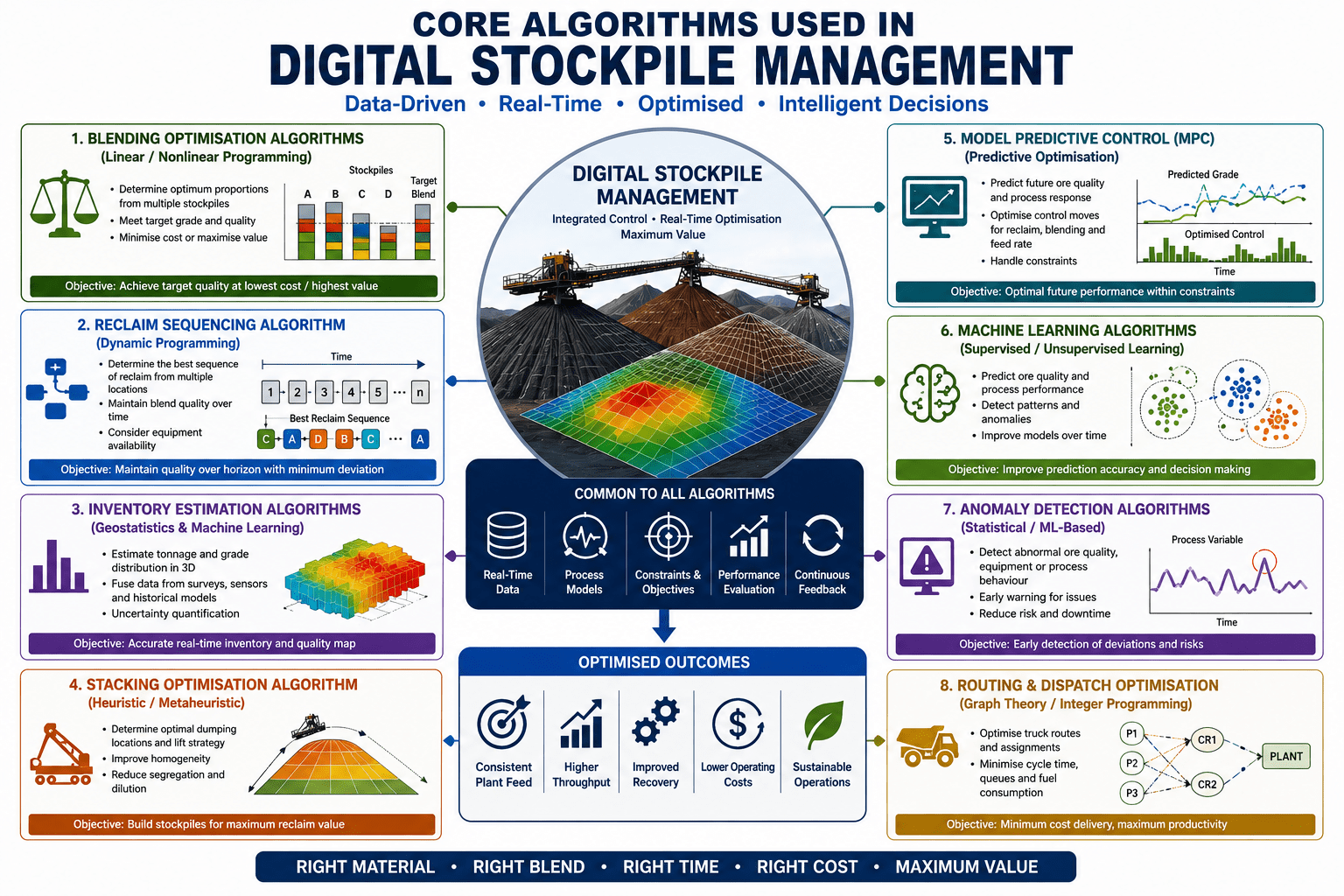
Advanced stockpile management systems rely on optimisation algorithms and artificial intelligence to determine the best way to stack, blend, and reclaim ore while meeting production targets and maintaining a consistent plant feed. These algorithms process large volumes of geological, operational, and metallurgical data to support real-time decision-making and improve overall plant performance.
## 1. Linear Programming (LP)
Linear Programming (LP) is one of the most widely used optimisation techniques in stockpile management. It determines the optimal blend of ore from multiple stockpiles while satisfying a set of operational constraints. The algorithm seeks to optimise an objective function—such as minimising cost or maximising profit—subject to limits on grade, throughput, moisture, hardness, and contaminant levels.
For example, a gold processing plant may require a feed grade of 1.8 g/t Au at a throughput of 800 tonnes per hour while limiting silica content to below 10%.
The LP algorithm calculates the proportion of ore to reclaim from each stockpile to achieve these targets at the lowest possible mining and haulage cost.
Because LP is computationally efficient, it is commonly used for daily and weekly production planning.
**Typical applications include:**
* Optimising ore blending.
* Minimising haulage costs.
* Meeting target feed grades.
* Balancing stockpile inventories.
* Maximising plant utilisation.
--- ## 2. Mixed Integer Programming (MIP)
Mixed Integer Programming extends Linear Programming by allowing certain decision variables to be restricted to whole numbers or binary (yes/no) values.
This makes it suitable for operational decisions involving equipment selection and scheduling. In stockpile management, MIP can determine:
* Which stockpile should be reclaimed.
* Which conveyor route should be selected.
* Which loader or reclaimer should operate.
* When a stockpile should be opened or closed.
* Which mining face should supply ore. By combining continuous blending calculations with discrete operational decisions, MIP provides practical solutions that can be directly implemented in plant operations.
--- ## 3. Dynamic Optimisation
Ore characteristics and production requirements change continuously throughout the day.
Dynamic optimisation algorithms update blending decisions in real time as new information becomes available from sensors, laboratory assays, and production systems.
Inputs typically include:
* Online grade measurements.
* Belt weightometer data.
* Moisture sensors.
* Crusher throughput.
* Mill power consumption.
* Production schedules.
The optimisation engine recalculates the optimum reclaim rates every few minutes, ensuring that plant feed remains as consistent as possible despite changes in ore quality or operating conditions.
--- ## 4. Genetic Algorithms (GA)
Genetic Algorithms are inspired by the principles of natural selection and evolution.
They are particularly effective when optimisation problems involve numerous conflicting objectives that cannot easily be solved using conventional mathematical methods.
Each potential blending strategy is treated as an individual "solution." The algorithm evaluates thousands of possible solutions, retains the best-performing combinations, and creates new generations through selection, crossover, and mutation until an optimal or near-optimal solution is found.
Genetic Algorithms are commonly used to:
* Maximise metal recovery.
* Minimise feed grade variability.
* Reduce trucking distances.
* Balance stockpile depletion.
* Optimise reclaim sequencing.
These algorithms are especially valuable for complex mining operations with many stockpiles and highly variable ore types.
--- ## 5. Simulated Annealing
Simulated Annealing is a probabilistic optimisation technique based on the cooling process of molten metals. Unlike many optimisation methods, it can escape local optimum solutions by occasionally accepting less favourable solutions during the early stages of optimisation.
In stockpile management, Simulated Annealing is useful for:
* Reclaim sequence optimisation.
* Equipment scheduling.
* Multi-stockpile blending.
* Haulage optimisation.
* Long-term production planning.
It is particularly effective where many possible blending combinations exist and the solution space is highly complex.
--- ## 6. Particle Swarm Optimisation (PSO)
Particle Swarm Optimisation is based on the collective behaviour of bird flocks or fish schools. Each particle represents a potential blending solution and adjusts its position by learning from both its own experience and the best-performing solutions within the swarm.
PSO offers rapid convergence and is well suited to:
* Real-time ore blending.
* Throughput optimisation.
* Energy minimisation.
* Multi-objective optimisation.
* Adaptive process control. Because of its computational efficiency, PSO is increasingly being incorporated into modern digital mine planning systems.
--- ## 7. Machine Learning Algorithms
Machine Learning enables stockpile management systems to learn from historical plant data rather than relying solely on predefined mathematical equations.
These models identify complex relationships between ore characteristics and processing performance, enabling accurate predictions of future plant behaviour.
Common Machine Learning techniques include:
* Random Forests.
* Gradient Boosting Machines (GBM).
* Extreme Gradient Boosting (XGBoost).
* Artificial Neural Networks (ANN).
* Support Vector Machines (SVM).
These models can predict:
* Plant throughput.
* Metal recovery.
* Energy consumption.
* Reagent usage.
* Product quality.
* Equipment performance.
* Feed variability.
By predicting processing outcomes before ore is reclaimed, operators can proactively select the most suitable blend.
--- ## 8. Reinforcement Learning (RL)
Reinforcement Learning is one of the most promising approaches for autonomous stockpile management. Unlike supervised learning, reinforcement learning improves through continuous interaction with the operating environment. The algorithm receives rewards for decisions that improve plant performance, such as increasing recovery or reducing variability, and penalties for poor decisions.
Over time, it learns the reclaim strategy that delivers the highest long-term performance.
Potential applications include: * Autonomous reclaim control. * Dynamic blending. * Equipment dispatch optimisation. * Real-time production scheduling. * Adaptive mine-to-mill optimisation.
As operational conditions change, the learning process continues, enabling the system to adapt without requiring extensive manual reprogramming.
--- ## 9. Model Predictive Control (MPC)
Model Predictive Control combines process models with optimisation algorithms to determine the best control actions over a future prediction horizon. Instead of reacting after feed quality changes occur, MPC predicts future conditions and adjusts reclaim rates proactively.
An MPC system continuously:
1. Collects real-time plant and stockpile data.
2. Predicts future ore quality and process performance.
3. Solves an optimisation problem to determine the best reclaim strategy.
4. Adjusts feeder speeds, conveyor rates, and reclaimer movements.
5. Repeats the optimisation as new measurements become available. This predictive capability reduces fluctuations in plant feed, improves equipment utilisation, and enhances metallurgical recovery.
--- ## 10. Digital Twin Optimisation
A Digital Twin is a continuously updated virtual representation of the stockpile and its associated material handling systems. Optimisation algorithms operate within the Digital Twin to evaluate alternative stacking and reclaiming strategies before they are implemented in the field.
The Digital Twin integrates:
* Geological block models.
* Truck dispatch records.
* Drone and LiDAR surveys.
* Online analyser data.
* Laboratory assays.
* Process plant performance.
* Production schedules.
Engineers can simulate multiple scenarios to determine the optimal blend, minimise rehandling, extend stockpile life, and improve downstream plant stability.
--- ## Comparison of Core Algorithms
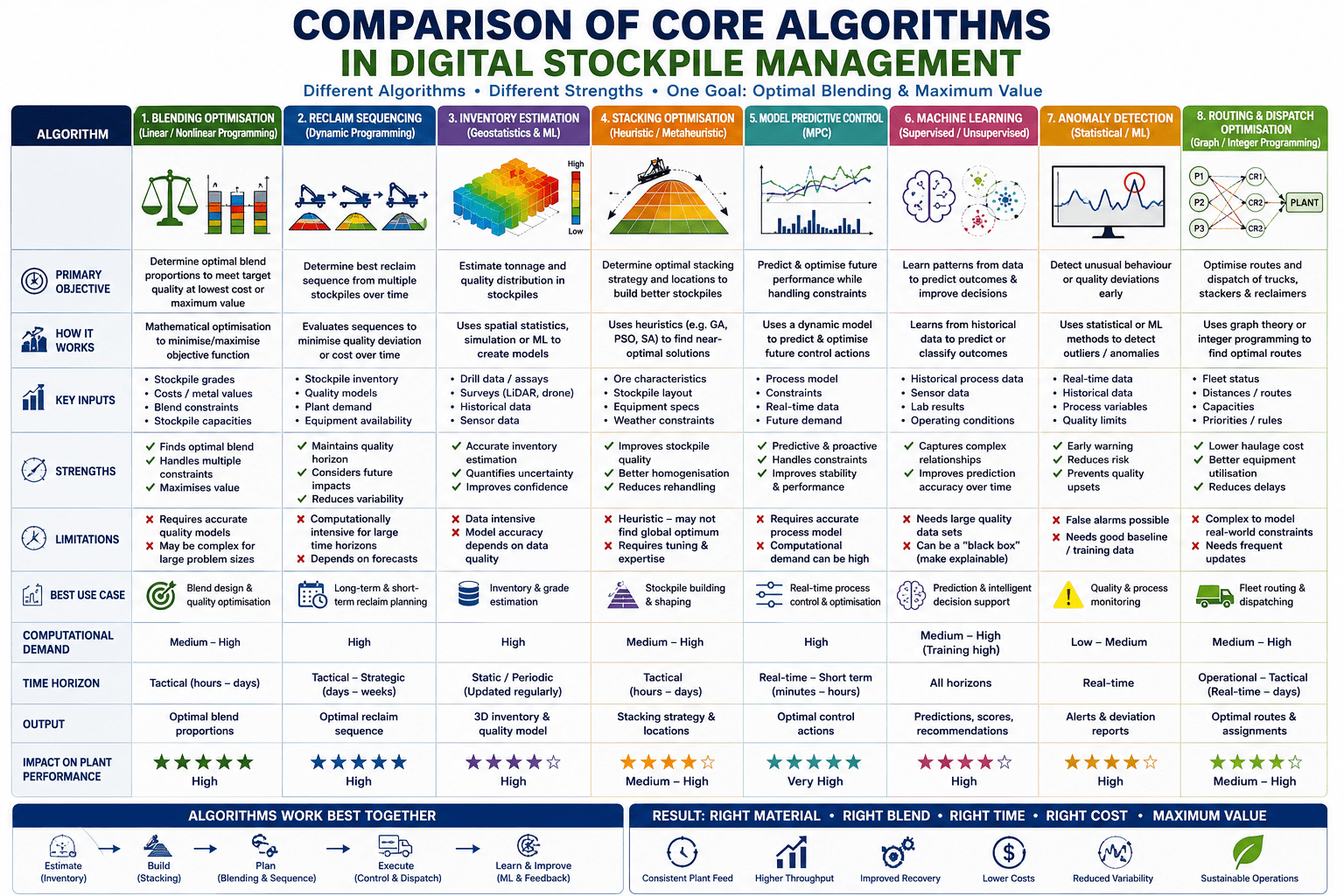
## Conclusion
Modern digital stockpile management combines optimisation algorithms, machine learning, and advanced control systems to transform stockpiles into intelligent, actively managed assets.
Linear Programming and Mixed Integer Programming provide robust planning tools, while Genetic Algorithms, Particle Swarm Optimisation, and Simulated Annealing solve complex multi-objective problems.
Machine Learning and Reinforcement Learning enable predictive and adaptive decision-making, and Model Predictive Control executes these decisions in real time.
Integrated within a Digital Twin environment, these algorithms help mining operations achieve more consistent feed quality, improved plant stability, higher recovery, lower operating costs, and increased profitability.
Real-Time Control Systems for Digital Stockpile Management
Real-time control systems are the operational backbone of digital stockpile management, transforming optimisation algorithms into practical actions that maintain a consistent, high-quality feed to the mineral processing plant. These systems continuously monitor stockpile conditions, material movement, and downstream plant performance, automatically adjusting reclaim rates and blending strategies to compensate for variations in ore quality, moisture, hardness, and production demand. By integrating advanced instrumentation, automation platforms, and intelligent control algorithms, real-time control systems improve plant stability, maximise recovery, and reduce operating costs. ## Objectives of Real-Time Control Systems The primary objective of a real-time stockpile control system is to deliver a stable and predictable feed to the processing plant despite natural variations in the orebody.
Key objectives include:
* Maintain target feed grade.
* Minimise ore hardness fluctuations.
* Optimise blending ratios.
* Maximise plant throughput.
* Improve metallurgical recovery.
* Reduce energy consumption.
* Minimise reagent usage.
* Reduce rehandling of material.
* Optimise stockpile utilisation.
* Support autonomous mine-to-mill operations.
--- # Architecture of a Real-Time Control System
A digital stockpile control system consists of several integrated layers that work together to monitor, analyse, optimise, and control material flow.
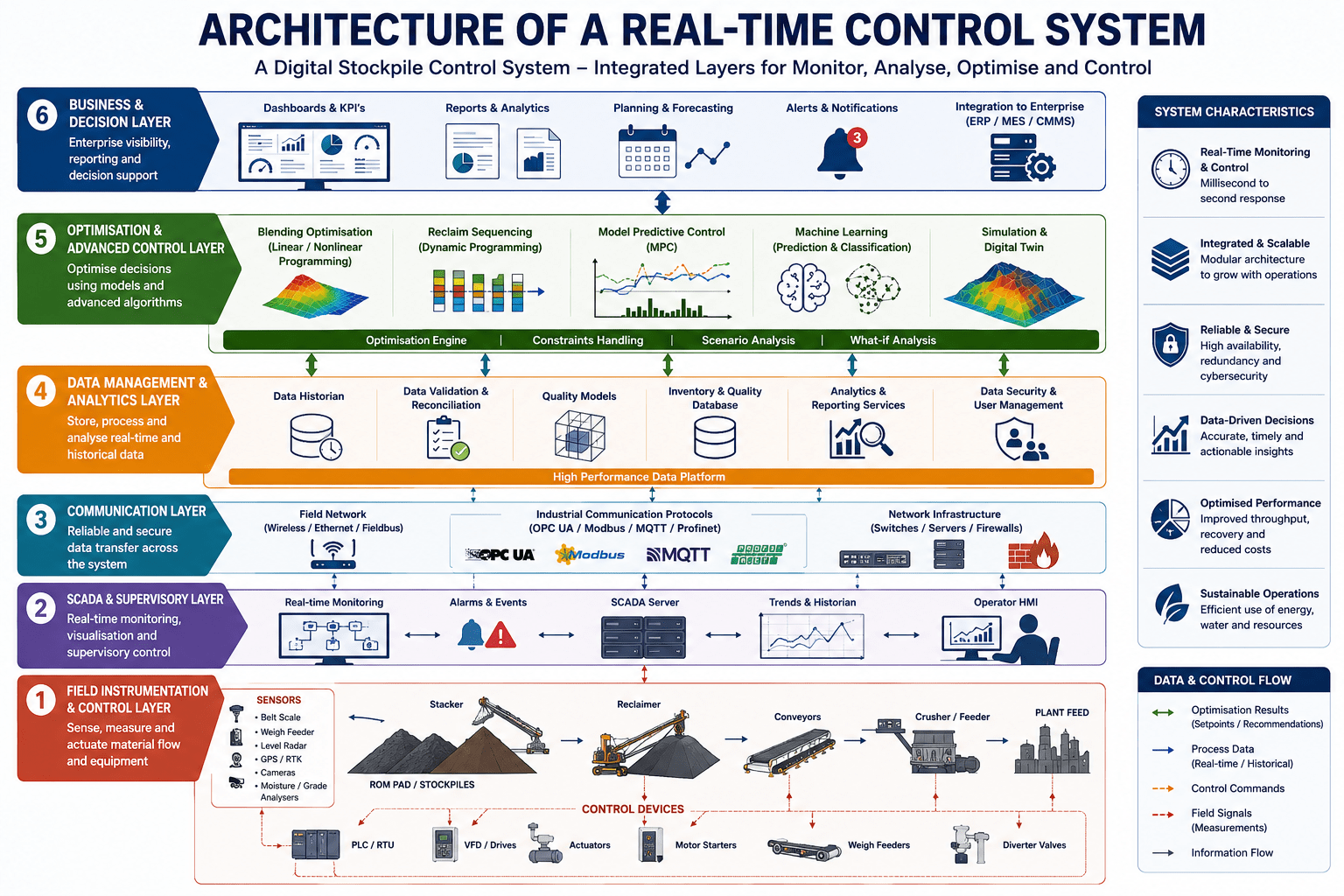
``` Each layer exchanges information continuously, allowing rapid responses to changing operating conditions.
--- # Instrumentation and Sensors
Real-time control depends on accurate and reliable field measurements. Modern stockpile systems incorporate a range of sensors that provide continuous information about material quality, quantity, and movement.
### Material Quality Sensors
* Online X-Ray Fluorescence (XRF) analysers
* Prompt Gamma Neutron Activation Analysis (PGNAA)
* Near-Infrared (NIR) analysers
* Moisture analysers
* Magnetic susceptibility sensors
* Particle size analysers
* Ore hardness estimation systems
These instruments provide continuous measurements of ore composition before the material enters the plant.
--- ### Material Handling Sensors
Material movement is monitored using:
* Belt weightometers
* Conveyor speed sensors
* Belt alignment switches
* Flow meters
* Bin level indicators
* Stockpile level sensors
* Laser scanners
* LiDAR systems These sensors measure the amount of material being stacked and reclaimed in real time.
--- ### Position Tracking
Equipment location is monitored using:
* GPS truck tracking
* RFID systems
* Machine guidance systems
* Drone photogrammetry
* Autonomous vehicle navigation
These technologies update the Digital Twin with the exact location of every ore load.
--- # Supervisory Control and Data Acquisition (SCADA)
SCADA serves as the central monitoring platform for stockpile operations. Its primary functions include:
* Collecting data from field instrumentation.
* Displaying real-time stockpile information.
* Recording historical operating data.
* Generating alarms.
* Producing production reports.
* Supporting operator decision-making.
Operators can visualise:
* Stockpile volumes
* Grade distribution
* Moisture maps
* Live reclaim locations
* Equipment status
* Conveyor utilisation
* Inventory levels
SCADA provides a comprehensive overview of the entire stockpile management system.
--- # Historian Database
All operational data is archived within a process historian, creating a long-term record of plant performance.
Typical data stored includes:
* Ore grades
* Conveyor tonnages
* Reclaim rates
* Moisture content
* Equipment operating hours
* Power consumption
* Stockpile inventories
This historical information supports performance analysis, optimisation, predictive maintenance, and machine learning model development.
--- # Advanced Process Control (APC)
Advanced Process Control automatically adjusts process variables to maintain the desired blend and production targets.
Typical manipulated variables include:
* Apron feeder speed
* Vibrating feeder speed
* Conveyor speed
* Reclaimer travel speed
* Stacker position
* Gate openings
* Crusher feed rate Controlled variables include:
* Feed grade
* Plant throughput
* Feed moisture
* Ore hardness
* Crusher load
* Mill feed consistency
Compared with traditional PID control, APC coordinates multiple interacting variables simultaneously, resulting in smoother plant operation and improved overall efficiency.
--- # Model Predictive Control (MPC)
Model Predictive Control represents one of the most advanced technologies available for stockpile management. Unlike conventional controllers that respond only after deviations occur, MPC predicts future process behaviour using mathematical models and optimisation algorithms. Every control cycle, MPC:
1. Reads live sensor data.
2. Predicts future stockpile composition.
3. Forecasts plant feed quality.
4. Solves an optimisation problem.
5. Determines the optimal reclaim rates.
6. Sends new setpoints to field equipment.
7. Repeats the process every few minutes.
This proactive approach minimises fluctuations before they affect downstream processes.
--- # Artificial Intelligence Integration
Artificial Intelligence enhances traditional control systems by learning from historical operating data.
AI models can predict:
* Plant recovery
* Throughput
* Grinding energy
* Flotation performance
* Tailings grade
* Equipment failures
* Feed variability
Machine learning continuously refines blending recommendations as new operational data becomes available, enabling increasingly accurate predictions and adaptive control strategies.
--- # Digital Twin Integration
The Digital Twin serves as the virtual representation of the physical stockpile.
It combines information from:
* Geological block models
* Mine schedules
* Truck dispatch systems
* Drone surveys
* Online analysers
* SCADA systems
* Laboratory assays
* Plant performance data
The Digital Twin continuously estimates:
* Material location
* Ore grade distribution
* Moisture content
* Remaining inventory
* Blending quality
* Predicted plant performance
Operators can simulate alternative reclaim strategies before implementing them, reducing operational risk and improving planning accuracy.
--- # Closed-Loop Automatic Control
A fully automated stockpile management system operates as a closed-loop control system.
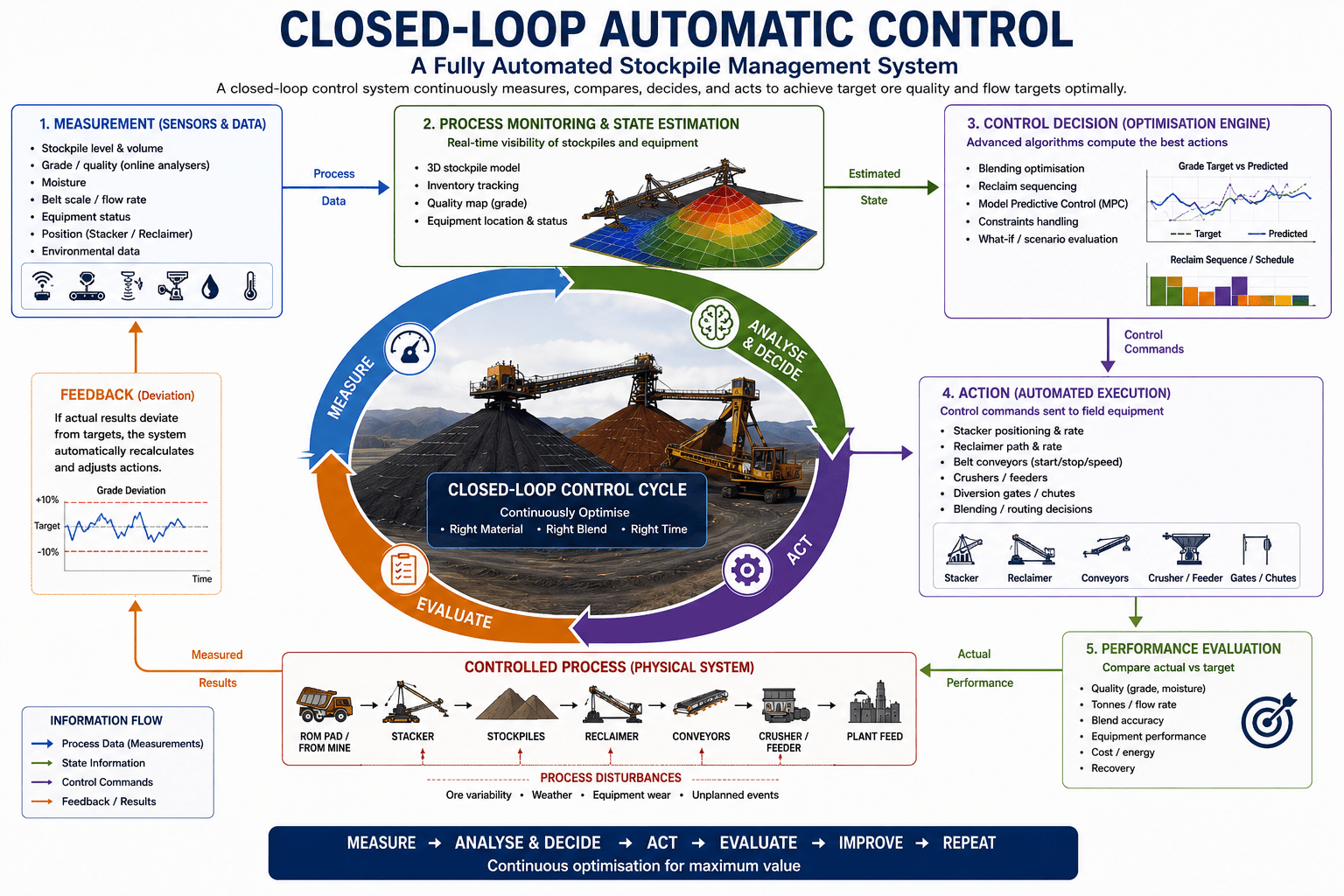
``` The continuous feedback loop enables the system to detect deviations from target conditions and make automatic adjustments without operator intervention.
--- # Benefits of Real-Time Control Systems
Plants implementing advanced real-time control systems typically achieve:
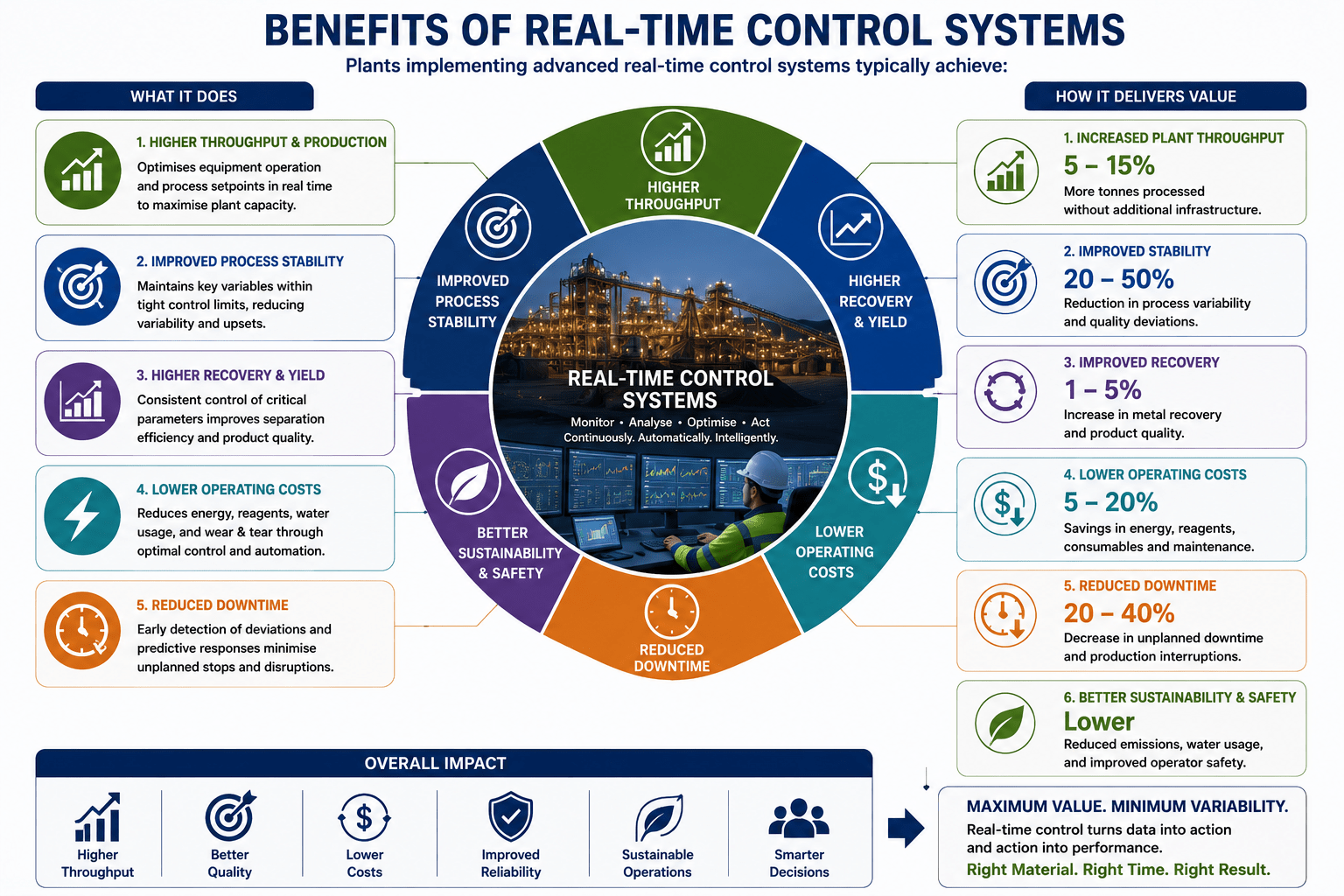
Actual improvements depend on ore variability, sensor quality, automation maturity, and operational discipline.
--- # Future Trends
The next generation of stockpile control systems will increasingly incorporate:
* Autonomous reclaimers and stackers.
* AI-driven adaptive control.
* Reinforcement learning for self-optimising blending.
* Edge computing for faster decision-making.
* Cloud-based Digital Twins.
* 5G-enabled industrial communications.
* Autonomous haulage integration.
* Enterprise-wide mine-to-mill optimisation.
These technologies will enable highly responsive, data-driven operations with minimal manual intervention.
## Conclusion
Real-time control systems are fundamental to modern digital stockpile management. By integrating field instrumentation, SCADA, historians, Advanced Process Control, Model Predictive Control, Digital Twins, and Artificial Intelligence, mining operations can achieve consistent plant feed quality, improved equipment utilisation, increased metallurgical recovery, and lower operating costs. As digital transformation accelerates across the mining industry, these systems will play a pivotal role in enabling autonomous, intelligent, and sustainable mine-to-mill operations.
Supervisory Control and Data Acquisition (SCADA) in Digital Stockpile Management
# Supervisory Control and Data Acquisition (SCADA) in Digital Stockpile Management
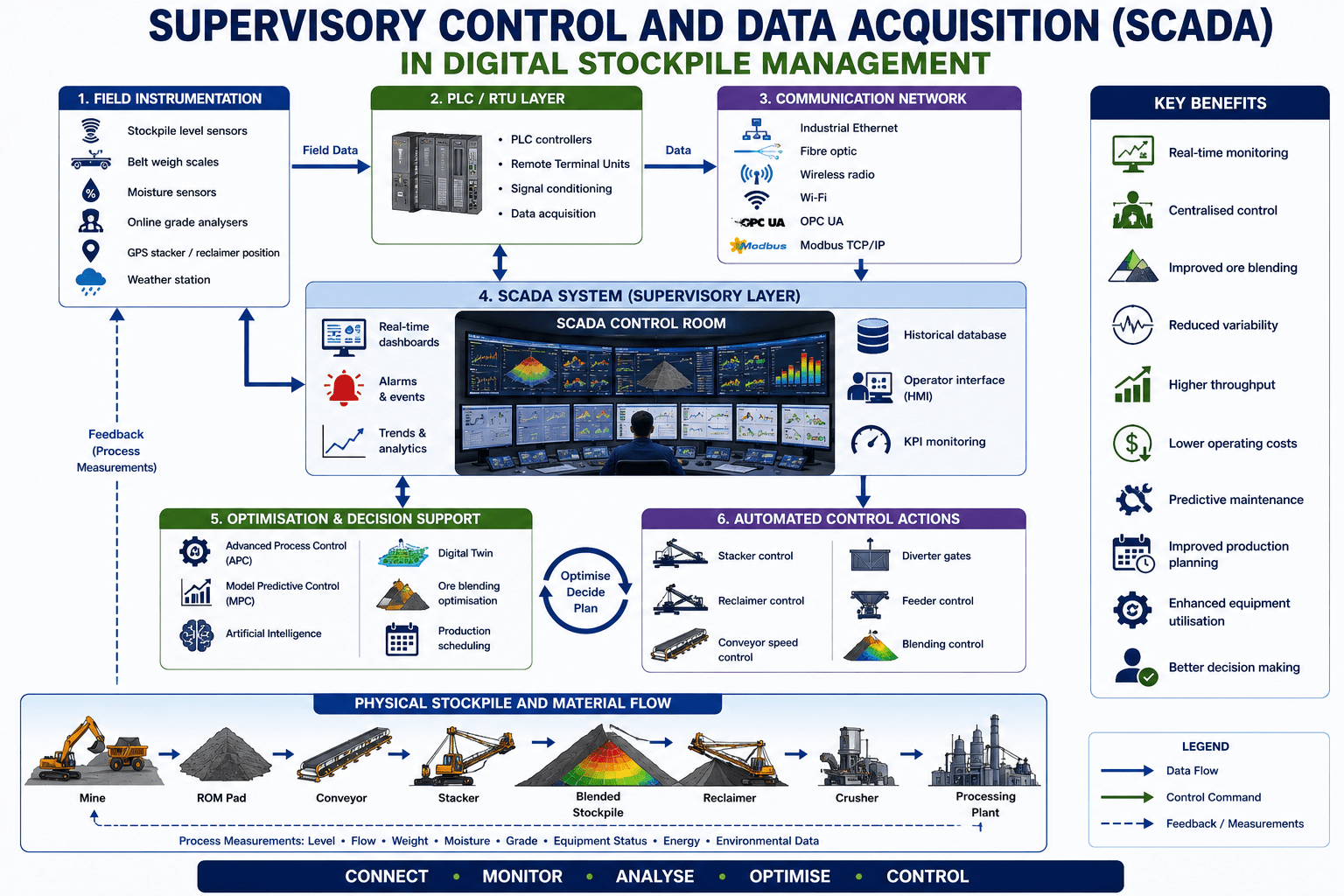
Supervisory Control and Data Acquisition (SCADA) is the central monitoring and supervisory control platform used to manage stockpile operations in modern mining and mineral processing plants.
It provides operators, metallurgists, and production managers with real-time visibility of material movement, stockpile inventory, ore quality, equipment status, and process performance.
By integrating data from field instruments, programmable logic controllers (PLCs), laboratory systems, and enterprise databases, SCADA enables informed operational decisions, improved blending accuracy, and enhanced process stability. In a digital stockpile management system, SCADA serves as the communication hub between field equipment and higher-level optimisation systems. It continuously collects data from sensors installed on conveyors, reclaimers, stackers, feeders, crushers, and stockpile monitoring systems.
This information is processed, displayed through graphical operator interfaces, and stored in a historical database for analysis and reporting. The result is a complete, real-time view of stockpile operations that supports both manual decision-making and automated process control.
--- # Functions of SCADA in Stockpile Management
SCADA performs several critical functions that ensure efficient stockpile operation:
* Collects real-time process data from field devices.
* Monitors equipment operating status.
* Displays live stockpile inventory and ore quality.
* Generates alarms for abnormal operating conditions.
* Records historical operating data.
* Supports production reporting and metallurgical accounting.
* Interfaces with optimisation and advanced control systems. * Enables remote monitoring and supervisory control.
These functions help operators respond quickly to changing ore conditions and maintain a stable feed to the processing plant.
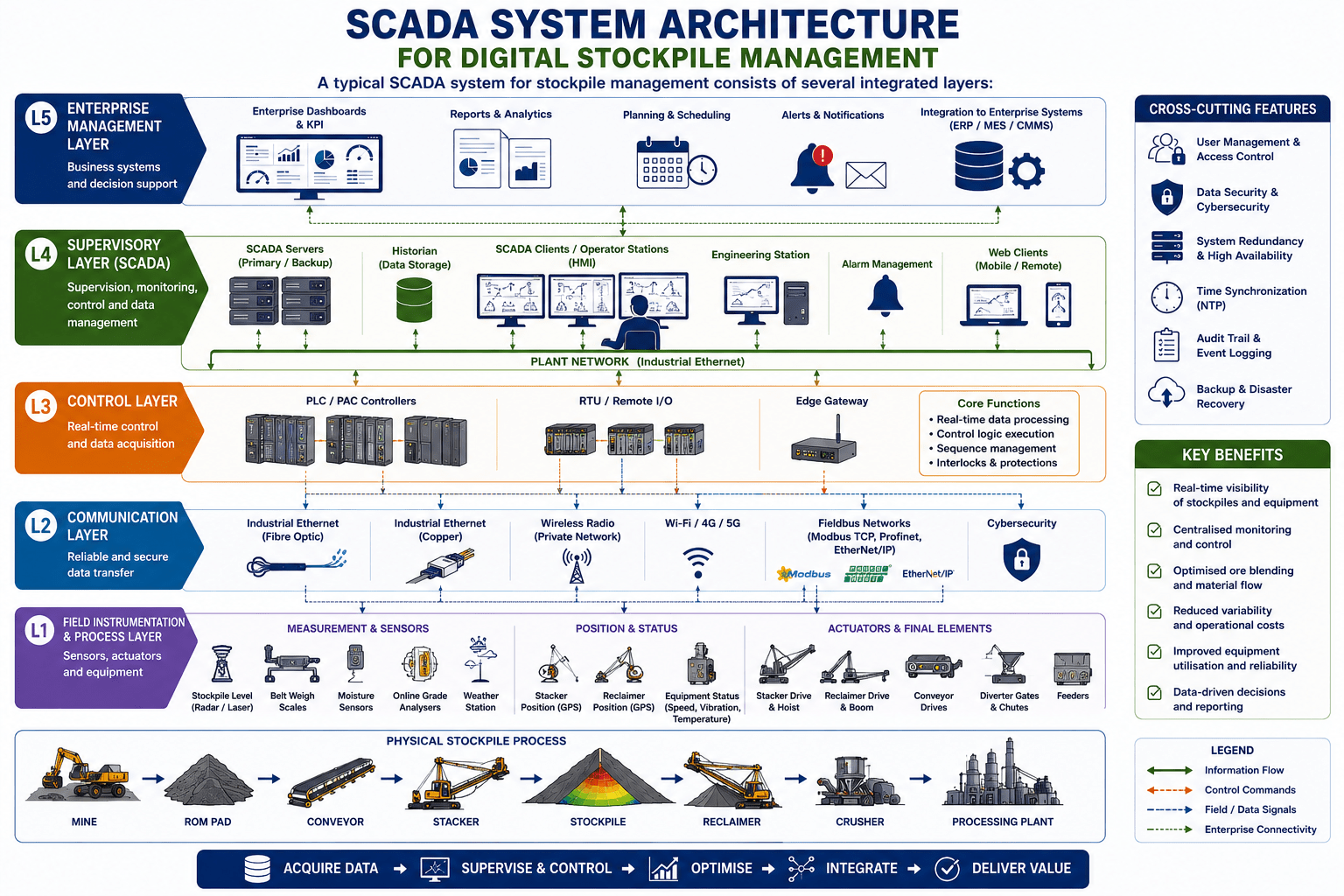
--- # SCADA System Architecture
A typical SCADA system for stockpile management consists of several integrated layers:
--- # Data Acquisition
SCADA continuously acquires data from numerous field instruments throughout the stockyard.
### Material Quality Measurements
* Online XRF analysers
* PGNAA analysers
* Near-Infrared (NIR) analysers
* Moisture analysers
* Online particle size analysers
These instruments provide continuous information about ore quality during stacking and reclaiming.
--- ### Material Flow Measurements
SCADA monitors:
* Conveyor tonnage
* Belt speed
* Feed rates
* Stockpile reclaim rates
* Crusher feed
* Mill feed
These measurements ensure that production targets are achieved while maintaining the desired blend.
--- ### Equipment Monitoring
Equipment status monitored includes:
* Motor running status
* Power consumption
* Conveyor loading
* Feeder speeds
* Reclaimer position
* Stacker boom angle
* Hydraulic pressures
* Bearing temperatures
* Vibration levels
Continuous monitoring helps detect equipment problems before they result in production losses.
--- # Human-Machine Interface (HMI)
The Human-Machine Interface (HMI) is the graphical component of the SCADA system that allows operators to interact with the process.
Typical HMI displays include:
* Live stockyard layout.
* Three-dimensional stockpile maps.
* Equipment status indicators.
* Conveyor flow diagrams.
* Production dashboards.
* Ore grade trends.
* Alarm summaries.
* Process performance indicators.
Operators can immediately identify abnormal operating conditions and take corrective action.
--- # Alarm Management
SCADA continuously monitors operating limits and alerts operators when abnormal conditions occur.
Typical alarms include:
* High moisture content.
* Low conveyor loading.
* Feeder overload.
* Equipment failure.
* High motor current.
* Belt misalignment.
* Emergency stop activation.
* Stockpile inventory limits.
* Grade deviation.
* Communication failures.
Effective alarm management enables rapid response, minimises downtime, and enhances operational safety.
--- # Historical Data (Historian)
Every process variable monitored by SCADA is archived within a process historian.
Typical historical records include:
* Ore grades.
* Feed rates.
* Stockpile inventory.
* Moisture content.
* Equipment utilisation.
* Energy consumption.
* Production rates.
* Equipment downtime.
* Alarm history.
* Operator actions.
Historical data is essential for trend analysis, performance benchmarking, predictive maintenance, and continuous improvement.
--- # Integration with Advanced Process Control (APC)
SCADA provides the real-time process data required by Advanced Process Control systems.
Typical APC functions include:
* Automatic feeder speed control.
* Reclaimer speed adjustment.
* Conveyor loading optimisation.
* Crusher feed regulation.
* Blend ratio control.
While APC performs the control calculations, SCADA provides the monitoring, visualisation, and supervisory functions that allow operators to oversee the process.
--- # Integration with Model Predictive Control (MPC)
Model Predictive Control relies on SCADA for continuous process measurements.
The interaction follows this sequence:
1. SCADA collects real-time plant data.
2. MPC predicts future process behaviour.
3. MPC calculates optimal control actions.
4. New setpoints are sent to the PLC.
5. SCADA displays the updated operating conditions.
6. The cycle repeats every few minutes.
This predictive approach helps maintain stable feed quality and improves downstream processing efficiency.
--- # Integration with Digital Twins
SCADA provides live operational data to the Digital Twin, ensuring that the virtual stockpile accurately reflects the physical stockpile.
Information transferred includes:
* Stockpile geometry.
* Material movement.
* Ore quality.
* Equipment status.
* Inventory levels.
* Production rates.
* Reclaim locations.
The Digital Twin uses this information to simulate future operating scenarios and optimise blending strategies before implementation.
--- # Integration with Artificial Intelligence
Artificial Intelligence applications use SCADA data to develop predictive models for plant optimisation.
Machine learning algorithms analyse historical and real-time data to predict:
* Feed quality.
* Metal recovery.
* Grinding energy.
* Equipment failures.
* Production bottlenecks.
* Ore hardness.
* Plant throughput.
These predictions support proactive operational decisions and improve overall process performance.
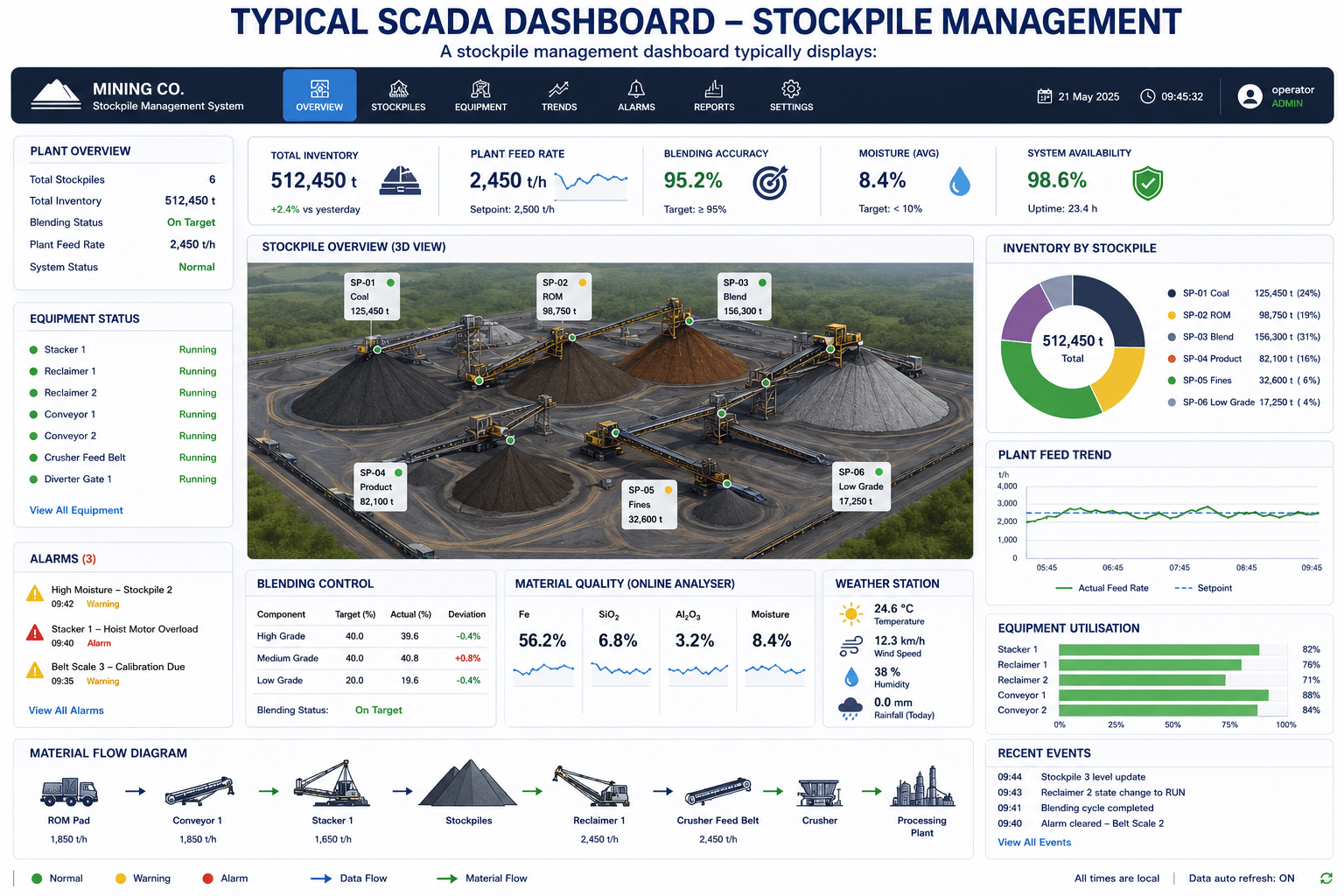
--- # Typical SCADA Dashboard
A stockpile management dashboard typically displays:
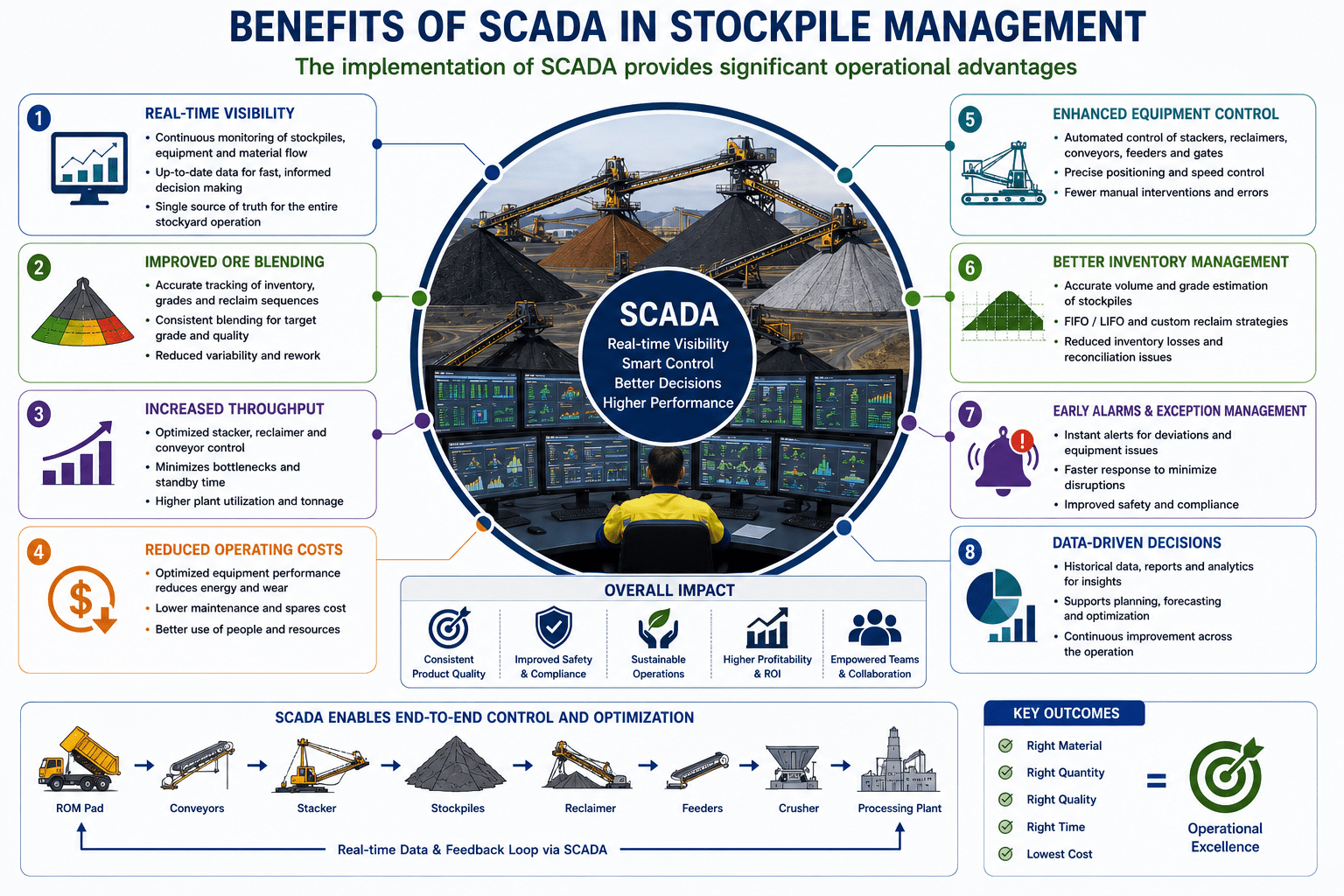
--- # Benefits of SCADA in Stockpile Management
The implementation of SCADA provides significant operational advantages:
--- # Future Developments
SCADA systems are evolving to support the next generation of intelligent mining operations through:
* Cloud-based SCADA platforms.
* Edge computing for faster local decision-making.
* AI-assisted operator decision support.
* Integration with autonomous mining equipment.
* Mobile dashboards for remote monitoring.
* Cybersecurity enhancements for industrial control systems.
* Digital Twin integration for predictive operations.
* Enterprise-wide mine-to-mill optimisation.
## Conclusion
Supervisory Control and Data Acquisition (SCADA) is the foundation of digital stockpile management, providing the real-time monitoring, data acquisition, visualisation, and supervisory control needed to optimise ore blending and material handling. By integrating field instrumentation, PLCs, process historians, Advanced Process Control, Model Predictive Control, Digital Twins, and Artificial Intelligence, SCADA transforms stockpile operations into an intelligent, connected system. This enables mining operations to achieve greater feed consistency, improved equipment utilisation, enhanced metallurgical performance, lower operating costs, and a more efficient and sustainable mine-to-mill process.
Economic Benefits and Justification for Using Control Systems in Stockpile Management
# Economic Benefits and Justification for Using Control Systems in Stockpile Management
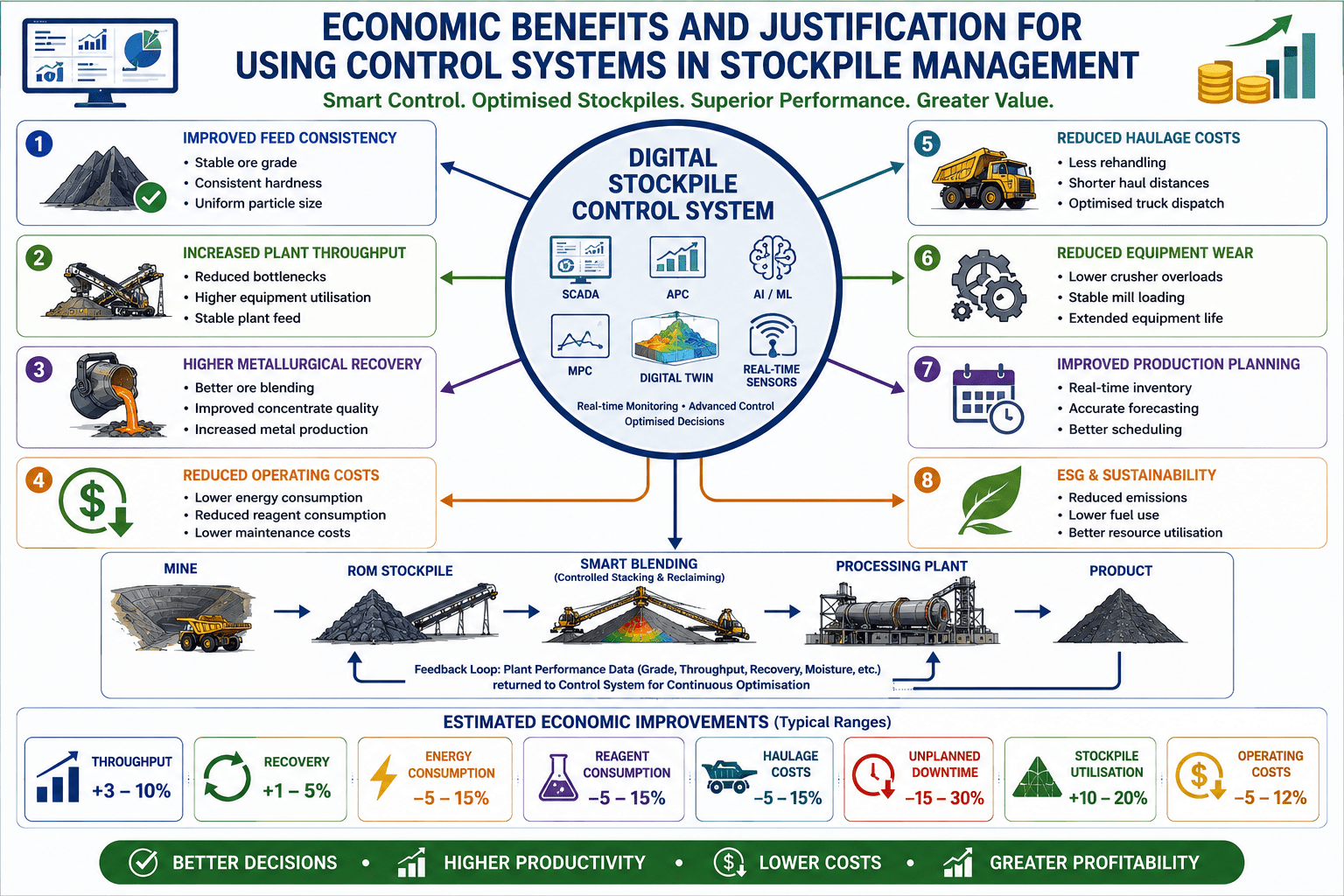
The implementation of advanced control systems in stockpile management represents a strategic investment that delivers measurable financial, operational, and environmental benefits throughout the mining value chain. Traditionally, stockpiles were viewed simply as storage facilities used to buffer fluctuations between mining and processing.
Today, with the integration of Supervisory Control and Data Acquisition (SCADA), Advanced Process Control (APC), Model Predictive Control (MPC), Digital Twins, and Artificial Intelligence (AI), stockpiles have become intelligent assets that actively optimise plant performance and profitability. By continuously monitoring ore quality and automatically controlling blending and reclaim strategies, these systems reduce variability, increase equipment utilisation, improve recovery, and lower operating costs, often providing an attractive return on investment within one to three years.
--- # 1. Improved Feed Consistency
One of the largest economic benefits is the delivery of a consistent plant feed. Variations in ore grade, hardness, moisture, and mineralogy can significantly reduce plant efficiency. Real-time control systems continuously adjust reclaim rates to maintain a stable blend, resulting in smoother operation of crushers, grinding mills, flotation circuits, and leaching plants.
### Economic Benefits
* Higher plant throughput.
* Reduced process interruptions.
* Improved recovery.
* Lower equipment stress.
* Better product quality.
**Typical Improvements** | KPI | Typical Improvement | | ---------------------- | ------------------: | | Feed grade variability | 20–50% reduction | | Throughput | 3–10% increase | | Recovery | 1–5% increase | Even a 1% increase in recovery at a large concentrator can translate into millions of pounds per year in additional revenue.
--- # 2. Increased Plant Throughput
Processing plants often operate below their design capacity due to unstable feed conditions. APC and MPC maintain a more uniform feed, allowing crushers, mills, and separation circuits to operate closer to their optimum design limits.
### Financial Benefits
* Increased tonnes processed.
* Improved utilisation of installed equipment.
* Lower unit processing cost.
* Deferred capital expenditure on plant expansion.
For a plant processing **5 million tonnes per year**, a **5% throughput increase** equates to an additional **250,000 tonnes** processed annually without major capital investment.
--- # 3. Improved Metal Recovery
Stable operating conditions improve separation efficiency in flotation, gravity concentration, magnetic separation, and hydrometallurgical circuits. ### Economic Impact
Higher recovery directly increases product sales while reducing valuable metal losses to tailings.
Example: | Parameter | Before APC | After APC | | ----------------------- | ---------: | --------: | | Recovery | 89% | 91% | | Annual Metal Production | 90,000 t | 92,000 t | An additional 2,000 tonnes of saleable metal can generate substantial additional annual revenue, depending on the commodity price.
--- # 4. Reduced Energy Consumption
Grinding is typically the most energy-intensive operation in mineral processing, accounting for 30–50% of total plant power consumption.
A consistent feed reduces:
* Mill overloads.
* Excessive recirculating loads.
* Over-grinding.
* Equipment idling.
Typical savings range from **2–8%** in energy consumption. For a concentrator consuming **100 GWh/year**, a **5% reduction** represents a saving of **5 GWh annually**, reducing both operating costs and greenhouse gas emissions.
--- # 5. Lower Reagent Consumption
Variability in feed quality often requires operators to overdose reagents to maintain recovery. Improved blending enables more stable operating conditions and optimised reagent addition.
Typical reductions include:
* Flotation collectors.
* Frothers.
* Lime.
* Cyanide.
* Flocculants.
Typical savings: **3–10% reduction in reagent consumption.**
--- # 6. Reduced Equipment Wear
Sudden changes in ore hardness increase mechanical stress on:
* Crushers.
* Grinding mills.
* Conveyors.
* Pumps.
* Cyclones.
* Screens.
Maintaining a consistent ore blend reduces:
* Mechanical shock loading.
* Liner wear.
* Conveyor spillage.
* Unscheduled maintenance.
### Economic Benefits
* Lower maintenance costs.
* Longer equipment life.
* Higher equipment availability.
* Reduced spare parts inventory.
--- # 7. Reduced Unplanned Downtime
Control systems identify abnormal operating conditions before equipment failures occur. Predictive monitoring enables maintenance teams to schedule repairs during planned shutdowns.
Typical improvements include:
* 15–30% reduction in unplanned downtime.
* Increased equipment availability.
* Improved production reliability.
Even a few additional operating hours per month can generate significant additional production.
--- # 8. Optimised Stockpile Utilisation
Digital stockpile management ensures:
* Reduced ore dilution.
* Better blending.
* Lower rehandling.
* Improved reclaim sequencing.
* Longer stockpile life.
This reduces unnecessary equipment movements and fuel consumption while improving overall operational efficiency.
--- # 9. Reduced Haulage Costs
Optimisation algorithms minimise unnecessary truck movements by selecting the most efficient reclaim sequence.
Benefits include:
* Reduced diesel consumption.
* Lower tyre wear.
* Reduced equipment hours.
* Improved fleet productivity.
Even small reductions in haulage distance can produce significant annual savings in large open-pit operations.
--- # 10. Improved Production Planning
Real-time visibility of stockpile inventory enables more accurate production scheduling.
Benefits include:
* Better ore reserve utilisation.
* Reduced production interruptions.
* Improved blending forecasts.
* More reliable shipment planning.
--- # 11. Improved Metallurgical Accounting
Accurate stockpile inventory tracking improves:
* Metal accounting.
* Inventory reconciliation.
* Production reporting.
* Financial forecasting.
Digital records also simplify compliance with corporate governance standards and reporting codes such as the **AMIRA Code of Practice**.
--- # 12. Environmental Benefits
Optimised stockpile management contributes to Environmental, Social and Governance (ESG) objectives by reducing:
* Energy consumption.
* Carbon emissions.
* Reagent usage.
* Dust generation.
* Material rehandling.
* Waste production.
These improvements support sustainability targets and may reduce environmental compliance costs.
--- # 13. Safety Improvements
Automation significantly reduces operator exposure to hazardous areas.
Examples include:
* Remote monitoring.
* Automated reclaim control.
* Drone stockpile surveys.
* Reduced vehicle interactions.
* Fewer manual stockpile inspections.
Improved safety can reduce accident-related costs, insurance claims, and production disruptions.
--- # Estimated Financial Benefits
The table below illustrates typical annual benefits for a medium-sized concentrator processing approximately **5 million tonnes per year**.
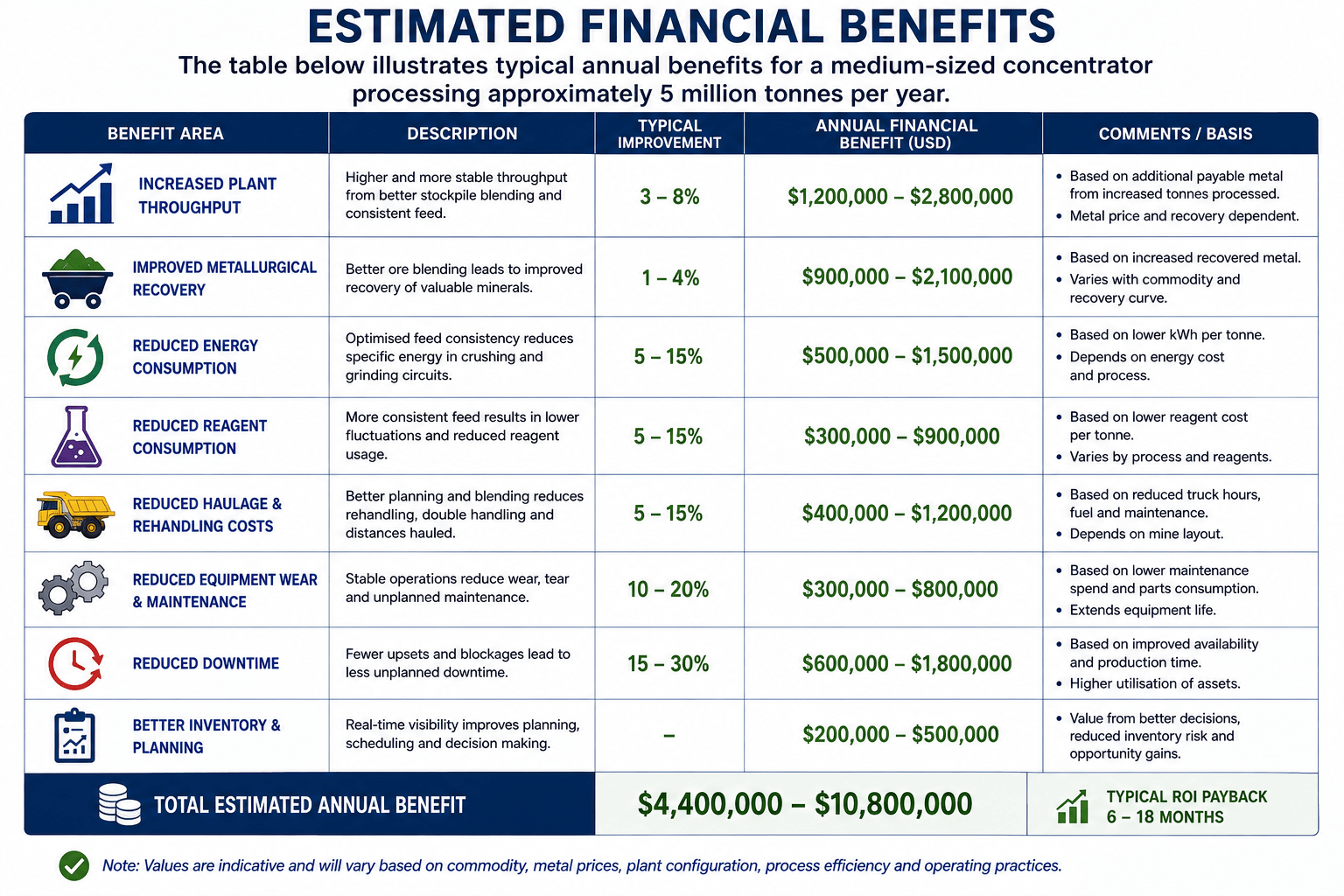
*These values are illustrative and depend on commodity prices, plant capacity, ore characteristics, and local operating costs.*
--- # Return on Investment (ROI)
The implementation cost of a modern stockpile control system typically includes:
* Online analysers.
* SCADA upgrades.
* Process historian.
* Digital Twin software.
* APC/MPC software.
* PLC modifications.
* Communications infrastructure.
* Engineering and commissioning.
* Operator training.
Typical investment: **£1–5 million** Typical payback period: **12–36 months** Return on investment: **100–500% over the project life**, depending on the scale of the operation and the effectiveness of implementation.
--- # Business Justification
The business case for implementing advanced control systems extends beyond immediate cost savings:
* Higher profitability through increased metal production.
* Better utilisation of existing assets without major capital expansion.
* Greater resilience to ore variability.
* Enhanced decision-making through real-time data.
* Improved compliance with ESG and corporate governance requirements.
* Reduced operational risk and unplanned downtime.
* Foundation for autonomous mining and Industry 4.0 initiatives.
For operations processing lower-grade ores or increasingly complex mineral deposits, these systems can be the difference between maintaining profitability and facing rising production costs.
## Conclusion
The economic justification for implementing SCADA, APC, MPC, Digital Twins, and AI in stockpile management is compelling. These technologies transform stockpiles from passive storage areas into intelligent, value-generating assets that optimise ore blending, stabilise plant feed, and improve the performance of downstream processing circuits. The resulting benefits—including higher throughput, increased recovery, lower energy and reagent consumption, reduced maintenance costs, improved inventory management, and enhanced safety—typically deliver substantial annual savings and rapid payback. As mining companies continue to pursue digital transformation and operational excellence, advanced stockpile control systems are becoming a strategic investment that strengthens profitability, sustainability, and long-term competitiveness.
Improved planning reduces expensive emergency operational changes.