
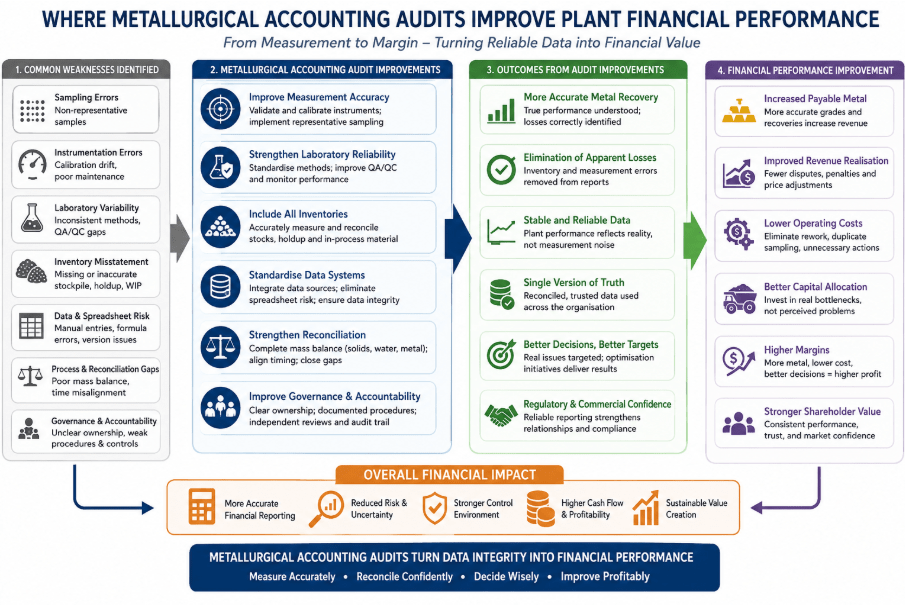
How to conduct a Mineral Processing Plant Audit
A mineral processing plant audit is a systematic evaluation of a processing facility to determine whether it is operating safely, efficiently, and profitably. The objective is to identify bottlenecks, reduce operating costs, improve recovery, and maximize throughput while maintaining product quality.
--- ## Why Conduct a Plant Audit?
A plant audit helps operators:
* Increase plant throughput
* Improve metallurgical recovery
* Reduce operating costs
* Lower energy and water consumption
* Identify equipment bottlenecks
* Improve product quality and consistency
* Reduce downtime and maintenance costs
* Improve safety and environmental compliance
* Provide a roadmap for plant optimization
--- # Step 1: Define the Audit Objectives Before beginning the audit, clearly establish the purpose.
Typical objectives include:
* Increasing production capacity
* Improving recovery and grade
* Reducing operating costs
* Investigating poor plant performance
* Preparing for expansion projects
* Benchmarking against design parameters
* Assessing equipment condition A clearly defined objective determines the scope and depth of the audit.
--- # Step 2: Gather Historical Data Collect and review available information:
### Plant Design Documents
* Process flow diagrams (PFDs)
* Piping and instrumentation diagrams (P&IDs)
* Equipment datasheets
* Design criteria reports
* Mass balance reports ### Operating Data
* Throughput records
* Recovery data
* Product grades
* Availability and utilization
* Power consumption
* Water consumption
* Reagent consumption
### Maintenance Information
* Failure history
* Planned maintenance schedules
* Equipment inspections
* Wear reports
* Spare parts consumption Historical trends often reveal recurring problems that may not be obvious during a site visit.
--- # Step 3: Review Plant Performance Indicators Key Performance Indicators (KPIs) should be evaluated.
## Production KPIs
* Plant throughput (tph)
* Annual production
* Equipment utilization
* Availability
* Downtime
## Metallurgical KPIs
* Recovery (%)
* Product grade
* Yield
* Separation efficiency
* Circulating load ## Cost KPIs
* Energy consumption (kWh/t)
* Water consumption (m³/t)
* Reagent consumption
* Maintenance cost per tonne
* Operating cost per tonne Benchmark current performance against design specifications and industry best practice.
--- # Step 4: Conduct a Physical Plant Inspection A walk-through inspection is one of the most important parts of the audit. Inspect:
### Ore Handling
* ROM pad management
* Stockpiles
* Feed consistency
* Segregation issues
* Moisture control
### Crushing Circuit
* Crusher condition
* Choke feeding
* Screen efficiency
* Conveyor condition
* Blockages
### Grinding Circuit
* Mill power draw
* Mill loading
* Media consumption
* Classification performance
* Cyclone operation
### DMS Circuit
* Medium density control
* Cyclone performance
* Media recovery efficiency
* Magnetite contamination
* Stability of operating conditions
### Flotation Circuit
* Cell condition
* Air distribution
* Reagent addition
* Froth stability
* Residence time
### Dewatering Circuit
* Thickener performance
* Filter efficiency
* Moisture control
* Water recovery
--- # Step 5: Verify Instrumentation and Control Systems Poor instrumentation frequently causes plant instability.
Review: * Flow meters
* Density gauges
* Belt scales
* Level sensors
* Pressure transmitters
* Sampling systems
* Online analyzers
* SCADA systems
* Alarm management Calibrate instruments where necessary.
--- # Step 6: Conduct Process Sampling Sampling provides the data required to understand actual plant performance.
Develop a sampling campaign that includes:
### Feed Streams
* Size distribution
* Density
* Mineralogy
* Moisture
### Intermediate Streams
* Slurry density
* Solids concentration
* Particle size distribution
* Assays
### Final Products
* Grade
* Recovery
* Moisture
* Contaminants Sampling should be representative and synchronized across the plant.
--- # Step 7: Complete a Mass Balance A mass balance is often the foundation of the audit.
Calculate:
* Solids flow rates
* Water balances
* Metal balances
* Recovery calculations
* Equipment efficiencies
* Losses to tailings Mass balancing frequently reveals:
* Hidden bottlenecks
* Sampling errors
* Equipment underperformance
* Metal losses
--- # Step 8: Assess Equipment Performance Evaluate each major equipment item against its design capacity.
### Crushers
* Capacity utilization
* Reduction ratio
* Liner wear
* Power draw
### Screens
* Efficiency
* Aperture condition
* Blinding
* Misplaced material
### Mills
* Power utilization
* Grinding efficiency
* Media consumption
* Throughput limitations
### Cyclones
* Pressure stability
* Cut size
* Bypass
* Roping conditions
### Pumps
* Operating point
* Efficiency
* Wear condition
* Energy consumption
--- # Step 9: Identify Bottlenecks Every plant has constraints that limit performance.
Common bottlenecks include:
* Inadequate feed preparation
* Screen capacity limitations
* Insufficient grinding capacity
* Poor cyclone performance
* Pump limitations
* Water shortages
* Poor instrumentation
* Maintenance practices
* Process control deficiencies Rank bottlenecks according to their impact on production and profitability.
--- # Step 10: Evaluate Operating Practices Observe how the plant is operated.
Assess:
* Start-up procedures
* Shutdown procedures
* Standard operating procedures
* Communication between shifts
* Housekeeping
* Sampling discipline
* Response to alarms
* Process control strategies
* Training levels Operator practices often have a major influence on plant performance.
--- # Step 11: Review Maintenance Practices Maintenance directly affects availability.
Evaluate:
* Preventive maintenance
* Predictive maintenance
* Shutdown planning
* Spare parts management
* Lubrication practices
* Equipment inspections
* Root cause failure analysis
* Maintenance backlog
--- # Step 12:
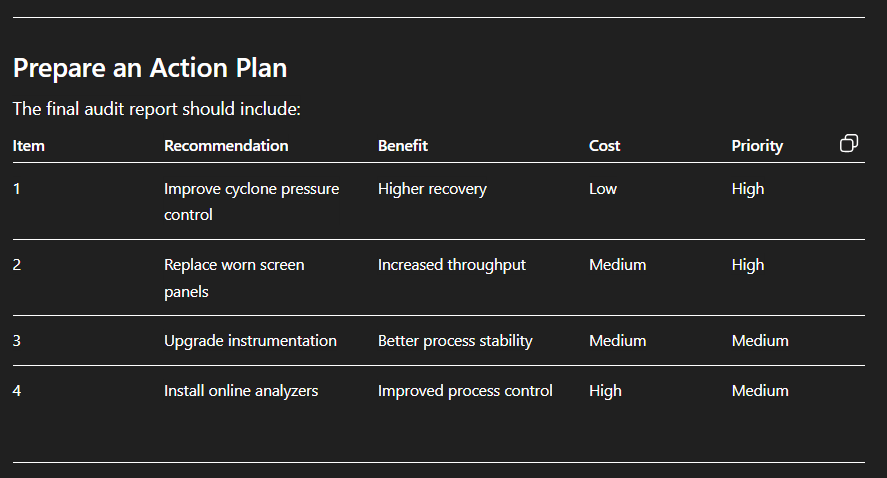
Develop Recommendations Recommendations should be practical and prioritized.
## Quick Wins
* Instrument calibration
* Density control improvements
* Operating procedure changes
* Maintenance improvements ## Medium-Term Improvements
* Equipment upgrades
* Control system modifications
* Process optimization studies
## Long-Term Projects
* Circuit redesign
* Expansion projects
* Major equipment replacement
* Advanced process control systems
--- # Typical Deliverables of a Mineral Processing Plant Audit
1. Executive summary
2. Plant performance review
3. Process flow assessment
4. Mass balance and metallurgical analysis
5. Equipment performance evaluation
6. Bottleneck identification
7. Cost analysis
8. Safety and environmental review
9. Improvement opportunities
10. Prioritized implementation roadmap
--- ## Conclusion
A mineral processing plant audit is far more than a site inspection. It is a structured evaluation of process performance, equipment capability, operating practices, and maintenance systems. When conducted properly, an audit identifies hidden losses, uncovers opportunities for increased throughput and recovery, and provides a clear roadmap for improving plant profitability and long-term operational sustainability.
What is metallurgical accounting Plant Audit
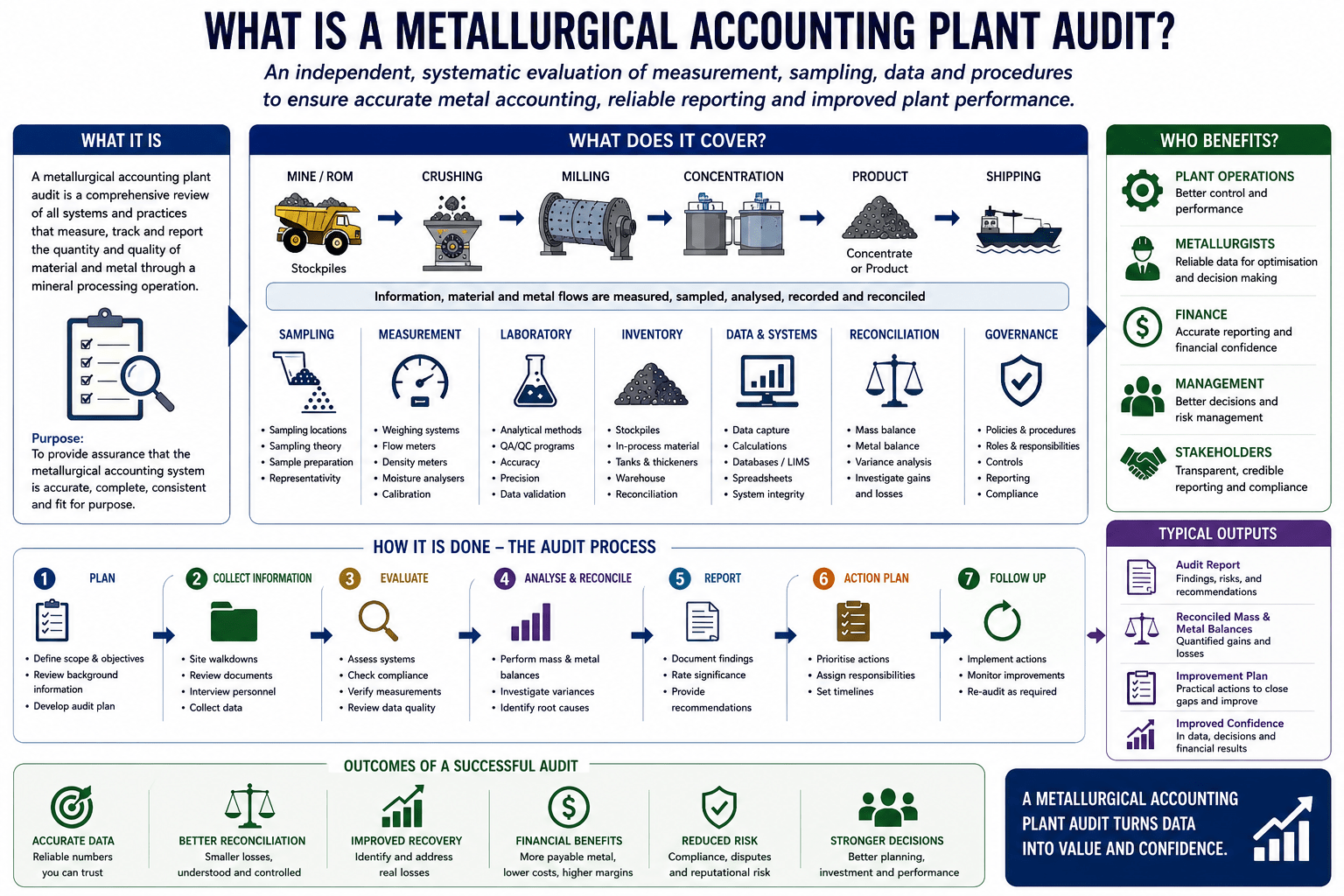
A **Metallurgical Accounting Plant Audit** is a systematic review of the systems, procedures, sampling methods, measurements, and calculations used to account for metal or mineral content as it moves through a mineral processing plant.
The primary objective is to ensure that the reported production, recoveries, and losses accurately reflect the actual performance of the operation. In simple terms, it answers the question:
> **"Can management trust the numbers being reported by the plant?"**
--- # Why is a Metallurgical Accounting Audit Important?
Inaccurate metallurgical accounting can result in:
* Overstated or understated recoveries
* Incorrect production reporting
* Unexplained metal losses
* Poor operational decisions
* Revenue losses
* Incorrect resource reconciliation
* Disputes between mining, processing, and finance departments
* Difficulty identifying process inefficiencies Even a small error in recovery calculations can represent millions of dollars in lost revenue over the life of a mine.
--- # Objectives of a Metallurgical Accounting Audit A metallurgical accounting audit aims to:
1. Verify the accuracy of production reporting.
2. Confirm that sampling systems are representative.
3. Validate flow measurements and instrumentation.
4. Assess mass balance closure.
5. Identify sources of metal losses.
6. Improve confidence in recovery calculations.
7. Ensure compliance with industry standards.
8. Establish a robust metallurgical accounting system.
--- # Scope of the Audit
## 1. Sampling Systems Audit Evaluate:
* Sample locations
* Sampling frequency
* Sampler design
* Sample preparation procedures
* Sample splitting methods
* Sample storage and security
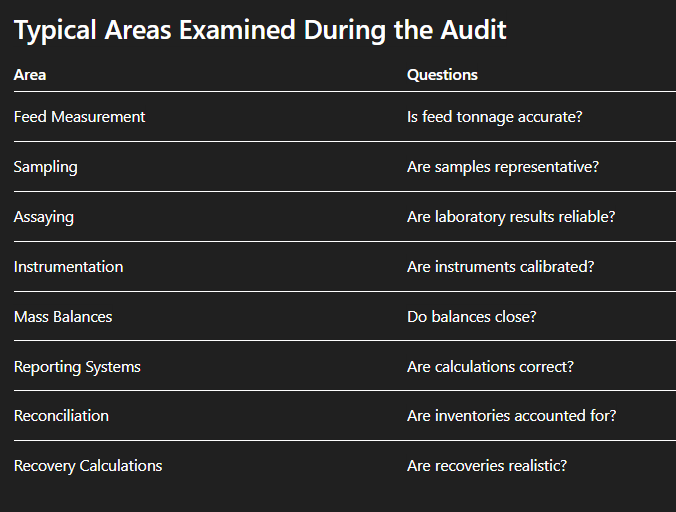
* Sampling precision and bias Questions to ask:
* Are all major streams being sampled?
* Are samples representative?
* Is contamination occurring?
* Are samples being collected consistently?
--- ## 2. Measurement Systems Audit Review all measurements used in metallurgical accounting.
### Flow Measurements
* Belt scales
* Flow meters
* Pump capacities
* Conveyor tonnage measurements
### Density Measurements
* Density gauges
* Manual density measurements
* Slurry density calculations
### Moisture Measurements
* Moisture analyzers
* Sampling procedures
* Drying methods
### Instrument Calibration
* Calibration frequency
* Calibration records
* Instrument accuracy
--- ## 3. Assay and Laboratory Audit Review laboratory procedures:
* Sample preparation
* Crushing and pulverizing methods
* Analytical techniques
* Laboratory quality assurance
* Certified reference materials
* Duplicate analyses
* Blank samples
* Precision and accuracy checks Questions include:
* Are assays reproducible?
* Is there laboratory bias?
* Are analytical errors being introduced?
--- ## 4. Mass Balance Audit The mass balance is the foundation of metallurgical accounting.
Verify:
* Solids balances
* Water balances
* Metal balances
* Recovery calculations
* Stream inventories
* Reconciliation procedures
A poorly closed mass balance often indicates:
* Sampling errors
* Measurement errors
* Instrument problems
* Unmeasured streams
* Data entry errors
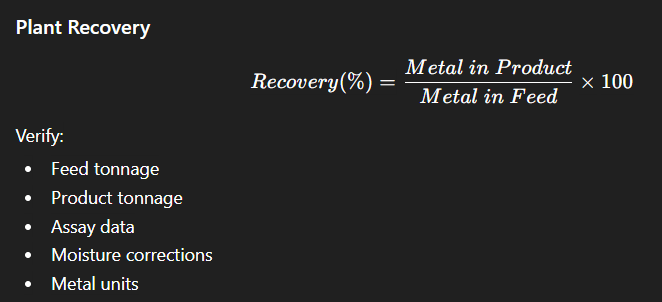
--- ## 5. Recovery Calculations Review:
--- ## 6. Inventory Reconciliation Determine whether inventories are properly managed.
Review:
* ROM stockpiles
* Intermediate stockpiles
* Concentrate stockpiles
* Tailings dams
* Pipeline inventories
* Surge bins
* Thickener inventories Large inventory changes often explain unexplained metal losses or gains.
--- # Key Performance Indicators
## Mass Balance Closure Typically:
* ±2% Excellent
* ±5% Good
* ±10% Requires investigation
* > 10% Poor ## Sampling Precision
* Relative precision of duplicate samples
* Variance analysis
* Bias determination ## Reconciliation Performance
* Plant production versus shipped product
* Feed metal versus recovered metal
* Monthly inventory adjustments
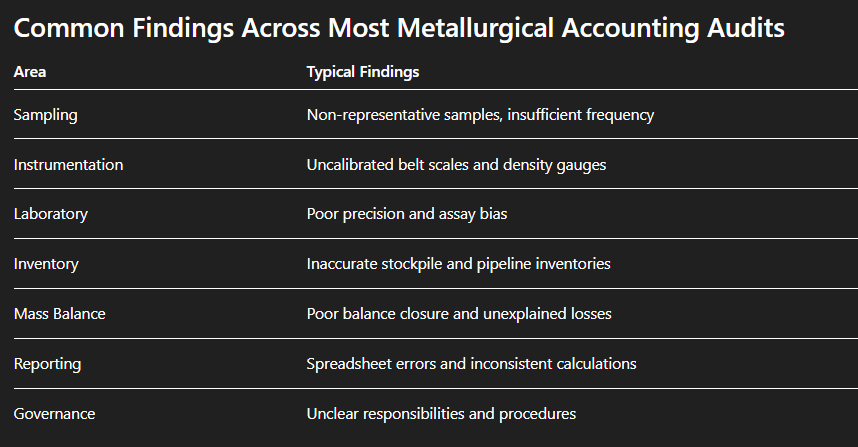
--- # Common Findings During Metallurgical Accounting Audits
### Inaccurate Belt Scales Small calibration errors can significantly affect recovery calculations.
### Poor Sampling Practices Manual sampling often introduces bias and inconsistency.
### Unmeasured Streams Spills, bypass streams, and re-circulating loads are frequently ignored.
### Laboratory Errors Poor sample preparation and analytical bias affect grade calculations.
### Inventory Errors Stockpile estimates are often inaccurate and poorly reconciled.
### Data Handling Issues Spreadsheet errors and incorrect formulas are surprisingly common.
--- # Typical Audit Methodology
### Phase 1
– Data Collection
* Process flow diagrams
* Historical production data
* Sampling procedures
* Laboratory procedures
* Instrument calibration records
### Phase 2
– Site Inspection
* Verify all process streams
* Inspect samplers
* Review instrumentation
* Observe operating practices
### Phase 3
– Sampling Campaign
* Conduct plant surveys
* Collect representative samples
* Validate measurements
* Verify laboratory performance
### Phase 4
– Reconciliation
* Develop mass balances
* Calculate recoveries
* Assess metal accounting accuracy
* Identify discrepancies
### Phase 5
– Recommendations
* Improve sampling systems
* Upgrade instrumentation
* Standardize procedures
* Implement reconciliation protocols
* Establish reporting standards
--- # Deliverables of a Metallurgical Accounting Audit
A comprehensive audit report typically includes:
1. Process flow and accounting boundaries
2. Sampling audit findings
3. Instrumentation assessment
4. Laboratory assessment
5. Mass balance closure analysis
6. Reconciliation review
7. Metal loss identification
8. Risk assessment
9. Improvement recommendations
10. Implementation roadmap
--- # Benefits of a Metallurgical Accounting Plant Audit
* Greater confidence in reported recoveries
* More accurate production reporting
* Better identification of metal losses
* Improved process optimization
* Better decision-making
* Increased profitability
* Improved mine-to-mill reconciliation
* Enhanced governance and reporting credibility
--- ## Conclusion
A **Metallurgical Accounting Plant Audit** is a comprehensive examination of the measurement and reporting systems that determine how much valuable mineral enters, moves through, and leaves a processing plant. The audit ensures that management can confidently answer three critical questions:
1. **How much metal did we feed?**
2. **How much metal did we recover?**
3. **Where did the unrecovered metal go?** Ultimately, a well-executed metallurgical accounting audit transforms plant data from simple production figures into reliable information for operational improvement, financial reporting, and strategic decision-making.
How to conduct a metallurgical accounting Plant Audit
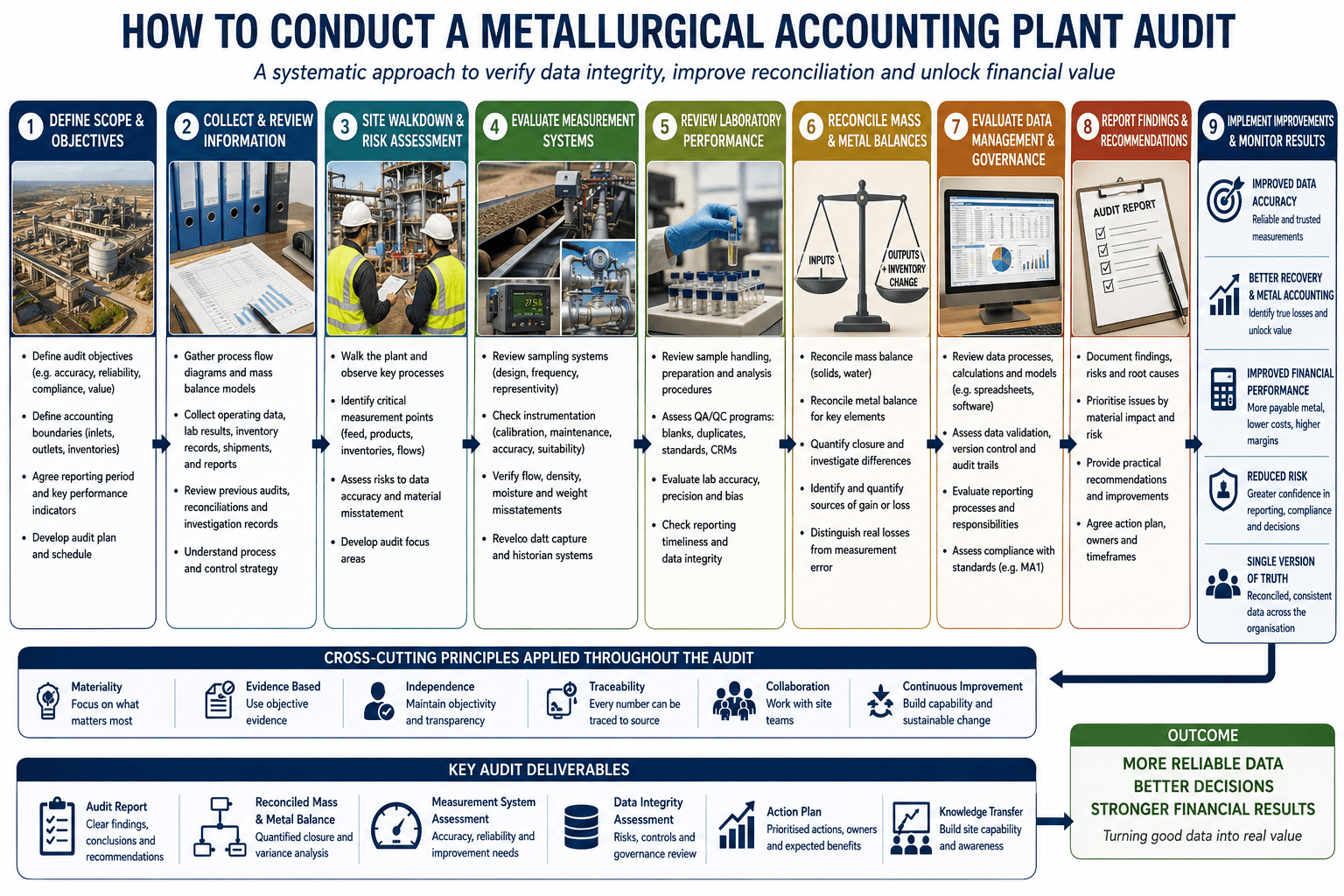
A **Metallurgical Accounting Plant Audit** is a structured assessment of the systems, measurements, procedures, and calculations used to determine how much valuable metal enters, moves through, and exits a mineral processing plant. The goal is to ensure that metallurgical reporting is accurate, reliable, and fit for operational and financial decision-making.
--- # Step 1: Define the Audit Objectives and Scope Start by clearly defining why the audit is being conducted.
Typical objectives include:
* Verify the accuracy of production reporting
* Investigate unexplained metal losses
* Improve recovery calculations
* Validate sampling and assaying systems
* Assess compliance with accounting standards
* Improve reconciliation between mining and processing
* Support due diligence or independent reviews
Define the accounting boundaries, including:
* Mine feed
* Stockpiles
* Process plant feed
* Intermediate streams
* Final products
* Tailings
* Shipping and sales points
--- # Step 2: Review the Existing Metallurgical Accounting System Obtain and review:
### Process Documentation
* Process flow diagrams (PFDs)
* Piping and instrumentation diagrams (P&IDs)
* Metallurgical accounting procedures
* Standard operating procedures
* Reporting templates
### Historical Data
* Production reports
* Recovery reports
* Reconciliation reports
* Laboratory reports
* Instrument calibration records
* Stockpile surveys Review at least six to twelve months of historical information to identify recurring issues and trends.
--- # Step 3: Define the Accounting Boundaries Every metallurgical accounting system should have clearly defined boundaries.
Typical accounting nodes include:
**Inputs**
* Run-of-mine ore
* Purchased ore
* Recycled materials **Internal Transfers**
* Crushing products
* Milling products
* Concentrates
* Middlings
* Recycle streams **Outputs**
* Saleable products
* Tailings
* Rejects
* Inventory movements Poorly defined boundaries often result in apparent metal losses.
--- # Step 4: Audit the Sampling Systems Sampling errors are often the largest source of metallurgical accounting inaccuracies.
Evaluate:
### Sample Locations
* Feed streams
* Product streams
* Tailings streams
* Intermediate process streams
### Sampling Methods
* Automatic samplers
* Manual sampling procedures
* Sample collection frequency
* Sample increment size
* Sampling timing
### Sample Preparation
* Drying procedures
* Crushing and pulverizing
* Sample splitting
* Sample storage
Questions to ask:
* Are samples representative?
* Are there opportunities for contamination? * Is there sampling bias? * Are all critical streams sampled? --- # Step 5: Audit Measurement Systems Verify all measurements used in metallurgical accounting calculations. ### Tonnage Measurements
* Belt scales
* Conveyor scales
* Weigh feeders
* Truck scales
### Flow Measurements
* Flow meters
* Pump curves
* Volumetric measurements
### Density Measurements
* Nuclear density gauges
* Manual density measurements
* Slurry sampling procedures
### Moisture Measurements
* Moisture analyzers
* Laboratory moisture determinations
Review:
* Calibration procedures
* Calibration frequency
* Maintenance records * Instrument accuracy
--- # Step 6: Audit the Laboratory
The laboratory is central to metallurgical accounting.
Review: ### Analytical Methods
* Assay techniques
* Detection limits
* Calibration methods
### Quality Assurance
* Certified reference materials
* Duplicate analyses
* Blank samples
* External laboratory checks
* Precision and bias testing
Questions include:
* Are assays repeatable?
* Are analytical methods suitable?
* Is laboratory bias present?
--- # Step 7: Conduct a Plant Survey A plant survey provides a snapshot of actual operating conditions.
During the survey:
* Stabilize plant operation
* Collect representative samples
* Measure flow rates
* Record densities
* Measure moisture contents
* Record operating conditions Data should be collected simultaneously across all major process streams.
--- # Step 8: Develop a Mass Balance A mass balance is the cornerstone of metallurgical accounting.
### Solids Balance Determine solids flow through each process stream.
### Water Balance Track water entering and leaving the plant.
### Metal Balance Determine the movement of valuable minerals or metals.
Mass balances should account for:
* Feed
* Products
* Tailings
* Internal recycle streams
* Inventory changes
--- # Step 9: Calculate Recovery Calculate recoveries for each circuit and the entire plant.
### Metal Recovery
**Recovery (%) = (Metal in Product ÷ Metal in Feed) × 100**
Verify:
* Feed tonnage
* Product tonnage
* Assays
* Moisture corrections
* Metal units Unexpected recoveries often indicate errors in:
* Sampling
* Measurements
* Assays
* Inventory calculations
--- # Step 10: Audit Inventory Management Inventory errors can significantly distort metallurgical accounting.
Review:
### Ore Stockpiles
* Survey methods
* Density assumptions
* Grade estimates
### Intermediate Inventories
* Surge bins
* Thickener inventories
* Pipeline inventories
### Product Inventories
* Concentrate stockpiles
* Storage facilities
* Shipping records
Questions to ask:
* Are stockpiles surveyed regularly?
* Are grade assumptions accurate?
* Are inventory adjustments documented?
--- # Step 11:
Review Reconciliation Procedures Compare:
### Mine versus Plant
* Ore tonnage
* Grades
* Metal content
### Plant versus Product
* Production
* Recoveries
* Metal losses
### Product versus Sales
* Concentrate production
* Shipment quantities
* Payable metal Investigate:
* Unexplained gains
* Unexplained losses
* Persistent reconciliation errors
--- # Step 12: Evaluate Data Management Systems Review:
* Data collection methods
* Manual data entry procedures
* Spreadsheet calculations
* Database systems
* Reporting processes
* Data security
* Version control Common problems include:
* Formula errors
* Missing data
* Incorrect assumptions
* Duplicate reporting
--- # Step 13: Assess Compliance with Industry Standards A robust metallurgical accounting system should align with recognized industry practices such as:
* The principles of the The Australasian Institute of Mining and Metallurgy (AusIMM) Metal Accounting Code of Practice
* Transparent accounting boundaries
* Defined responsibilities
* Documented procedures
* Regular reconciliation
* Independent verification processes
--- # Step 14: Identify Risks and Improvement Opportunities Typical findings include:
### Sampling Risks
* Manual sampling bias
* Inadequate sample frequency
### Measurement Risks
* Uncalibrated belt scales
* Inaccurate density measurements
### Laboratory Risks
* Poor quality control
* Assay bias
### Inventory Risks
* Infrequent stockpile surveys
* Poor inventory estimation
### Reporting Risks
* Spreadsheet errors
* Lack of independent verification
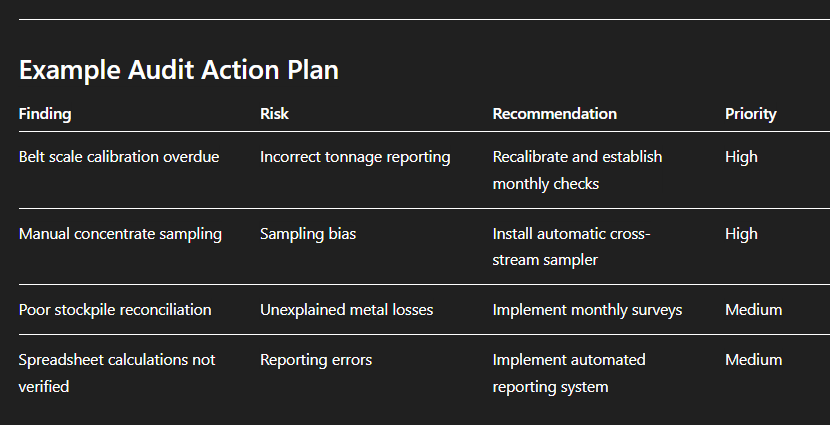
--- # Prepare the Audit Report
A good metallurgical accounting audit report should contain:
## Executive Summary
* Key findings
* Major risks
* Opportunities
## System Assessment
* Sampling systems
* Measurement systems
* Laboratory systems
* Reconciliation systems
## Mass Balance Results
* Solids balance
* Water balance
* Metal balance
* Recovery calculations
## Findings and Recommendations
* Immediate corrective actions
* Medium-term improvements
* Long-term system enhancements
--- # Typical Deliverables
1. Metallurgical accounting system review
2. Sampling audit report
3. Instrumentation assessment
4. Laboratory assessment
5. Mass balance and reconciliation report
6. Metal loss analysis
7. Risk register
8. Corrective action plan
9. Prioritized improvement roadmap
10. Management presentation
--- # Conclusion
A **Metallurgical Accounting Plant Audit** is fundamentally an exercise in establishing confidence in plant numbers. It systematically evaluates the entire measurement chain—from sampling and assaying to flow measurement, inventory management, and reconciliation—to ensure that every tonne and every unit of valuable metal can be accurately accounted for. The audit should ultimately answer five critical questions:
1. **How much metal entered the plant?**
2. **How much metal was recovered?**
3. **How much metal was lost?**
4. **Where did the losses occur?**
5. **Can management trust the reported figures?**
Prepare:
Examples of Metalllurgical Accounting Plant Audits
Metallurgical accounting audits are routinely conducted across the mining industry to improve reconciliation, reduce metal losses, and increase confidence in production reporting. While many audit reports remain confidential, several public examples and typical industry cases illustrate where and why these audits are undertaken.
--- ## 1. Gold Processing Plants Barrick Gold and AngloGold Ashanti have publicly discussed the importance of metallurgical accounting and reconciliation practices across their operations.
### Typical Audit Findings
* Feed tonnage discrepancies due to poorly calibrated belt scales
* Inaccurate stockpile volume estimates
* Sampling bias in gravity and flotation circuits
* Differences between plant production and refinery receipts
### Typical Outcomes
* Installation of automated samplers
* Improved stockpile survey procedures
* More frequent instrument calibration
* Improved metal reconciliation and recovery reporting
--- ## 2. Platinum Group Metal (PGM) Concentrators Anglo American Platinum and Impala Platinum operate highly complex concentrators where metallurgical accounting audits are essential because even small losses can represent substantial revenue.
### Typical Audit Findings
* Unaccounted metal in circulating loads
* Sampling errors in flotation concentrates
* Inaccurate density measurements
* Poor accounting of pipeline and thickener inventories
### Typical Outcomes
* Better sampling protocols
* Improved accounting boundaries
* Enhanced inventory management
* More reliable metal balances
--- ## 3. Copper Concentrators Large copper concentrators such as those operated by Freeport-McMoRan and Codelco routinely perform metallurgical accounting audits.
### Typical Audit Findings
* Underestimation of concentrate moisture
* Laboratory assay precision issues
* Errors in concentrate shipment accounting
* Poor reconciliation between mine and mill
### Typical Outcomes
* Enhanced laboratory quality control
* Improved moisture measurement systems
* Better shipment reconciliation procedures
* Increased confidence in payable metal reporting
--- ## 4. Diamond Processing and DMS Plants Diamond producers such as De Beers Group place enormous emphasis on metallurgical accounting due to the high value of recovered diamonds.
### Typical Audit Findings
* Inadequate accounting boundaries around recovery circuits
* Poor tracking of re-crush streams
* Insufficient security and chain-of-custody procedures
* Incomplete inventory accounting
### Typical Outcomes
* Improved recovery accounting
* Enhanced security procedures
* Better process flow reconciliation
* More accurate inventory tracking
--- ## 5. Iron Ore Beneficiation Plants Major iron ore producers such as Rio Tinto and Vale S.A. conduct reconciliation audits to improve product quality reporting.
### Typical Audit Findings
* Inaccurate moisture determination
* Product stockpile estimation errors
* Poor feed blending records
* Sampling precision issues ### Typical Outcomes
* Improved moisture accounting
* Better stockpile surveying
* Enhanced quality reporting systems
* Reduced reconciliation variance
--- # Example Case Study 1
– Gold Plant Audit
### Problem A 4 Mtpa gold plant reported recoveries fluctuating between 87% and 94%.
### Audit Findings
* Belt scale error of approximately 3%
* Under-sampling of cyclone overflow
* Inaccurate stockpile inventories
* Laboratory duplicate precision outside acceptable limits
### Result
* Recovery reporting stabilized at approximately 90%
* Metal balance closure improved from ±12% to ±4%
* Management confidence in production reporting significantly increased
--- # Example Case Study 2
– PGM Concentrator Audit
### Problem Monthly metal reconciliation consistently showed unexplained platinum losses.
### Audit Findings
* Thickener inventories excluded from accounting boundaries
* Sampling bias in flotation concentrate streams
* Density measurements inaccurate by approximately 5%
### Result
* Metal accounting system redesigned
* Accounting boundaries redefined
* Mass balance closure improved to within ±3%
--- # Example Case Study 3
– DMS Plant Audit
### Problem Diamond recovery reporting varied significantly from month to month.
### Audit Findings
* Incorrect feed tonnage measurements
* Incomplete accounting for recycle streams
* Inconsistent concentrate sampling procedures
### Result
* Automated sampling implemented
* Feed measurement systems recalibrated
* Recovery calculations standardized
--- # Example Case Study 4
– Copper Concentrator Audit
### Problem Payable copper reported by the smelter was consistently lower than plant estimates.
### Audit Findings
* Concentrate moisture understated
* Assay bias between mine laboratory and commercial laboratory
* Shipment inventory adjustments not properly documented
### Result
* Laboratory QA/QC procedures upgraded
* Independent umpire laboratory introduced
* Improved concentrate accounting procedures
--- # Typical Benefits Achieved Following a metallurgical accounting audit, operations often achieve:
* Improved mass balance closure from ±10–15% to ±2–5%
* More reliable recovery calculations
* Better reconciliation between mine, plant, and sales
* Improved identification of metal losses
* Increased management confidence in reported figures
* Enhanced governance and financial reporting credibility
--- # A Typical South African Example
A PGM concentrator processing **200,000 tonnes per month** at a feed grade of **4 g/t** contains approximately:
**Contained metal = 200,000 × 4 = 800,000 grams (800 kg) of PGMs per month** If the metallurgical accounting system has only a **2% reconciliation error**, approximately: **800 kg × 2% = 16 kg of PGMs** Depending on basket prices, this can represent a very significant financial value. This illustrates why metallurgical accounting plant audits are considered essential governance and value-protection exercises in modern mineral processing operations.
Audits showing improved plant financial performance
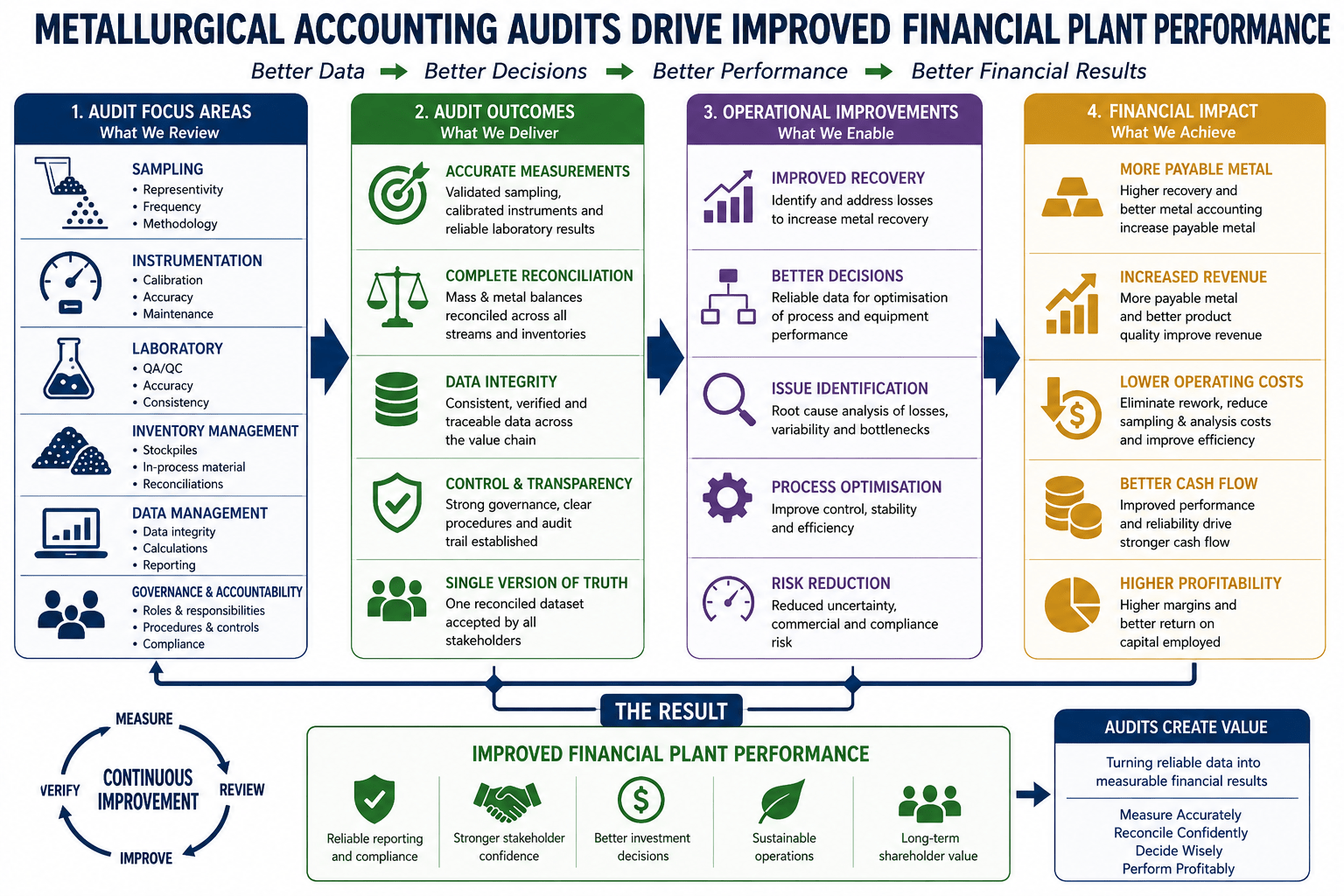
These are not always publicly disclosed in detail, so they are presented in a **representative case-study format used in the mining industry**.
--- # 1. Gold Plant Audit
– Recovery Correction and Hidden Metal Recovery
## Operation profile
* Gold CIL/CIP plant
* Throughput: ~3–5 Mtpa
## Problem before audit
* Reported recovery: 92–95%
* Actual recovery (after audit reconciliation): ~90–91%
* Large monthly “unexplained losses” in tailings
* Belt scale and cyclone feed measurement uncertainty
## Audit findings
* Belt scale over-reporting feed by ~2–3%
* Cyclone overflow sampling bias (fine gold under-captured)
* Stockpile inventory overestimation
* Laboratory assay consistency acceptable (not the main issue)
## Actions taken
* Recalibrated belt scales
* Installed automatic cross-stream samplers
* Improved tailings sampling strategy
* Standardised reconciliation model
## Financial improvement
* True recovery improved by ~1.5–2%
* Previously “lost gold” partially recovered through process adjustments
* Annual benefit: **multi-million USD uplift in payable gold**
* Reduced variance between plant and refinery reporting
**Key financial insight:** Small feed measurement errors in gold plants massively distort recovery and revenue reporting.
--- # 2. Platinum Group Metals (PGM) Concentrator – Inventory and Metal Balance Fix ## Operation profile
* PGM flotation concentrator in Southern Africa
* High-value basket metals (Pt, Pd, Rh) ## Problem before audit
* Persistent negative or positive monthly metal balances
* “Invisible losses” in circuit
* Management uncertainty about true recovery
## Audit findings
* Thickener and pipeline inventories not included in accounting model
* Density measurement drift in slurry streams (~3–5% error)
* Under-accounting of circulating loads
* Incomplete sampling of intermediate streams ## Actions taken
* Full redesign of metallurgical accounting boundary
* Added in-process inventory tracking
* Installed calibrated density measurement systems
* Improved reconciliation software logic
## Financial improvement
* Eliminated unexplained monthly losses
* Recovery reporting stabilised within ±2–3% accuracy band
* Identified additional recoverable metal in tailings and circulating load
* Annual value recovery: **significant multi-million USD improvement in payable metal confidence and reduced write-offs**
**Key financial insight:** In PGMs, inventory misstatement alone can distort millions of dollars of metal accounting.
--- # 3. Copper Concentrator – Concentrate Moisture and Shipment Reconciliation
## Operation profile
* Large copper flotation concentrator exporting concentrate
## Problem before audit
* Discrepancy between plant production and smelter receipts
* Frequent commercial disputes with off-take partner
* Variable payable copper content
## Audit findings
* Concentrate moisture consistently underestimated (~1–2% error)
* Sampling of final concentrate not representative
* Assay bias between plant lab and umpire lab
* Shipment stockpile reconciliation gaps
## Actions taken
* Introduced independent umpire laboratory
* Installed automatic concentrate samplers
* Standardised moisture measurement procedures
* Tightened shipment reconciliation system
## Financial improvement
* Reduced penalty deductions from smelter
* Increased payable copper reporting accuracy
* Recovered previously “lost” metal through moisture correction alone
* Improved contract negotiation position
**Key financial insight:** In copper operations, moisture and sampling bias directly affect payable revenue.
--- # 4. Diamond DMS Plant – Security + Accounting Alignment
## Operation profile
* Diamond Dense Media Separation (DMS) plant
## Problem before audit
* Variability between plant recovery and sales carats
* Unexplained diamond losses
* Weak inventory tracking in recovery circuits
## Audit findings
* Incomplete accounting of re-crush and recycle streams
* Inconsistent reporting of fines and recovery tailings
* Inventory leakage between plant stages (process + security overlap)
* Weak reconciliation between recovery plant and sales parcels
## Actions taken
* Introduced strict accounting boundaries per recovery stage
* Installed tighter sampling and security controls
* Improved reconciliation between plant and valuation house
* Standardised reporting of all diamond-bearing streams
## Financial improvement
* Increased measured recovery confidence
* Reduced unaccounted diamond losses
* Improved valuation of production parcels
* Stronger control over high-value inventory
**Key financial insight:** In diamonds, metallurgical accounting directly overlaps with security and revenue assurance.
--- # 5. Iron Ore Plant – Stockpile and Product Quality Reconciliation
## Operation profile
* Large iron ore beneficiation and export operation
## Problem before audit
* Differences between mine, plant, and port tonnage
* Product grade inconsistencies
* Stockpile misclassification issues
## Audit findings
* Moisture correction inconsistencies in stockpiles
* Poor stockpile surveying frequency
* Blending errors between ore types
* Conveyor scale calibration drift
## Actions taken
* Improved stockpile surveying using regular volumetric + density checks
* Recalibrated belt scales
* Introduced tighter blending control system
* Standardised moisture accounting across value chain
## Financial improvement
* Reduced reconciliation losses between mine and port
* Improved product specification consistency
* Lower penalties for off-spec material
* Better export contract compliance
**Key financial insight:** In bulk commodities, stockpile accuracy is a major financial driver.
--- # Cross-Case Financial Themes (What All Successful Audits Achieve) Across all these operations, metallurgical accounting audits typically deliver:
## 1. Recovery Improvement (1–3%) * Often worth millions annually * Comes from fixing measurement bias, not process change
## 2. Inventory Correction
* One-time balance sheet adjustment
* Eliminates “phantom losses or gains”
## 3. Reduced Revenue Leakage
* Moisture, sampling, and assay corrections
* Better payable metal realization
## 4. Lower Reconciliation Variance
* Stable, predictable reporting
* Improved investor and board confidence
## 5. Better Decision-Making
* Capital projects based on real bottlenecks
* Avoidance of unnecessary plant upgrades
--- # Final Conclusion A consistent conclusion from metallurgical accounting plant audits across commodities is:
> **The largest financial gains do not come from changing the process — they come from correcting how the process is measured and accounted for.
** Even small improvements in sampling, measurement, and reconciliation accuracy routinely translate into:
* Multi-million dollar annual value recovery
* Stronger contract performance
* Improved plant confidence
* Reduced financial disputes
What can be expected from a Successful Metallurgical Accounting Audit
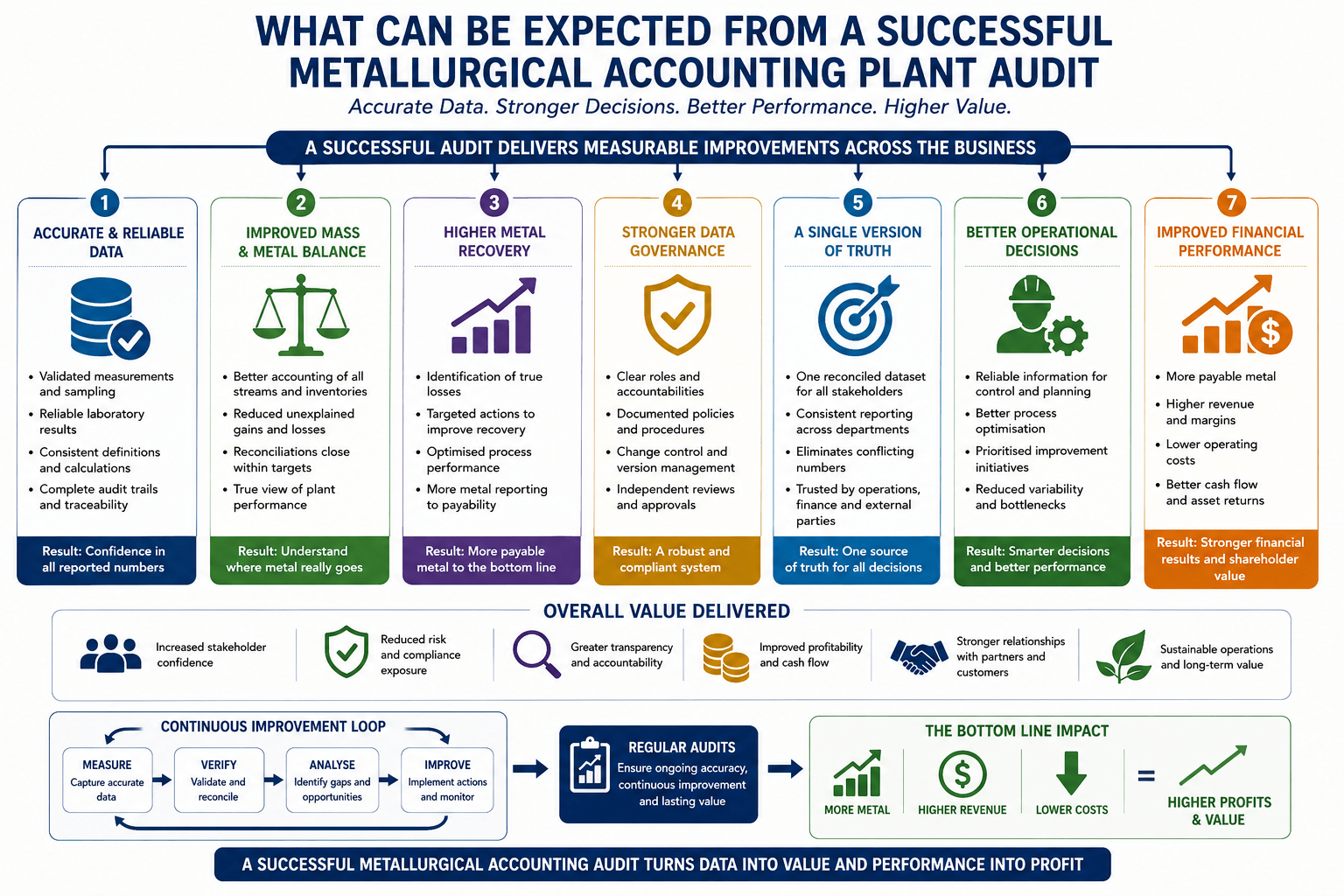
--- # 1. The Reported Production Numbers Are Either Valid or Systematically Biased A key outcome is determining whether the plant’s reported figures are:
Valid (best case)
* Within acceptable reconciliation limits (typically ±2–5%)
* Consistent over time
* Supported by independent measurements
### Or systematically biased
* Consistently over-reporting or under-reporting metal
* Driven by measurement or sampling errors
* Not random fluctuations, but structural issues
**Core conclusion:** The audit confirms whether production reporting is *truthful within error limits* or *fundamentally distorted*.
--- # 2. Mass Balance Closure Indicates System Integrity A successful audit almost always confirms whether the plant’s mass balance is sound.
### Typical conclusions:
* Good closure (±2–5%) → system is reliable
* Moderate closure (±5–10%) → acceptable but needs improvement
* Poor closure (>10%) → major structural issues exist
**Core conclusion:** If the mass balance closes well, the system is internally consistent. If not, there are hidden errors in measurement, sampling, or accounting boundaries.
--- # 3. Sampling Is the Dominant Source of Error (Not Processing Itself) One of the strongest industry-wide conclusions is: > Most metallurgical accounting errors originate from sampling, not from the process. ### Successful audit conclusion: * Sampling systems are either:
* Statistically representative (good case), or
* Biased/inconsistent (common case)
### Typical issues identified:
* Manual sampling bias
* Poor cutter design or installation
* Insufficient sampling frequency
* Segregation in slurry or ore streams
**Core conclusion:** Improving sampling yields greater gains than changing plant equipment.
--- # 4. Instrumentation Errors Have a Disproportionate Impact Even small measurement errors can significantly distort metallurgical accounting.
### Typical audit conclusions:
* Belt scales, flow meters, and density gauges often drift out of calibration
* Small errors (1–3%) propagate into large metal accounting discrepancies *
Some streams are not measured at all (hidden flows)
**Core conclusion:** Instrumentation accuracy is critical because small errors compound across the entire system.
--- # 5. Inventory Is a Major Source of “Invisible Metal” A successful audit often shows that:
### Key conclusion: > Stockpiles, pipelines, and in-process inventories are frequently the main cause of reconciliation differences.
### Common findings:
* Overestimated stockpile tonnages
* Incorrect grade assumptions
* Unmeasured material holdup in circuits
* Poor reconciliation between physical and recorded inventories
**Core conclusion:** Inventory errors often explain “lost” or “extra” metal.
--- # 6. Laboratory Performance Is Usually Better Than Plant Perception Contrary to operator assumptions, audits often conclude:
* Laboratories are generally accurate within acceptable limits
* Most errors come from:
* Sampling * Sample preparation (not analysis)
* Inconsistent QA/QC practices
**Core conclusion:** The lab is rarely the biggest problem—sampling feeding the lab is.
--- # 7. Recovery Calculations Are Often Correct but Misleading A major audit insight is: > Recovery values can appear accurate while being based on flawed inputs.
### Typical conclusion:
* Recovery trends may be valid
* Absolute recovery values may be biased
* Reported improvements may be artificial
**Core conclusion:** Correct-looking recovery numbers can still be wrong if underlying measurements are biased.
--- # 8. Metal Losses Can Be Located and Quantified A successful audit typically identifies where metal is being lost:
### Common loss areas:
* Tailings streams (fine or soluble losses)
* Circulating loads
* Thickener underflow/overflow
* Spillage and unaccounted material
* Stockpile misclassification
**Core conclusion:** Metal losses are not “unknown”—they are usually traceable with better accounting resolution. -
-- # 9. Data Systems (Especially Spreadsheets) Are a Hidden Risk Another common conclusion:
* Manual spreadsheets introduce hidden calculation errors
* Lack of version control causes inconsistencies
* Different departments use different datasets
**Core conclusion:** Data management systems are often the weakest link in metallurgical accounting.
--- # 10. The Plant Is Often More Stable Than Reported Data Suggests A successful audit often reveals:
* The plant process is relatively stable
* Apparent instability is caused by measurement noise
* True process variability is lower than reported
**Core conclusion:** The process is usually not the problem—the measurement system is.
--- # 11. Governance and Accountability Are Critical Weak Points Audits frequently conclude:
* Roles and responsibilities are unclear
* No single owner of metallurgical accounting
* Weak reconciliation discipline between mine, plant, and finance
**Core conclusion:** Strong governance is essential for reliable metallurgical accounting.
--- # 12. A Reconciled “Single Version of Truth” Can Be Established The most important final outcome is: > It is possible to establish one consistent, trusted metallurgical accounting model. This includes:
* Agreed feed tonnages
* Verified assays
* Calibrated instrumentation
* Defined inventories
* Closed mass balance
**Core conclusion:** A unified, auditable, and defensible metallurgical accounting system can be built and maintained.
--- # Overall Summary of Key Audit Conclusions A successful metallurgical accounting plant audit typically concludes that:
* Production data is either valid or systematically biased
* Sampling is the primary source of error
* Instrumentation errors significantly distort results
* Inventory inaccuracies explain many reconciliation issues
* Laboratory systems are usually acceptable
* Recovery figures may be misleading despite appearing correct
* Metal losses can be identified and reduced
* Data systems require strengthening
* Governance is critical for long-term reliability
* A single reliable accounting system can be achieved
--- # Final Insight The most important overarching conclusion is: > A metallurgical accounting plant audit does not just correct numbers—it restores confidence in the entire decision-making system of the operation.
Financial implications for a Mine and Plants
A **metallurgical accounting plant audit** has direct and often significant financial consequences because it affects how much metal a mine believes it is producing, recovering, and selling. In many operations, even small improvements in accounting accuracy translate into large changes in revenue, cost control, and asset valuation.
--- # 1. Correction of Revenue Misstatement (Up or Down) One of the most immediate financial implications is the correction of reported production.
### What the audit may reveal:
* Overstated production (inflated revenue previously reported)
* Understated production (hidden value not previously recognized)
* Timing errors in revenue recognition
### Financial impact:
* Adjustments to monthly/annual revenue statements
* Possible restatement of historical production figures
* Changes in royalty and tax calculations
Even a **1–2% error in metal accounting** can translate into **millions of dollars per year** in medium-to-large operations.
--- # 2. Identification of “Invisible Metal Losses” Audits often uncover metal losses that were previously unaccounted for.
### Typical sources:
* Tailings losses
* Circulating load losses
* Stockpile misclassification
* Measurement and sampling bias
* Moisture and density errors
### Financial implication:
* Direct recovery improvement opportunities
* Increased payable metal
* Higher concentrate or product sales
This is often the **largest financial upside** of an audit.
--- # 3. Improved Metallurgical Recovery Reporting (Real vs Reported) A key financial outcome is aligning reported recovery with actual recovery.
### Before audit:
* Recovery may be artificially high or low due to biased inputs
### After audit:
* Recovery reflects true plant performance
### Financial implications:
* More accurate bonus/penalty payments (in off-take agreements)
* Better benchmarking of plant performance
* More reliable life-of-mine revenue forecasting
--- # 4. Inventory Revaluation (Hidden Balance Sheet Impact) Metallurgical accounting audits often reveal errors in inventory valuation.
### Affected areas:
* ROM stockpiles
* Work-in-progress material
* Concentrate inventories
* Tailings storage estimates
### Financial implications:
* Increase or decrease in asset values on the balance sheet
* Correction of working capital calculations
* Adjustments to cost per tonne metrics
Inventory corrections can result in **large once-off accounting adjustments**.
--- # 5. Reduction in Operating Costs Through Better Control Improved accounting leads to better operational decisions.
### Cost impacts:
* Reduced reagent overuse
* Optimised grinding and energy consumption
* Improved water management
* Reduced reprocessing of misplaced material Even a **1–3% improvement in operating efficiency** can significantly reduce unit costs. --- # 6. Improved Decision-Making for Plant Optimisation Better data quality leads to better financial decisions. ### Examples: * Justifying capital expenditure (new cyclones, mills, samplers) * Avoiding unnecessary upgrades based on false bottlenecks * Prioritising high-impact improvements Financial implication: * Capital is allocated more efficiently * Reduced risk of poor investment decisions --- # 7. Impact on Offtake Agreements and Penalties Many mines sell concentrate under contracts that include: * Payable metal terms * Penalty elements (impurities, moisture) * Recovery-based pricing adjustments ### Audit implications: * Corrected concentrate grades * Accurate moisture determination * Improved shipment reconciliation Financial impact: * Reduced penalties * Improved payable metal * Better contract negotiation position
--- # 8. Reduction in “Unexplained Losses” (Shrinkage) Before audits, mines often carry unexplained metal losses.
After audits:
* Losses are quantified and explained
* True shrinkage is identified and controlled
### Financial effect:
* Reduced write-offs
* Improved transparency in financial reporting
* Better confidence in production statements
--- # 9. Improved Forecasting and Life-of-Mine Valuation Accurate metallurgical accounting improves forecasting models.
### Impacts:
* More accurate production forecasts
* Better cash flow modelling
* Improved reserve valuation
* More reliable investor reporting
Financial implication:
* Direct impact on **mine valuation and investment attractiveness**
--- # 10. Risk Reduction and Compliance Benefits Audits reduce financial and regulatory risks.
### Risks mitigated:
* Misreporting of production to regulators
* Incorrect royalty payments
* Disputes with buyers or partners
* Audit qualifications from external auditors
Financial implication:
* Lower legal and compliance exposure
* Reduced risk of penalties or disputes
--- # 11. Improved Return on Existing Assets (No Capital Required) One of the most important financial insights:
> Many metallurgical accounting improvements require **no capital expenditure**, only better measurement and control.
### Examples:
* Better sampling
* Improved calibration
* Corrected mass balances
* Standardised reporting
Financial implication:
* High return on audit investment (often **very high ROI**)
--- # 12. Example Financial Impact Scenario Consider a medium-sized concentrator:
* Throughput: 2 million tonnes/year
* Grade: 2% metal
* Metal contained: 40,000 tonnes/year If an audit identifies just a **1% recovery improvement**:
* Extra metal recovered = 400 tonnes/year If metal value = $20,000/tonne: **Additional revenue = $8 million/year**
This excludes additional savings from:
* Reduced losses
* Better inventory control
* Improved operating efficiency
--- # Summary of Key Financial Implications A metallurgical accounting plant audit typically results in:
### Revenue Impacts
* Correction of over/under-reported production
* Increased payable metal
* Improved pricing accuracy
### Cost Impacts
* Reduced operating costs
* Better reagent and energy efficiency
* Lower waste and losses
### Balance Sheet Impacts
* Inventory revaluation
* Asset value corrections
* Improved working capital accuracy
### Strategic Impacts
* Better investment decisions
* Improved mine valuation
* Stronger investor confidence
--- # Final Conclusion
The financial implication of a metallurgical accounting plant audit is best summarised as: > It transforms metallurgical accounting from a reporting function into a value-recovery system. In many mines, the audit does not just identify errors—it **recovers lost value, improves profitability, and strengthens financial governance across the entire operation**.
The influence of mass balance closure on system integrity
## What is Mass Balance Closure?
A mass balance is based on the **Law of Conservation of Mass**, which states that mass cannot be created or destroyed. Therefore, for a processing plant operating under steady-state conditions:
**Total Mass In = Total Mass Out ± Inventory Change**
Similarly, for valuable metals: **Contained Metal In = Contained Metal Out ± Inventory Change ± Measurement Error** In practice, every stream entering and leaving the plant should be measured so that both the total mass and the contained metal can be reconciled.
--- ## Why Mass Balance Closure Is Important
A successful mass balance demonstrates that:
* Feed measurements are accurate.
* Product and tailings tonnages are correctly measured.
* Sampling systems are representative.
* Laboratory assays are reliable.
* Inventory changes have been properly accounted for.
* There are no significant unmeasured streams or unexplained losses. In essence, good mass balance closure confirms that the metallurgical accounting system is internally consistent.
--- # Interpreting Mass Balance Closure
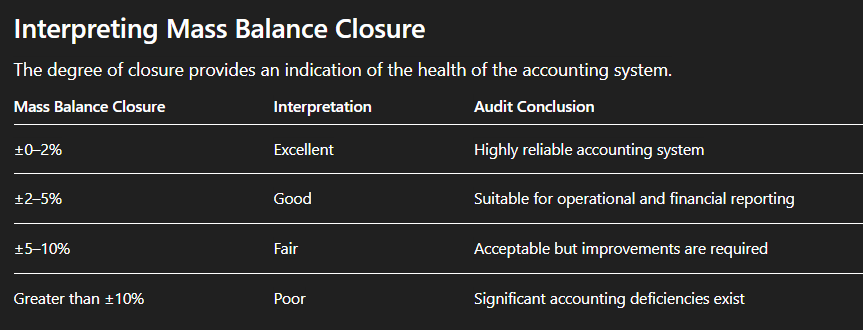
Although acceptable limits vary depending on the commodity, plant complexity, and sampling uncertainty, most modern operations aim for reconciliation errors below **5%**, with critical circuits often targeting **2% or less**.
--- # What Poor Mass Balance Closure Indicates When a plant consistently fails to achieve satisfactory closure, the audit usually identifies one or more underlying causes.
### 1. Sampling Errors Sampling is the most common source of poor reconciliation. Typical problems include:
* Non-representative manual sampling
* Incorrect sampler design
* Inadequate sampling frequency
* Sample contamination
* Sample loss during preparation Because assay calculations depend entirely on sample quality, poor sampling introduces systematic errors throughout the accounting system.
--- ### 2. Measurement Errors Incorrect flow measurements directly affect mass calculations. Common examples include:
* Belt scales drifting out of calibration
* Inaccurate slurry flow meters
* Density gauges providing incorrect readings
* Moisture determinations affecting dry tonnage calculations Even a 2% error in feed tonnage can significantly distort recovery calculations.
--- ### 3. Inventory Errors Many plants underestimate the effect of inventory. Typical examples include:
* Thickener inventories
* Pipeline holdup
* Surge bins
* Stockpile estimation errors
* Concentrate storage Failure to account for inventory movement frequently creates apparent metal gains or losses.
--- ### 4. Laboratory Bias Although less common than sampling errors, laboratory bias can also prevent balance closure. Potential causes include:
* Poor analytical precision
* Calibration drift
* Sample preparation errors
* Inadequate QA/QC procedures
--- ### 5. Unmeasured Streams Hidden process streams often explain reconciliation problems. Examples include:
* Spillage
* Emergency bypasses
* Pump gland water
* Recycle streams
* Dust losses
* Drainage systems Unless every significant stream is included in the accounting boundary, the mass balance will not close.
--- # Example 1 – Gold Processing Plant
A gold processing plant reported highly variable monthly recoveries ranging from **88% to 95%**.
The metallurgical accounting audit found:
* Mass balance closure varied between **±12% and ±15%**.
* The primary belt scale had not been calibrated for over twelve months.
* Tailings samples consistently underestimated gold grade because fine particles were excluded during manual sampling.
* Stockpile inventories were estimated visually rather than by survey. After corrective actions:
* Belt scales were recalibrated.
* Automatic tailings samplers were installed.
* Monthly stockpile surveys were implemented.
* Standard sampling procedures were introduced.
### Result Mass balance closure improved to approximately **±3%**, and reported recoveries became consistent with plant operating conditions. Management could now distinguish genuine process improvements from measurement errors.
--- # Example 2 – Copper Concentrator A copper concentrator consistently experienced differences between concentrate shipments and plant production reports.
The audit identified:
* Concentrate moisture measurements were inaccurate.
* Slurry density measurements varied significantly between operators.
* Pipeline inventories were excluded from monthly reconciliation. After improving instrumentation and accounting for inventory changes:
* Mass balance closure improved from approximately **±9% to ±2%**.
* Shipment reconciliation became significantly more reliable.
* Commercial disputes with the smelter were substantially reduced.
--- # Financial Implications of Good Mass Balance Closure A well-closed mass balance delivers significant financial benefits.
### Improved Revenue Accuracy Reliable production figures ensure that concentrate production and payable metal are correctly reported.
### Better Recovery Calculations True metallurgical performance can be distinguished from accounting errors, enabling engineers to optimise the process more effectively.
### Reduced Inventory Adjustments Accurate inventory accounting minimises unexpected write-offs and balance sheet corrections.
### Increased Investor Confidence Reliable production reporting enhances confidence among investors, lenders, and regulators.
### Better Capital Allocation Management can identify genuine process bottlenecks rather than investing in solutions to problems caused by inaccurate data.
--- # Indicators of a Healthy Mass Balance
A successful metallurgical accounting audit typically finds that:
* Feed, product, and tailings streams reconcile within acceptable limits.
* Metal balances are consistent over time.
* Instrument calibrations are current.
* Sampling systems comply with recognised best practices.
* Inventory movements are regularly measured and reconciled.
* Production reports are supported by independent verification. These indicators demonstrate that the accounting system is robust and capable of supporting operational and financial decision-making.
--- # Key Audit Conclusion
One of the strongest indicators of an effective metallurgical accounting system is **good mass balance closure**. When the mass and metal balances consistently reconcile within acceptable limits, it provides objective evidence that the plant's measurements, sampling systems, laboratory analyses, and inventory controls are functioning together as an integrated and reliable system.
Conversely, persistent failure to achieve mass balance closure is rarely a process problem—it is usually evidence of weaknesses in measurement, sampling, laboratory practices, inventory management, or accounting boundaries. Identifying and correcting these weaknesses enables a mine to improve reporting accuracy, reduce financial risk, and make better operational decisions. In summary, **mass balance closure is not merely a mathematical exercise; it is the primary measure of the integrity of a metallurgical accounting system.
A plant that consistently achieves good mass balance closure has established a sound foundation for reliable production reporting, effective process optimisation, and strong financial governance.**
How does the reported prduction numbers influence financial performance
One of the most important conclusions from a metallurgical accounting plant audit is whether the production figures reported by the operation accurately reflect actual plant performance.
Production data forms the basis for operational decisions, financial reporting, resource reconciliation, royalty calculations, and investor confidence. Therefore, establishing the reliability of these figures is a primary objective of any audit.
### What Does "Valid" Mean?
Reported production numbers are considered **valid** when they are supported by reliable measurements, representative sampling, accurate laboratory analyses, and a reconciled mass balance.
In a well-controlled operation:
* Feed tonnage is accurately measured using calibrated belt scales or weigh feeders.
* Feed, concentrate, and tailings samples are representative of the material being processed.
* Laboratory assays are precise, accurate, and supported by a robust quality assurance/quality control (QA/QC) programme.
* Mass and metal balances reconcile within acceptable limits, typically ±2–5%.
* Inventory movements are correctly measured and recorded. Under these conditions, management can confidently rely on production reports to evaluate plant performance, forecast production, and make investment decisions.
### What Is Systematic Bias?
Systematic bias occurs when reported production figures are consistently higher or lower than the true production because of recurring errors in the metallurgical accounting system. Unlike random errors, systematic bias does not average out over time and can significantly distort reported performance.
Common causes include:
* Poorly calibrated belt scales that consistently over- or under-report ore tonnage.
* Non-representative sampling that overestimates concentrate grade or underestimates tailings grade.
* Laboratory bias caused by incorrect analytical methods or inadequate QA/QC procedures.
* Incorrect moisture corrections affecting dry tonnage calculations.
* Failure to account for in-process inventories such as surge bins, pipelines, or thickeners.
* Spreadsheet or software calculation errors in metallurgical reporting. Because these errors are persistent, they can create a false picture of plant performance over months or even years.
--- ## Example 1: Gold Processing Plant A gold processing plant reported an average monthly recovery of **94%**, significantly above the historical average for similar ore types.
A metallurgical accounting audit found that:
* The primary belt scale over-reported feed tonnage by **2.5%** due to calibration drift.
* Automatic samplers on the tailings stream were not collecting representative samples because the cutter failed to traverse the full stream. * The laboratory was operating within acceptable QA/QC limits, indicating that analytical bias was not the primary issue. After recalibrating the belt scale and improving the tailings sampling system, the true recovery was determined to be **91.8%**.
### Financial implication Although management initially believed the plant was operating exceptionally well, the audit demonstrated that reported recoveries were artificially inflated.
Correcting the measurement bias enabled engineers to identify genuine process improvement opportunities, resulting in higher actual gold recovery and improved long-term profitability.
--- ## Example 2: Platinum Concentrator
A platinum concentrator consistently reported monthly metal production approximately **3% higher** than the quantities reconciled with downstream smelting operations. The audit identified several systematic errors: * Slurry density measurements were consistently low due to poorly maintained density gauges.
* Thickener inventories were excluded from the metallurgical accounting boundary.
* Intermediate flotation concentrate samples were collected manually, introducing sampling bias. Following improvements to instrumentation, inventory accounting, and sampling procedures, reconciliation differences were reduced to less than **2%**, providing management with significantly greater confidence in reported production.
--- ## Business Consequences of Systematically Biased Production Numbers If production figures are systematically biased, the consequences extend well beyond the processing plant.
### Financial reporting Incorrect production figures may lead to inaccurate revenue recognition, inventory valuation, and operating cost calculations, potentially affecting financial statements.
### Operational decision-making Management may incorrectly conclude that plant performance is improving or deteriorating, leading to inappropriate operating changes or unnecessary capital expenditure.
### Resource and reserve reconciliation Biased production data reduces confidence in the reconciliation between the geological resource model, the mine, and the processing plant, making reserve estimation less reliable.
### Contractual implications Inaccurate concentrate grades, recoveries, or shipment quantities can result in disputes with customers, smelters, or joint venture partners and may affect payable metal calculations.
### Investor confidence Reliable production reporting is essential for maintaining credibility with investors, lenders, and regulators. Persistent discrepancies can undermine confidence in the mine's operational and financial performance.
--- ## Indicators
That Reported Production May Be Systematically Biased During a metallurgical accounting audit, several warning signs may indicate systematic bias:
* Mass balances consistently fail to close within acceptable limits.
* Reported recoveries are consistently higher than industry benchmarks for similar ore types.
* Significant differences exist between plant production and downstream refinery or smelter receipts.
* Large, unexplained monthly inventory adjustments are common.
* Belt scales, flow meters, or density gauges have overdue calibrations.
* Laboratory duplicate analyses show persistent bias rather than random variation.
* Different departments (mine, plant, laboratory, and finance) report conflicting production figures.
--- ## Key Conclusion
One of the most valuable outcomes of a metallurgical accounting plant audit is determining whether reported production figures are **a reliable representation of actual plant performance or the result of systematic bias**. When production data is validated through representative sampling, calibrated instrumentation, accurate laboratory analysis, and robust mass balance reconciliation, management can make operational, financial, and strategic decisions with confidence.
Conversely, when systematic bias is identified, correcting the underlying causes often delivers substantial financial benefits by improving the accuracy of production reporting, revealing hidden metal losses, and enabling more effective process optimisation. In essence, **a successful metallurgical accounting audit transforms production data from a collection of reported numbers into a trusted foundation for operational excellence and financial governance**.
A major source of error. Sampling over processing
"You cannot manage what you cannot measure, and you cannot measure accurately without representative sampling."This finding has been consistently demonstrated across gold, platinum group metals (PGMs), copper, iron ore, coal, diamond, and base metal operations. Many processing plants are capable of achieving stable metallurgical performance, yet management often observes large fluctuations in reported recoveries, concentrate grades, or metal balances. Metallurgical accounting audits frequently reveal that these apparent fluctuations are not caused by changes in the process but by errors introduced during sampling. In other words, the plant may be operating consistently, while the data used to assess its performance is unreliable.
--- # Why Sampling Matters Every metallurgical accounting calculation depends on two fundamental measurements:
* **The quantity of material (tonnage or mass flow)**
* **The grade of the valuable mineral or metal** While tonnage is measured by belt scales, weigh feeders, or flow meters, grade is determined through sampling and laboratory analysis. If a sample is not representative of the material stream, even the most accurate laboratory analysis will produce misleading results.
This principle is often expressed as:
> **A precise analysis of a poor sample is still a poor result.** Therefore, the quality of metallurgical accounting is fundamentally limited by the quality of the sampling process.
--- # Why Sampling Errors Dominate Unlike laboratory analytical errors, which are generally small and well controlled through quality assurance programmes, sampling errors occur at the beginning of the measurement chain. Once a biased sample has been collected, no amount of laboratory precision or sophisticated reconciliation can correct that bias. Sampling errors are particularly significant because mineral particles are rarely distributed uniformly within an ore stream. Valuable minerals may be concentrated in specific particle sizes or density fractions, making representative sampling difficult without properly designed equipment and procedures.
--- # Types of Sampling Errors Identified During Audits Successful audits commonly identify several forms of sampling error.
## 1. Fundamental Sampling Error Fundamental sampling error arises from the natural heterogeneity of the ore. Coarse particles containing valuable minerals are often unevenly distributed, making it difficult for small samples to accurately represent the entire stream. For example, in a gold plant, coarse free gold particles may be present in only a few fragments of ore. If these particles are not included in the sample, the measured gold grade will underestimate the actual feed grade.
--- ## 2. Delimitation Error Delimitation error occurs when the sampling device fails to collect the entire cross-section of the material stream. Examples include:
* Manual shovel sampling from conveyor belts.
* Sampling only the surface of stockpiles.
* Partial interception of slurry streams. These practices introduce systematic bias because different portions of the stream often contain different particle sizes and grades.
--- ## 3. Extraction Error Extraction errors occur when the sampler does not collect the material correctly.
Common causes include:
* Incorrect cutter speed.
* Cutter openings that are too small.
* Material bouncing out of the sampler.
* Sampler blockages. These errors frequently result in preferential collection of either coarse or fine particles.
--- ## 4. Sample Preparation Error After collection, errors may be introduced during:
* Crushing
* Splitting
* Pulverising
* Drying
* Storage Poor sample preparation can contaminate samples or produce non-representative sub-samples for laboratory analysis.
--- # Why the Process Is Often Not the Problem
A common misconception is that fluctuations in reported recovery automatically indicate poor plant performance. Metallurgical accounting audits often demonstrate the opposite. For example, a flotation circuit may operate at relatively constant feed rate, reagent dosage, air flow, and residence time. However, reported recovery may fluctuate by several percentage points because the concentrate and tailings samples are inconsistent. After improving the sampling system, the apparent variability frequently disappears, confirming that the process itself was stable all along.
--- # Example 1
– Gold Processing Plant A gold processing plant reported monthly recovery variations between **88% and 95%**, leading management to believe that the grinding and leaching circuits were unstable.
A metallurgical accounting audit found:
* Manual tailings sampling collected only surface slurry.
* Fine gold particles remained suspended below the sampling point.
* Belt scale measurements were accurate.
* Laboratory precision was acceptable.
After installing automatic cross-stream samplers and standardising sampling procedures:
* Recovery variation reduced to approximately **90–91%** each month.
* No significant process modifications were required.
* The perceived instability had been caused almost entirely by sampling bias.
### Financial Outcome Management avoided unnecessary capital expenditure on plant modifications and instead invested in improved sampling infrastructure, achieving more reliable production reporting at a fraction of the cost.
--- # Example 2
– PGM Concentrator A platinum concentrator experienced persistent reconciliation differences between the concentrator and downstream smelter.
The audit identified:
* Manual sampling of flotation concentrate introduced operator bias.
* Sampling frequency varied between shifts.
* Laboratory analyses showed good repeatability.
Following installation of automatic samplers and revised sampling procedures:
* Reconciliation improved from approximately **±8% to less than ±3%**.
* Confidence in recovery calculations increased substantially.
* Monthly production reporting became significantly more consistent.
--- # Example 3
– Iron Ore Beneficiation Plant An iron ore operation experienced inconsistent product grade reporting.
The audit found:
* Samples were collected only from accessible areas of stockpiles.
* Particle segregation caused coarse and fine fractions to contain different iron grades.
* Conveyor belt sampling was not representative.
Following implementation of cross-belt automatic samplers:
* Product grade variability decreased.
* Customer specification compliance improved.
* Penalties for off-spec shipments were reduced.
--- # Financial Implications Recognising sampling as the dominant source of accounting error has important financial consequences.
## Improved Revenue Accuracy Representative sampling produces more accurate concentrate grades and recovery calculations, reducing the risk of under- or over-reporting production.
--- ## Better Process Optimisation Engineers can distinguish genuine metallurgical problems from measurement errors, allowing optimisation efforts to focus on the real process constraints.
--- ## Reduced Capital Expenditure Plants frequently avoid expensive equipment upgrades after audits demonstrate that poor accounting data—not poor equipment performance—was responsible for apparent operational problems.
--- ## Improved Contract Compliance More reliable sampling reduces disputes with smelters and customers over concentrate quality and payable metal.
--- ## Increased Investor Confidence Reliable production reporting strengthens financial reporting and enhances confidence among investors, lenders, and regulators.
--- # Best Practices for Reducing Sampling Errors Successful audits commonly recommend:
* Installing automatic cross-stream samplers on all critical process streams.
* Designing sampling systems in accordance with the principles of representative sampling and the Theory of Sampling.
* Standardising sampling procedures across all shifts.
* Regularly inspecting and maintaining sampling equipment.
* Training operators in correct sampling techniques.
* Monitoring sampling precision using duplicate samples and statistical quality control.
* Auditing sampling systems periodically to ensure continued compliance.
--- # Key Audit Conclusion One of the most consistent findings from metallurgical accounting plant audits is that **sampling is the dominant source of error in metallurgical accounting, while the mineral processing plant itself is often performing much more consistently than the reported data suggests**.
This conclusion fundamentally changes how mines approach performance improvement. Rather than immediately investing in new processing equipment, successful operations first ensure that their sampling systems produce representative, unbiased data.
Only then can management accurately assess plant performance, identify genuine process bottlenecks, and implement improvements that deliver measurable financial benefits. In summary,
**accurate sampling is the cornerstone of reliable metallurgical accounting. Without representative samples, even the most sophisticated laboratory analyses, reconciliation software, and process control systems cannot produce trustworthy production figures.** As the mining industry often states: > **"You cannot manage what you cannot measure, and you cannot measure accurately without representative sampling."**
Impact of Instrument errors on Financial Performance
instrumentation errors have a disproportionately large impact on the accuracy of metallurgical accounting.One of the most important conclusions from a successful metallurgical accounting plant audit is that **small instrumentation errors can have a disproportionately large impact on production reporting, metallurgical recovery, reconciliation, and ultimately the financial performance of a mining operation**.
Although modern mineral processing plants rely on sophisticated instrumentation to measure process variables, even minor inaccuracies in critical instruments can propagate throughout the metallurgical accounting system, resulting in significant errors in reported production and metal recovery. Unlike random process fluctuations, instrumentation errors are often **systematic**, meaning they consistently overestimate or underestimate measurements. Because metallurgical accounting calculations are based on these measurements, the resulting errors accumulate throughout the process, affecting operational decisions, financial reporting, and strategic planning.
--- # Why Instrumentation Is Critical Every metallurgical accounting system depends on accurate measurements of:
* Ore tonnage
* Slurry flow rates
* Slurry density
* Moisture content
* Product weights
* Stockpile movements
* Water balances
These measurements are obtained using instruments such as:
* Belt scales
* Weigh feeders
* Flow meters
* Density gauges
* Moisture analysers
* Load cells
* Level transmitters
* Online analysers If these instruments are inaccurate, every downstream calculation—including mass balances, metal balances, recoveries, and production reports—will also be inaccurate.
--- # Why Small Errors Become Large Financial Problems
Many metallurgical accounting calculations multiply several measured variables together. For example, contained metal is calculated as:
> **Contained Metal = Tonnage × Grade**
If: * Feed tonnage is overstated by **2%** * Feed grade is overstated by **1%** the calculated contained metal may be overstated by approximately **3%**, before considering additional errors in product measurements or inventories.
When similar errors occur in multiple process streams, the cumulative effect can significantly distort recovery calculations and reconciliation results.
--- # Common Instrumentation Errors Identified During Audits ## 1. Belt Scale Errors Belt scales are among the most critical instruments in any processing plant because they determine feed and product tonnage.
Typical causes of error include:
* Calibration drift
* Material build-up on idlers
* Damaged load cells
* Belt misalignment
* Incorrect zero calibration
### Example
A gold plant processing **5 million tonnes per year** experienced a belt scale calibration drift of **2%**.
The consequences included:
* Feed tonnage overstated by 100,000 tonnes annually.
* Reported recovery artificially inflated.
* Incorrect operating cost per tonne.
* Distorted reserve reconciliation. Following recalibration, production reporting became significantly more accurate.
--- ## 2. Slurry Density Measurement Errors
Density measurements are fundamental in flotation, grinding, and dense medium separation (DMS) circuits.
Poor density measurement affects:
* Solids flow calculations
* Cyclone performance evaluation
* Residence time calculations
* Recovery estimates
* Water balances
### Example
A PGM concentrator used nuclear density gauges that had not been calibrated for over a year.
The audit found:
* Density underestimated by approximately **4%**.
* Solids flow calculations significantly affected.
* Monthly metal balance consistently failed to close. After calibration:
* Metal balance closure improved from **±9% to approximately ±3%**.
--- ## 3. Flow Meter Errors Flow meters determine slurry and water movement throughout the plant.
Common problems include:
* Scaling within pipes
* Air entrainment
* Sensor fouling
* Incorrect installation
* Electronic drift Inaccurate flow measurements distort:
* Residence times
* Water balances
* Solids throughput
* Reagent dosage calculations
--- ## 4. Moisture Measurement Errors Moisture content directly affects dry tonnage calculations. Even small moisture errors influence:
* Concentrate production
* Shipment weights
* Payable metal calculations
* Inventory valuation
### Example
A copper concentrate with actual moisture of **9%** was consistently reported as **7%**.
The result was:
* Overstatement of dry concentrate production.
* Inflated payable copper calculations.
* Commercial reconciliation disputes with the smelter.
--- ## 5. Online Analytical Instrument Errors
Modern plants increasingly use online analysers to monitor:
* Grade
* Particle size
* Chemical composition
If these instruments drift from calibration:
* Process control decisions become unreliable.
* Recovery optimisation suffers.
* Laboratory reconciliation deteriorates.
--- # Example 1
– Gold Processing Plant
A gold operation reported recoveries consistently above design expectations.
The metallurgical accounting audit found:
* Feed belt scale over-reading by approximately **2.3%**.
* Tailings flow meter under-reading.
* Laboratory performance within acceptable QA/QC limits.
Following recalibration:
* Recovery calculations became realistic.
* Mass balance closure improved from **±11% to approximately ±4%**.
* Management gained confidence in monthly production reports.
### Financial Impact
The operation avoided making unnecessary capital investments aimed at solving a problem that was actually caused by inaccurate instrumentation.
--- # Example 2
– Dense Medium Separation (DMS) Plant
A diamond DMS plant experienced unstable separation efficiency.
The audit identified:
* Density gauge calibration drift.
* Incorrect medium density reporting.
* Magnetic separator performance incorrectly assessed due to inaccurate density measurements.
Corrective actions included:
* Recalibration of density instrumentation.
* Routine verification using manual density measurements.
* Improved instrument maintenance procedures.
### Result
* More stable separation density.
* Improved diamond recovery.
* Reduced operating costs associated with medium losses.
--- # Financial Implications of Instrumentation Errors
## Incorrect Revenue Reporting
Over- or under-measured production affects revenue recognition and profitability reporting.
--- ## Poor Investment Decisions Management may invest in new equipment when the apparent bottleneck is actually caused by inaccurate measurements.
--- ## Increased Operating Costs Incorrect measurements can lead to:
* Excessive reagent consumption.
* Higher energy usage.
* Poor grinding efficiency.
* Reduced recovery.
--- ## Inventory Misstatement Measurement errors distort:
* Stockpile inventories.
* Concentrate inventories.
* Work-in-progress valuation.
This directly affects financial statements.
--- ## Contractual Risks
Incorrect product measurements may result in:
* Customer disputes.
* Smelter penalties.
* Incorrect royalty calculations.
* Reduced payable metal.
--- # Best Practices Identified During Audits
Successful metallurgical accounting audits typically recommend:
* Establishing formal calibration schedules for all critical instruments.
* Verifying belt scales using certified test weights.
* Regularly comparing online instruments with manual measurements.
* Implementing preventive maintenance programmes.
* Documenting all calibration records.
* Defining acceptable measurement uncertainty for each instrument.
* Performing periodic independent verification by qualified personnel.
* Integrating instrument health monitoring into the plant control system.
--- # Indicators of a Healthy Instrumentation System
A well-maintained processing plant should demonstrate:
* Current calibration certificates for all critical instruments.
* Stable mass and metal balance closure.
* Consistent production reporting.
* Agreement between online measurements and manual verification.
* Minimal unexplained reconciliation differences.
* Reliable long-term performance trends.
These indicators provide confidence that production figures are based on accurate and traceable measurements.
--- # Key Audit Conclusion
One of the clearest conclusions from metallurgical accounting plant audits is that **instrumentation errors have a disproportionately large impact on the accuracy of metallurgical accounting**.
Small errors in belt scales, density gauges, flow meters, moisture analysers, or online sensors can propagate throughout the accounting system, producing misleading production figures, inaccurate recovery calculations, and poor reconciliation. Importantly, these errors often create the false impression that the processing plant is underperforming, when in reality the problem lies in the measurement system.
By ensuring that all critical instruments are properly selected, calibrated, maintained, and independently verified, mines can significantly improve the accuracy of metallurgical accounting, strengthen financial reporting, and make more informed operational decisions. In summary, **accurate instrumentation is the foundation of reliable metallurgical accounting.
Without trustworthy measurements, even the most sophisticated sampling systems, laboratory analyses, and reconciliation models cannot produce credible production figures or support effective business decisions.**
Inventory is a major source of Invisible Metall -
inventory is often the largest source of unexplained metal gains and losses.One of the most significant conclusions from successful metallurgical accounting plant audits is that **inventory is often the largest source of unexplained metal gains and losses**.
These discrepancies are commonly referred to as **"invisible metal"** because the metal has not physically disappeared; rather,
it is temporarily stored within the processing system or incorrectly measured, estimated, or reported. Metallurgical accounting audits frequently demonstrate that apparent metal losses are not always the result of poor metallurgical performance. Instead, they are often caused by inaccurate accounting for inventories contained within stockpiles, surge bins, thickener tanks, pipelines, concentrate storage facilities, or tailings systems.
Properly identifying and quantifying these inventories can significantly improve reconciliation accuracy, financial reporting, and operational decision-making.
--- # What Is Invisible Metal? Invisible metal refers to **valuable metal that exists within the mining and processing value chain but is not accurately reflected in the metallurgical accounting system**.
The metal may be physically present in:
* Run-of-mine (ROM) stockpiles
* Coarse ore stockpiles
* Fine ore bins
* Grinding mills
* Surge bins
* Thickeners
* Pipelines
* Flotation cells
* Concentrate storage tanks
* Filter cakes
* Tailings dams
* Recycle streams If these inventories are not measured accurately or reconciled regularly, the accounting system may incorrectly report metal gains or losses.
--- # Why Inventory Creates Accounting Errors Unlike continuous process streams, inventories are dynamic. Material enters and leaves storage points continuously, making accurate measurement challenging.
Errors commonly arise because:
* Stockpile tonnages are estimated rather than surveyed.
* Material grades are assumed rather than sampled.
* Moisture content changes over time.
* Pipeline and thickener inventories are ignored.
* Material remains in equipment during shutdowns.
* Inventory movements are recorded late or not at all.
These factors cause discrepancies between measured inputs and outputs, resulting in apparent metal losses that are purely accounting issues.
--- # Common Sources of Invisible Metal
## 1. Run-of-Mine (ROM) Stockpiles ROM stockpiles are often the first source of reconciliation differences.
### Typical audit findings
* Stockpile volumes estimated visually.
* Incorrect bulk density assumptions.
* Variable ore grades within the stockpile.
* Infrequent stockpile surveys.
### Financial impact
An overestimated stockpile may artificially increase reported inventory assets, while an underestimated stockpile may result in apparent metal losses.
--- ## 2. Process Stockpiles Intermediate stockpiles between crushing, grinding, or beneficiation circuits frequently contain significant quantities of valuable metal.
Audit findings often include:
* Poor segregation management.
* Inadequate grade control.
* Incomplete inventory records.
These inventories may explain short-term reconciliation discrepancies.
--- ## 3. Thickener Inventories
Thickeners can contain hundreds or even thousands of tonnes of slurry.
During audits, it is common to find that:
* Thickener solids inventories are excluded from metallurgical accounting.
* Density measurements are inaccurate.
* Inventory changes during shutdowns are ignored.
As a result, metal appears to be "lost" when it is simply retained within the thickener.
--- ## 4. Pipeline Inventories Long slurry pipelines may contain considerable quantities of mineralized material.
Typical issues include:
* No accounting for pipeline fill during start-up.
* Material remaining in pipelines during shutdowns.
* Variable slurry densities. Ignoring these inventories can significantly affect monthly metal reconciliation.
--- ## 5. Concentrate Storage Concentrate stored in tanks, sheds, or warehouses represents valuable inventory.
Audits frequently identify:
* Delayed shipment reporting.
* Incorrect moisture corrections.
* Inaccurate stock measurements.
Consequently, concentrate production may not reconcile with sales.
--- ## 6. Tailings Storage Facilities
Although tailings represent waste, they also contain unrecovered valuable minerals. Poor accounting of tailings can result from:
* Inadequate sampling.
* Incorrect flow measurements.
* Failure to distinguish between fresh and historical deposits.
This affects recovery calculations and long-term resource evaluation.
--- # Example 1
– Gold Processing Plant
A gold processing operation experienced persistent monthly reconciliation differences averaging **8%**.
The audit identified:
* ROM stockpile surveys conducted only twice per year.
* Bulk density values based on historical assumptions.
* Significant gold inventory remaining within the grinding circuit following planned shutdowns.
* Pipeline inventories excluded from monthly reconciliation. ### Corrective actions
* Monthly drone-based stockpile surveys.
* Updated bulk density determinations.
* Inclusion of in-process inventories in the accounting model.
* Standard operating procedures for inventory measurement during shutdowns.
### Results
* Reconciliation improved from **±8% to approximately ±3%**.
* Apparent metal losses were substantially reduced.
* Financial reporting became more reliable.
--- # Example 2
– Platinum Concentrator
A PGM concentrator consistently reported unexplained platinum losses.
The audit found:
* Thickener inventories excluded from reconciliation.
* Concentrate storage tanks measured manually using inconsistent methods.
* Pipeline inventories ignored.
Following implementation of inventory accounting procedures:
* Monthly metal balances stabilised.
* Unexplained losses were largely eliminated.
* Management confidence in production reporting increased.
--- # Example 3
– Copper Concentrator
A copper operation experienced discrepancies between plant production and concentrate shipments.
The audit revealed:
* Concentrate storage inventories were not reconciled at month-end.
* Moisture corrections varied between departments.
* Shipment timing created accounting differences.
After implementing standard inventory procedures:
* Concentrate inventories matched shipping records.
* Commercial reconciliation improved.
* Revenue reporting became more accurate.
--- # Financial Implications of Inventory Errors
## Misstated Revenue Inventory errors can delay or accelerate revenue recognition, affecting reported financial performance.
--- ## Incorrect Asset Valuation
Ore, concentrate, and work-in-progress inventories are balance sheet assets. Overestimating or underestimating these inventories can materially affect:
* Total assets.
* Working capital.
* Cost of sales.
* Gross profit.
--- ## Poor Recovery Calculations If inventory changes are ignored, recovery calculations become unreliable because not all contained metal is accounted for.
--- ## Reduced Investor Confidence
Large unexplained inventory adjustments reduce confidence in operational reporting and financial governance.
--- ## Operational Inefficiency
Poor inventory visibility makes it difficult to:
* Schedule plant production.
* Optimise blending.
* Manage stockpiles.
* Plan maintenance shutdowns.
--- # Best Practices for Inventory Management
Successful metallurgical accounting audits typically recommend:
* Regular stockpile surveys using drones, laser scanning, or conventional surveying.
* Routine determination of bulk density for all stockpiles.
* Defined accounting boundaries for all in-process inventories.
* Monthly reconciliation of surge bins, thickeners, pipelines, and concentrate storage.
* Continuous monitoring of inventory movements.
* Standard procedures for measuring inventories during plant shutdowns.
* Integration of inventory management into the metallurgical accounting system.
--- # Indicators of Good Inventory Control
A well-managed operation should demonstrate:
* Regularly surveyed stockpiles.
* Accurate inventory records.
* Documented inventory measurement procedures.
* Reconciled work-in-progress inventories.
* Consistent concentrate storage records.
* Minimal unexplained inventory adjustments.
These indicators provide confidence that inventory is being managed as an integral part of the metallurgical accounting system.
--- # Key Audit Conclusion One of the most important findings from metallurgical accounting plant audits is that **inventory is often the largest source of "invisible metal"**.
In many cases, apparent metal losses are not caused by poor plant performance but by inadequate measurement and accounting of material held within stockpiles, pipelines, thickeners, surge bins, and concentrate storage facilities.
By improving inventory measurement, defining clear accounting boundaries, and regularly reconciling all in-process and finished product inventories, mines can dramatically improve mass balance closure, strengthen financial reporting, and increase confidence in production figures.
Ultimately, **metal cannot be managed if it cannot be located**. Successful metallurgical accounting systems treat inventory not as a static balance sheet item but as a dynamic component of the production process.
Proper inventory control transforms "invisible metal" into **visible, measurable, and accountable value**, enabling more accurate operational decisions, stronger financial governance, and improved profitability.
Laboratory performance is usually better than Plant perception - the analytical laboratory is rarely the primary source of metallurgical accounting errors.
One of the more surprising conclusions from successful metallurgical accounting plant audits is that **the analytical laboratory is rarely the primary source of metallurgical accounting errors**.
While plant personnel often attribute poor reconciliation, inconsistent recoveries, or unexpected production results to laboratory inaccuracies, detailed audits frequently demonstrate that the laboratory is performing within acceptable quality standards.
Instead, the root causes are usually found in **sampling, sample preparation, instrumentation, or inventory management**.
This finding is significant because it shifts improvement efforts from laboratory re-analysis to strengthening the entire **measurement chain**, beginning with representative sampling and ending with accurate reporting.
--- # Why Laboratories Are Often Blamed
When production figures do not reconcile, laboratory assays are often questioned because they are the most visible component of the metallurgical accounting process.
Common concerns include:
* "The assays are inconsistent."
* "The laboratory results are too high."
* "The concentrate grade is incorrect."
* "The recovery calculations don't make sense." While these concerns are understandable, metallurgical accounting audits consistently show that the laboratory is only one part of a much larger measurement system. If the sample reaching the laboratory is biased or non-representative, the laboratory will accurately analyse an unrepresentative sample. This principle is frequently summarised as: > **The laboratory can only analyse the sample it receives—it cannot correct errors introduced before the sample arrives.**
--- # The Metallurgical Accounting Measurement Chain
Every reported grade depends on a sequence of activities:
1. Representative sampling
2. Sample transport and handling
3. Sample preparation
4. Laboratory analysis
5. Data validation
6. Metallurgical accounting calculations
An error at any stage before laboratory analysis will affect the final reported grade. For example:
* A biased sample produces a biased assay.
* A contaminated sample produces misleading results.
* Poor sample preparation introduces additional variability. Even a laboratory operating to the highest analytical standards cannot compensate for these upstream errors.
--- # What Audits Commonly Find Metallurgical accounting audits frequently conclude that:
* Laboratory analytical precision is within specification.
* Certified reference materials produce acceptable results.
* Duplicate analyses show good repeatability.
* Instrument calibration is satisfactory.
* Laboratory bias is small compared with sampling uncertainty.
Conversely, audits often identify significant weaknesses in:
* Manual sampling procedures.
* Automatic sampler performance.
* Sample preparation methods.
* Sample handling and storage.
* Moisture determination before analysis.
These upstream deficiencies contribute far more to reconciliation errors than laboratory analysis itself.
--- # Laboratory Quality Assurance Demonstrates Good Performance
Modern mineral laboratories typically operate comprehensive Quality Assurance and Quality Control (QA/QC) programmes.
These commonly include:
### Certified Reference Materials (CRMs)
Reference materials with known grades are analysed routinely to verify analytical accuracy. Successful audits generally find that laboratory results remain within established control limits.
--- ### Duplicate Samples Duplicate analyses assess analytical precision. Well-managed laboratories generally achieve excellent repeatability, indicating that the analytical process is stable.
--- ### Blank Samples Blank samples detect contamination. Most audits report contamination levels that are negligible when laboratory procedures are properly followed.
--- ### External Proficiency Testing Many laboratories participate in inter-laboratory comparison programmes. Consistently good performance provides independent confirmation of analytical competence.
--- # Example 1
– Gold Processing Plant A gold plant experienced large fluctuations in reported recovery. Plant personnel believed the fire assay laboratory was producing inconsistent results.
The metallurgical accounting audit found:
* Laboratory duplicate assays showed excellent precision.
* Certified reference materials consistently met acceptance criteria.
* External laboratory comparisons confirmed analytical accuracy.
However, the audit also found:
* Manual feed sampling collected only coarse material.
* Fine gold particles bypassed the sampling point.
* Sample preparation procedures varied between shifts.
### Result After improving sampling procedures:
* Recovery reporting became significantly more consistent.
* Laboratory results required no major corrective action.
* Management recognised that sampling—not laboratory analysis—had been responsible for the apparent variability.
--- # Example 2 – Copper Concentrator
A copper concentrator experienced persistent reconciliation differences between plant production and smelter settlements.
The audit investigated laboratory performance. Findings included:
* Plant laboratory assays agreed closely with independent umpire laboratory results.
* Analytical precision exceeded contractual requirements.
The actual causes were:
* Non-representative concentrate sampling.
* Moisture measurement errors.
* Inconsistent stockpile accounting.
### Outcome By correcting sampling and moisture determination, reconciliation improved substantially without changing laboratory analytical methods.
--- # Financial Implications Recognising that laboratory performance is generally reliable has important financial implications.
## Better Investment Decisions
Rather than investing unnecessarily in new laboratory equipment, mines can focus resources on improving:
* Sampling systems.
* Instrument calibration.
* Inventory management.
* Data reconciliation.
--- ## Reduced Investigation Costs
Repeated laboratory re-analysis often fails to resolve reconciliation problems. Understanding the true source of error avoids unnecessary analytical costs.
--- ## Improved Operational Confidence
When laboratory performance is independently verified, engineers can confidently use assay data to optimise processing circuits.
--- ## Better Governance Independent verification of laboratory performance strengthens confidence in production reporting for:
* Investors.
* Regulators.
* External auditors.
* Joint venture partners.
--- # When Laboratory Performance Does Become a Problem
Although laboratories are usually not the primary cause of accounting errors, audits occasionally identify genuine laboratory deficiencies.
Examples include:
* Poor calibration of analytical instruments.
* Inadequate quality control procedures.
* Sample contamination during preparation.
* Incorrect analytical methods.
* Failure to participate in external proficiency programmes.
* Insufficient staff training.
These issues should be addressed promptly because they can introduce systematic analytical bias.
--- # Best Practices Identified During Audits
Successful metallurgical accounting audits recommend that laboratories should:
* Maintain comprehensive QA/QC programmes.
* Regularly analyse certified reference materials.
* Perform duplicate and blank analyses routinely.
* Participate in external proficiency testing.
* Maintain calibration schedules for analytical instruments.
* Standardise sample preparation procedures.
* Document all analytical methods and quality records.
* Communicate regularly with plant metallurgists regarding assay quality.
--- # Indicators of a High-Performing Laboratory A laboratory supporting a robust metallurgical accounting system should demonstrate:
* Consistent performance of certified reference materials.
* Excellent duplicate precision.
* Minimal contamination detected by blank samples.
* Successful participation in external proficiency testing.
* Documented analytical procedures.
* Current instrument calibration records.
* Independent verification of analytical accuracy.
These indicators provide confidence that the laboratory is producing reliable analytical data.
--- # Key Audit Conclusion
A consistent conclusion from metallurgical accounting plant audits is that **laboratory performance is generally better than plant perception**. In most cases, analytical laboratories operate within recognised quality standards, while the major sources of metallurgical accounting error lie upstream—in representative sampling, sample preparation, instrumentation, and inventory management.
This finding has important operational and financial implications. By recognising that the laboratory is usually not the weakest link, mines can focus improvement efforts on the areas that have the greatest influence on reconciliation accuracy and production reporting.
Ultimately, **a laboratory can only measure the material presented to it**. If representative samples are collected, properly prepared, and analysed under a rigorous QA/QC programme, laboratory results become a dependable foundation for metallurgical accounting.
Successful plant audits therefore reinforce a fundamental principle of mineral processing:
> **Reliable metallurgical accounting is built on a strong measurement chain, and the laboratory is only as effective as the quality of the samples it receives.**
Recovery calculations are often correct but misleading -
Recovery is only as reliable as the data behind it—and in many plants, that data tells a more complex story than the formula suggests.One of the most important—and often misunderstood—conclusions from metallurgical accounting plant audits is that
**recovery calculations can be mathematically correct while still being operationally and financially misleading**.
This sounds contradictory, but it is a common outcome in real plants. The recovery formula is simple and correct, yet the **inputs used in the calculation may be biased, incomplete, or inconsistently measured**, leading to recovery values that appear accurate but do not reflect true plant performance.
--- # Why Recovery Calculations Appear Reliable
Recovery is usually calculated as:
> **Recovery (%) = (Metal in Product ÷ Metal in Feed) × 100**
On paper, this is straightforward and correct. In well-run spreadsheets or metallurgical accounting systems, the calculation itself is rarely wrong.
This leads to an important audit observation:
> **The problem is usually not the formula—it is the data feeding the formula.**
--- # How Recovery Becomes Misleading Even when calculations are correct, recovery becomes misleading when one or more of the following occur:
## 1. Biased Feed Measurements If feed tonnage or grade is incorrect, recovery will be distorted.
Typical issues include:
* Belt scale over- or under-reading
* Inaccurate stockpile grade estimates
* Non-representative feed sampling
### Effect:
* Feed metal is overstated or understated
* Recovery appears artificially high or low
--- ## 2. Biased Product Measurements Product streams are often better controlled, but still vulnerable to error.
Common issues: * Concentrate sampling bias
* Moisture mismeasurement
* Poor sample representativity in final products ### Effect:
* Product metal is incorrectly estimated
* Recovery becomes distorted in the opposite direction to feed errors
--- ## 3. Ignoring or Misstating Inventory Changes This is one of the most common audit findings.
If metal is temporarily stored in:
* Stockpiles
* Thickeners
* Pipelines
* Mills or surge bins and not included in the calculation, recovery becomes distorted.
### Effect:
* Apparent
“metal loss” or “metal gain” that does not exist physically
* Monthly recovery fluctuations unrelated to process performance
--- ## 4. Timing Mismatches Feed and product are often measured over different time periods.
For example:
* Feed measured daily
* Product shipped weekly or monthly
* Stockpile movement not aligned
### Effect:
* Recovery fluctuates due to timing, not metallurgical performance
--- ## 5. Inconsistent Moisture Corrections Moisture errors directly affect dry tonnage calculations.
Small differences in moisture assumptions can significantly affect:
* Concentrate metal content
* Feed tonnage basis
* Recovery percentage
--- # Why This Is Dangerous
The key issue is not that recovery is wrong in a random way—it is that it can be:
> **Consistently wrong in a believable way** This leads to:
* False confidence in plant performance
* Misleading improvement trends
* Incorrect benchmarking against design
* Faulty operational decisions
A plant may believe it is improving when it is actually stable—or worse, deteriorating.
--- # Example 1 – Gold Processing Plant
A gold CIL plant reported stable recoveries between **92% and 94%**, meeting design expectations.
However, a metallurgical accounting audit found:
* Feed belt scale overestimating tonnage by ~2%
* Tailings sampling underestimating fine gold losses
* Stockpile inventory not updated monthly
After correcting measurement and inventory errors:
* True recovery was closer to **90–91%**
* Apparent “good performance” was largely due to biased feed data
### Key insight:
The recovery calculation was correct—but the inputs created a false sense of performance.
--- # Example 2 – Copper Concentrator
A copper concentrator showed improving recovery trends over 12 months.
Audit findings revealed:
* Increasing concentrate moisture error
* Gradual drift in feed density measurements
* Timing mismatch between plant feed and smelter shipments
### Result:
* Real recovery was essentially flat
* Reported improvement was an artefact of measurement drift
--- # Example 3 – PGM Plant
A platinum plant reported unexplained monthly recovery volatility.
Audit identified:
* Ignored thickener inventory changes
* Inconsistent sampling frequency across shifts
* Slurry density measurement bias After corrections:
* Recovery stabilised significantly
* “Volatility” was shown to be accounting noise, not process instability
--- # Financial Implications When recovery is misleading, the financial consequences can be significant:
## 1. False Performance Bonuses or Penalties Incorrect recovery values may trigger contractual incentives or penalties that are not justified by actual performance.
--- ## 2. Misallocation of Capital Management may invest in plant upgrades to improve a “problem” that does not exist.
--- ## 3. Incorrect Operating Decisions Operators may change grinding, flotation, or leaching conditions unnecessarily, potentially worsening real performance.
--- ## 4. Misleading Investor Reporting
Inflated or deflated recovery trends affect:
* Earnings reports
* Production guidance
* Market confidence
--- ## 5. Hidden Value Loss
True recovery may be lower than reported, meaning metal is being lost without visibility or corrective action.
--- # Why the Problem Persists Recovery calculations remain widely trusted because:
* The formula is simple and universally accepted
* Spreadsheet systems hide underlying data issues
* Measurement errors cancel each other out in some cases (masking bias)
* Focus is often on process changes rather than measurement integrity
--- # How Audits Fix the Problem Successful metallurgical accounting audits improve recovery reliability by:
* Calibrating feed and product measurements
* Standardising sampling systems
* Including all inventory in reconciliation models
* Aligning timing of feed and product measurements
* Strengthening moisture and density measurement procedures
* Implementing full mass balance reconciliation
--- # Key Audit Conclusion
A consistent conclusion from metallurgical accounting plant audits is:
> **Recovery calculations are often mathematically correct but operationally misleading because they depend on biased or incomplete input data.
** The real issue is not the recovery formula itself, but the **integrity of the measurement chain feeding it**.
When sampling, instrumentation, and inventory systems are properly controlled, recovery becomes a powerful and reliable indicator of plant performance.
Without this foundation, recovery can give a false sense of security or incorrectly signal problems where none exist.
In essence: > **Recovery is only as reliable as the data behind it—and in many plants, that data tells a more complex story than the formula suggests.**
Metal Losses can be Located and Quantified -
Metal losses can almost always be located and quantified once the measurement system is complete and properly reconciled.A key conclusion from successful metallurgical accounting plant audits is that **metal losses are not “mysterious” or inherently unknown**.
In most operations, they are **traceable, explainable, and quantifiable** once the metallurgical accounting system is properly structured, measured, and reconciled. What often appears as “unexplained loss” is usually the result of **poor measurement resolution, missing inventory, sampling bias, or incomplete mass balance boundaries** rather than truly unknown process behaviour.
--- # What “Metal Loss” Really Means Metal loss in metallurgical accounting refers to:
> **The difference between metal entering the system and metal accounted for in products, inventories, or measured outputs.**
This “loss” can occur in two ways:
### 1. Real metallurgical loss (physical loss)
* Metal that is not recovered due to process inefficiency
* Reports to tailings or waste streams
* Example: fine gold escaping flotation recovery
### 2. Accounting or measurement loss (apparent loss)
* Metal that exists but is not properly measured or accounted for
* Example: inventory not included in reconciliation
A major audit conclusion is:
> **Most “unknown losses” are actually accounting losses, not process losses.**
--- # Why Metal Losses Appear
“Invisible” Metal losses appear untraceable when:
* Sampling is non-representative
* Instruments are uncalibrated or drifting
* Inventories are not included in mass balance
* Timing differences exist between feed and product measurements
* Internal recycle streams are ignored
* Moisture or density corrections are inconsistent When these issues combine, they mask the true location of metal.
--- # How Audits Locate Metal Losses
A metallurgical accounting audit systematically reconstructs the plant using:
* Full mass balance (solids, water, and metal)
* Stream-by-stream sampling
* Instrument verification
* Inventory reconciliation
* Time-aligned production data
This allows auditors to “follow the metal” through every stage of the plant.
--- # Typical Locations Where Metal Losses Are Found
## 1. Tailings Streams
The most obvious but often poorly quantified loss point.
Audit findings commonly include:
* Fine particles not captured in sampling
* Incomplete understanding of recovery efficiency
* Misaligned feed vs tailings sampling
Often reveals **true metallurgical inefficiency**
--- ## 2. Circulating Loads (Grinding & Classification)
Metal can be temporarily “hidden” in:
* Cyclone underflow/overflow cycles
* Mill charge
* Recirculating slurry loops If not properly accounted for:
* Metal appears lost in short-term balances
* Monthly reconciliation fluctuates artificially
--- ## 3. Stockpiles and ROM Pads A major source of apparent loss.
Common findings:
* Incorrect bulk density assumptions
* Outdated survey data
* Grade variability within stockpiles
Often reveals **metal already on site but not accounted for**
--- ## 4. Thickeners and Pipelines Slurry holdup in processing equipment is frequently overlooked.
Audit findings:
* Thickener underflow not included in inventory
* Pipeline fill volumes ignored during shutdown/startup
* Slurry residence time not modelled
--- ## 5. Concentrate Storage and Shipment Systems
Losses often arise due to:
* Moisture errors
* Delayed reconciliation between production and shipment
* Sampling bias in final product streams
--- ## 6. Spillage, Drainage, and Unmeasured Streams
Often small individually but significant cumulatively:
* Conveyor spillage
* Wash water losses
* Maintenance discharge streams
* Emergency bypass flows
--- # Example 1 – Gold Plant Metal Loss Recovery
A gold plant reported a persistent **5–7% “unexplained gold loss”**.
### Audit findings:
* Tailings sampling underestimated fine gold
* ROM stockpiles overestimated grade variability
* Mill holdup not included in monthly reconciliation
### Outcome:
* True loss reduced to **~2–3%** * “Lost gold” was actually distributed across:
* tailings (true loss)
* stockpiles (inventory error)
* mill circuit (in-process inventory)
Metal was never lost—it was **mislocated in the accounting system**.
--- # Example 2 – PGM Concentrator
A platinum concentrator showed negative monthly metal balances.
### Audit findings:
* Thickener inventories excluded
* Pipeline slurry not measured
* Density bias in slurry measurements
### Outcome:
* Apparent losses eliminated after inventory correction
* True losses were significantly smaller and stable
* Monthly reconciliation stabilised within ±3%
--- # Example 3
– Copper Plant A copper concentrator experienced smelter vs plant discrepancies.
### Audit findings:
* Moisture over-correction in concentrate shipments
* Sampling bias in final product
* Timing mismatch between production and shipment ### Outcome:
* “Lost copper” traced to accounting mismatch
* Payable metal increased after correction
* Commercial disputes resolved
--- # Key Insight from All Audits
Across commodities, the consistent conclusion is:
> **Metal is rarely truly lost in unknown ways—it is usually misplaced within the accounting system.**
Once the full system is measured correctly, metal losses become:
* Visible
* Locatable
* Quantifiable
* Actionable
--- # Financial Implications
## 1. Recovery Improvement Opportunities Identified Once true losses are located:
* Process inefficiencies can be targeted directly
* Real metallurgical improvements can be made
--- ## 2. Elimination of False Losses Many “losses” are actually:
* Inventory errors
* Measurement bias
* Sampling issues Correcting these improves financial accuracy without changing the plant.
--- ## 3. Improved Capital Allocation Instead of investing in unnecessary upgrades, mines can:
* Focus on real bottlenecks
* Avoid chasing phantom losses
--- ## 4. Better Revenue Realisation
Correct identification of product streams ensures:
* Accurate payable metal
* Reduced disputes
* Improved contract performance
--- ## 5. Stronger Investor Confidence Transparent, traceable metal accounting improves:
* Reporting credibility
* Audit readiness
* Financial governance
--- # Why Metal Losses Become “Findable” Once a proper metallurgical accounting system is implemented:
* Full mass balance closure is achieved
* All inventories are included
* Sampling bias is minimised
* Instruments are calibrated
* Time alignment is corrected At that point:
> Metal losses are no longer hidden—they are distributed across identifiable streams.
--- # Key Audit Conclusion
A consistent conclusion from metallurgical accounting plant audits is:
> **Metal losses can almost always be located and quantified once the measurement system is complete and properly reconciled.**
What initially appears as “lost metal” is usually a combination of:
* Measurement errors
* Sampling bias
* Inventory misstatement
* Timing differences Once these are corrected, the system transitions from uncertainty to clarity.
In essence: > **A metallurgical accounting audit does not just reduce losses—it reveals where the metal has been all along.**
Data systems are a hidden risk -
A metallurgical accounting system is only as reliable as its weakest data interface—and in many operations, that weakness is the spreadsheet.Are a Hidden Risk A consistent conclusion from metallurgical accounting plant audits is that **the biggest risks are often not in the plant, the laboratory, or even the sampling system—but in the data systems used to compile and report the results**, particularly spreadsheets. While spreadsheets are flexible, familiar, and widely used across mining operations, they are also one of the **least controlled and most error-prone components** of the metallurgical accounting chain. In many audits, spreadsheet structures—not metallurgical performance—are found to be the primary source of unexplained reconciliation errors.
--- # Why Spreadsheets Are So Widely Used
Spreadsheets are popular in metallurgical accounting because they:
* Are easy to build and modify
* Require no formal IT infrastructure * Allow rapid calculations and scenario testing
* Can be adapted by individual engineers or metallurgists
* Provide visual outputs for reporting However, the same flexibility that makes spreadsheets attractive also makes them vulnerable.
--- # Why Spreadsheets Become a Hidden Risk
## 1. Lack of Version Control One of the most common audit findings is:
* Multiple spreadsheet versions in circulation
* Different departments using different files
* No clear “single source of truth”
### Result:
* Different recovery numbers reported for the same plant
* Inconsistent monthly reporting
* Disputes between plant, finance, and corporate teams
--- ## 2. Hidden Formula Errors Spreadsheets often contain:
* Incorrect cell references
* Broken formulas after edits
* Hard-coded values instead of dynamic links
* Copy-paste errors between sheets
These errors are rarely visible but can significantly distort:
* Recovery calculations
* Metal balances
* Production reports
--- ## 3. Manual Data Entry Errors
Many metallurgical accounting spreadsheets rely on manual input from:
* Lab results
* Belt scale readings
* Stockpile surveys
* Shipment records Common issues include:
* Typing mistakes
* Unit conversion errors (wet vs dry tonnes)
* Missing or duplicated entries Even small errors can have large financial impacts.
--- ## 4. Inconsistent Calculation Logic Different engineers may build different logic structures:
* Different recovery formulas
* Different treatment of inventories
* Different assumptions for moisture or density
* Different time alignment methods
### Result:
* Same plant, different answers depending on spreadsheet used
--- ## 5. Lack of Audit Trail Most spreadsheets do not track:
* Who changed what
* When changes were made
* Why changes were made This creates a major governance risk because:
> Data cannot be independently verified or reconstructed.
--- ## 6. Embedded Assumptions (Hidden Bias) Spreadsheets often contain:
* Hard-coded recovery factors
* Assumed densities
* Fixed moisture values
* “Adjustment factors” to force closure
These assumptions may persist for years without review, creating **systematic bias in reported production**.
--- # Example 1 – Gold Plant Reporting Error
A gold plant reported stable monthly recoveries around **93–94%**, but an audit revealed inconsistent reconciliation between departments.
### Findings:
* Three different spreadsheets used for the same calculation
* One file contained a hard-coded recovery adjustment factor
* Feed tonnage linked to an outdated dataset
* Tailings data manually overwritten monthly
### Outcome:
* True recovery was lower than reported by ~1.5%
* Apparent stability was an artefact of spreadsheet adjustments
* Standardised reporting system implemented
Financial implication:
**misstated production performance and delayed identification of recovery losses**
--- # Example 2 – PGM Concentrator Mass Balance Issue
A platinum concentrator could not close its monthly metal balance.
### Audit findings:
* Separate spreadsheets for plant, laboratory, and finance
* Inconsistent time periods (daily vs monthly aggregation)
* Manual reconciliation adjustments inserted to “force closure”
### Outcome:
* Once integrated system was introduced:
* Mass balance closed within ±3%
* “Unexplained losses” reduced significantly
* Reporting consistency improved
--- # Example 3 – Copper Shipment Reconciliation
A copper operation had persistent disputes with its smelter.
### Findings:
* Shipment data entered manually into Excel
* Moisture corrections applied inconsistently
* Multiple spreadsheet versions in circulation
### Outcome:
* Standardised data system implemented
* Commercial disputes significantly reduced
* Payable metal reconciliation improved
--- # Financial Implications of Spreadsheet Risk
## 1. Misstated Revenue Incorrect spreadsheet logic can directly affect:
* Metal production reporting
* Revenue recognition
* Royalty calculations
--- ## 2. Hidden Metal Losses Spreadsheets can mask real losses by:
* Adjusting data to force closure
* Averaging inconsistent results
* Applying undocumented corrections
--- ## 3. Poor Investment Decisions
If data is unreliable:
* Plants may invest in the wrong upgrades
* Real bottlenecks remain hidden
* Capital is misallocated
--- ## 4. Commercial Disputes Inconsistent reporting between:
* Mine
* Smelter
* Offtaker can lead to:
* Payment delays
* Penalties
* Contract disputes
--- ## 5. Loss of Governance Control Without controlled systems:
* No audit trail exists
* Regulatory confidence decreases
* External auditors raise concerns
--- # Why the Risk Is Often Hidden Spreadsheets remain risky because:
* They produce “plausible” answers even when wrong
* Errors often cancel each other out temporarily
* Users trust familiar tools
* Problems only become visible during audits or disputes
This makes them a **silent but powerful source of systematic bias**.
--- # Best Practices Identified in Audits
Successful metallurgical accounting systems typically replace uncontrolled spreadsheets with:
## 1. Centralised Data Systems
* Single source of truth
* Controlled access and permissions
--- ## 2. Automated Data Integration
* Direct links from:
* Belt scales
* Laboratory systems
* Plant historians
* Stockpile surveys
--- ## 3. Version Control and Audit Trails
* Every change tracked
* Full traceability of calculations
--- ## 4. Standardised Calculation Engines
* One approved recovery and mass balance model
* No local variations
--- ## 5. Independent Validation
* Regular reconciliation checks
* External audit capability
--- # Key Audit Conclusion A consistent conclusion from metallurgical accounting plant audits is:
> **Spreadsheets are one of the most significant hidden risks in metallurgical accounting because they introduce uncontrolled variability, hidden assumptions, and untraceable errors into otherwise well-measured systems.** Even when plants have good sampling, calibrated instrumentation, and reliable laboratory performance, poor data systems can still produce misleading results.
In essence: > **A metallurgical accounting system is only as reliable as its weakest data interface—and in many operations, that weakness is the spreadsheet.**
The Plant Is Often More Stable Than Reported Data Suggests
A stable process can appear unstable when measured poorly, but a robust metallurgical accounting system reveals the true performance of the plant.Large fluctuations in reported recovery, concentrate grade, throughput, or metal production are frequently interpreted as evidence of unstable plant performance. However, detailed audits commonly show that much of this apparent variability originates from the **measurement system** rather than from the process itself.
This finding is important because it changes the focus of performance improvement.
Instead of assuming that the plant requires operational changes or capital upgrades, the audit often demonstrates that the priority should be improving **sampling, instrumentation, laboratory procedures, inventory accounting, and data management**.
--- # Why Reported Data Appears Unstable The processing plant is a physical system governed by engineering principles.
Once operating conditions such as feed rate, grind size, reagent addition, pulp density and residence time are stabilised, plant performance normally changes gradually rather than dramatically.
In contrast, reported production data is influenced by many measurement processes, including:
* Sampling
* Instrument calibration
* Laboratory analysis
* Inventory estimation
* Moisture determination
* Data processing Each of these introduces uncertainty.
When combined, they can make a stable plant appear highly variable.
--- # Sources of Apparent Variability
## 1. Sampling Variability
The most common source of apparent instability is poor sampling.
Examples include:
* Manual sampling by different operators.
* Inconsistent sampling frequency.
* Non-representative slurry samples.
* Particle segregation.
These factors can cause concentrate or tailings grades to fluctuate even when the process remains stable.
--- ## 2. Instrumentation Drift Small calibration errors in:
* Belt scales
* Flow meters
* Density gauges
* Moisture analysers can produce significant variation in calculated recoveries over time.
The process itself may not have changed at all.
--- ## 3. Inventory Movements Material temporarily stored in:
* Stockpiles
* Mills
* Surge bins
* Thickeners
* Pipelines can create apparent gains or losses between reporting periods. The reported production therefore varies even though total metal within the system remains essentially unchanged.
--- ## 4. Data Processing Errors
Spreadsheet errors, inconsistent reporting periods, or manual data adjustments frequently introduce additional variability into production reports.
--- # What Audits Typically Find
Successful metallurgical accounting audits often conclude that:
* Process operating parameters are relatively stable.
* Equipment performance is consistent.
* Laboratory precision is acceptable.
* Measurement uncertainty is significantly larger than process variability. In other words:
> **The plant is stable, but the measurement system is noisy.**
--- # Example 1 – Gold Processing Plant
A gold processing plant reported monthly recoveries ranging between **88% and 95%**.
Management believed:
* Leaching efficiency was unstable.
* Grinding performance varied significantly.
* Reagent control required improvement.
The metallurgical accounting audit found:
* Manual tailings sampling introduced large sampling bias.
* Feed belt scale calibration drifted over several months.
* Laboratory precision remained excellent.
After installing automatic samplers and recalibrating instrumentation:
* Reported recovery stabilised between **90.5% and 91.5%**.
* Process variability reduced dramatically.
* No significant process modifications were required.
### Key conclusion The plant had been operating consistently; the apparent instability originated from measurement errors.
--- # Example 2 – Platinum Concentrator
A PGM concentrator experienced frequent fluctuations in concentrate grade.
The audit identified:
* Different sampling practices between shifts.
* Variable slurry density measurements.
* Inconsistent inventory accounting.
Following implementation of standardised measurement procedures:
* Grade variability decreased substantially.
* Recovery trends became predictable.
* Process control improved because operators trusted the data.
--- # Example 3 – Copper Flotation Plant
Operators believed flotation performance deteriorated every weekend.
The audit showed:
* Weekend laboratory staffing remained unchanged.
* Plant operating conditions were consistent.
* Manual sampling procedures differed between weekday and weekend crews.
After standardising sampling:
* The apparent weekend performance decline disappeared.
* Management concluded that the flotation circuit had never been unstable.
--- # Statistical Evidence Many metallurgical accounting audits use statistical techniques to distinguish between:
* **True process variation**, and
* **Measurement variation**.
Typical analyses include:
* Control charts.
* Variance analysis.
* Repeatability and reproducibility studies.
* Sampling precision assessments.
* Measurement system analysis.
These studies frequently demonstrate that a large proportion of observed production variability originates from the measurement system rather than from the processing circuit itself.
--- # Financial Implications
## Avoiding Unnecessary Capital Expenditure
If reported instability is caused by poor measurements, expensive plant modifications may provide little or no benefit.
Instead, relatively inexpensive improvements in sampling and instrumentation can deliver greater value.
--- ## Improved Process Optimisation Stable data enables engineers to identify genuine process changes.
This leads to:
* Better reagent optimisation.
* Improved grind control.
* More effective flotation optimisation.
* More reliable recovery improvement initiatives.
--- ## Better Operational Decision-Making
Reliable production data reduces unnecessary operational interventions.
Operators can distinguish between:
* Real process problems.
* Normal statistical variation.
* Measurement errors.
--- ## Increased Investor Confidence
Consistent production reporting improves confidence among:
* Investors.
* Lenders.
* Regulators. *
Joint venture partners.
--- # Best Practices Identified During Audits
To reveal true plant performance, successful operations typically:
* Install representative automatic sampling systems.
* Maintain rigorous instrument calibration programmes.
* Include inventory changes in reconciliation.
* Standardise laboratory and sampling procedures.
* Eliminate spreadsheet inconsistencies.
* Monitor measurement uncertainty alongside process performance.
* Conduct routine metallurgical accounting audits.
--- # Indicators of a Stable Plant
Following a successful audit, plants typically demonstrate:
* Consistent mass balance closure.
* Stable recovery trends.
* Reduced month-to-month reconciliation differences.
* Lower variability in concentrate grades.
* Improved agreement between production reports and downstream receipts.
* Greater confidence in performance indicators.
These improvements do not necessarily indicate that the process has changed—they often indicate that the **measurement system has improved**.
--- # Key Audit Conclusion A recurring conclusion from metallurgical accounting plant audits is that **the mineral processing plant is often considerably more stable than the reported production data suggests**.
Much of the apparent variability in recoveries, grades, and production arises not from the process itself but from errors introduced through sampling, instrumentation, inventory accounting, laboratory handling, and data management.
By improving the integrity of the metallurgical accounting system, mines can separate **true process behaviour** from **measurement noise**.
This allows engineers to make better operational decisions, management to report production with greater confidence, and investors to rely on more accurate performance information.
Ultimately, a successful metallurgical accounting audit demonstrates a fundamental principle of mineral processing:
> **A stable process can appear unstable when measured poorly, but a robust metallurgical accounting system reveals the true performance of the plant.**
Governance and Accountability Are Critical Weak Points
Ultimately, strong governance transforms metallurgical accounting from a collection of technical measurements into a trusted business system that supports operational excellence, financial integrity, regulatory compliance, and informed decision-making.One of the most significant conclusions from successful metallurgical accounting plant audits is that **technical deficiencies are often symptoms of broader governance and accountability weaknesses rather than isolated engineering problems**.
While audits routinely identify issues with sampling, instrumentation, laboratory performance, and inventory management, the underlying cause is frequently the absence of clear ownership, documented procedures, and effective oversight of the metallurgical accounting system.
In many operations, metallurgical accounting is viewed as a technical reporting function. However, leading mining companies increasingly recognise it as a **business-critical governance process** that underpins production reporting, financial statements, resource reconciliation, royalty payments, and investor confidence.
--- # What Is Governance in Metallurgical Accounting?
Governance refers to the policies, organisational structures, responsibilities, controls, and review processes that ensure metallurgical accounting information is:
* Accurate
* Consistent
* Transparent
* Traceable
* Independently verifiable
* Fit for operational and financial decision-making
Good governance ensures that every reported production figure can be traced back to its original measurement, sample, laboratory result, and calculation.
--- # Why Governance Matters Metallurgical accounting information influences decisions worth millions of dollars. It is used to determine:
* Production performance
* Metal recoveries
* Plant efficiency
* Inventory valuation
* Revenue recognition
* Royalty and tax calculations
* Reserve reconciliation
* Executive performance incentives
* Investor reporting Without effective governance, confidence in these decisions is significantly reduced.
--- # Common Governance Weaknesses Identified During Audits
## 1. Unclear Ownership of the Metallurgical Accounting System
A common audit finding is that no single individual is responsible for the integrity of the entire accounting process.
Responsibilities are often divided among:
* Processing operations
* Metallurgy
* Laboratory
* Survey
* Mine planning
* Finance
* Information technology
While each department manages its own data, no one is accountable for the overall quality of the reconciled production figures.
### Consequences
* Conflicting production reports
* Slow resolution of discrepancies
* Poor communication between departments
* Recurring reconciliation problems
--- ## 2. Lack of Documented Procedures Many plants rely heavily on informal practices. Audits frequently identify:
* Undocumented sampling procedures
* Inconsistent reconciliation methods
* Operator-dependent reporting practices
* Different calculation methods between departments Without documented procedures, consistency cannot be maintained over time.
--- ## 3. Poor Change Management Metallurgical accounting systems evolve continuously.
Examples include:
* Instrument replacement
* Laboratory upgrades
* Spreadsheet modifications
* Software updates
* Process changes Without formal change control:
* Calculations change without documentation.
* Historical comparisons become unreliable.
* Hidden biases are introduced.
--- ## 4. Weak Internal Review Processes Successful governance requires independent verification.
Audits often find:
* No routine review of mass balances.
* Calibration certificates not verified.
* QA/QC reports not reviewed.
* Inventory reconciliations accepted without challenge.
This allows errors to persist for extended periods.
--- ## 5. Limited Audit Trail
A robust accounting system should allow every reported figure to be traced back to its source.
Weak systems often lack:
* Version control.
* Data validation records.
* Approval workflows.
* Historical change logs.
Without traceability, it becomes difficult to investigate discrepancies.
--- # Example 1 – Gold Processing Operation
A gold mine experienced recurring differences between plant production reports and financial statements.
The audit found:
* Metallurgy prepared recovery reports.
* Finance prepared production reports.
* Survey managed stockpile inventories.
* Laboratory maintained assay databases.
No department had responsibility for integrating all information into a single, controlled metallurgical accounting system.
### Corrective actions The mine:
* Appointed a Metallurgical Accounting Coordinator.
* Established monthly reconciliation meetings.
* Introduced formal reporting procedures.
* Defined responsibilities using a responsibility matrix.
### Results
* Reporting consistency improved.
* Production disputes were significantly reduced.
* Senior management gained greater confidence in monthly reports.
--- # Example 2 – Copper Concentrator
A copper concentrator repeatedly adjusted production figures after month-end close.
The audit identified:
* Spreadsheet calculations modified without approval.
* No documented reconciliation procedure.
* Different departments using different reporting assumptions.
Following implementation of governance controls:
* All calculation changes required formal approval.
* Monthly reconciliation became standardised.
* External audit findings were substantially reduced.
--- # Example 3 – Platinum Concentrator
A PGM operation experienced persistent unexplained metal losses.
Technical investigations found no major processing deficiencies.
The governance audit revealed:
* Calibration schedules were not monitored.
* Sampling procedures differed between shifts.
* No independent review of metallurgical accounting reports.
After implementing governance improvements:
* Sampling became standardised.
* Calibration compliance increased.
* Monthly metal balances became significantly more reliable.
--- # Financial Implications of Weak Governance
## Misstated Financial Results Poor governance can result in:
* Incorrect production reporting.
* Misstated inventory values.
* Inaccurate revenue recognition.
These issues directly affect financial statements.
--- ## Increased Operational Risk Without accountability:
* Measurement errors remain unresolved.
* Process improvements target incorrect problems.
* Operational decisions become less reliable.
--- ## Commercial Disputes Weak governance increases the likelihood of disputes regarding:
* Payable metal.
* Product quality.
* Contract performance.
* Joint venture reporting.
--- ## Regulatory and Compliance Risk Many jurisdictions require reliable production reporting for:
* Royalties.
* Environmental reporting.
* Mineral resource reporting.
* Tax calculations.
Weak governance increases the risk of regulatory non-compliance.
--- ## Reduced Investor Confidence
Investors increasingly evaluate governance alongside technical performance. Reliable metallurgical accounting strengthens:
* Environmental, Social and Governance (ESG) reporting.
* Corporate transparency.
* Financial credibility.
--- # Best Practices Identified During Audits Successful operations typically establish:
## Clear Accountability One individual or committee is responsible for the integrity of the metallurgical accounting system.
--- ## Formal Procedures Documented procedures cover:
* Sampling.
* Instrument calibration.
* Laboratory QA/QC.
* Inventory measurement.
* Data validation.
* Reconciliation.
--- ## Regular Independent Reviews Routine internal audits verify:
* Mass balance closure.
* Instrument calibration.
* Laboratory performance.
* Inventory reconciliation.
--- ## Change Management All modifications to:
* Software.
* Calculations.
* Instrumentation.
* Reporting procedures. are documented, approved, and validated before implementation.
--- ## Compliance with International Standards Many leading mining companies align their systems with recognised frameworks such as the
The Australasian Institute of Mining and Metallurgy **Metal Accounting Code of Practice (MA1)**, which emphasises defined responsibilities, traceability, risk management, and continuous improvement throughout the metallurgical accounting process.
--- # Indicators of Strong Governance
A well-governed metallurgical accounting system typically demonstrates:
* Clearly assigned responsibilities.
* Documented operating procedures.
* Regular internal and external audits.
* Traceable production data.
* Controlled document management.
* Independent review of reconciliation reports.
* Continuous improvement programmes.
These indicators provide confidence that production data is both technically sound and organisationally controlled.
--- # Key Audit Conclusion A recurring conclusion from metallurgical accounting plant audits is that **governance and accountability are often the weakest elements of the metallurgical accounting system**.
Technical improvements in sampling, instrumentation, and laboratory performance can only be sustained if they are supported by clear ownership, documented procedures, effective internal controls, and independent oversight.
The most successful mining operations recognise that metallurgical accounting is not solely a metallurgical responsibility—it is a cross-functional business process involving operations, laboratories, survey, maintenance, finance, and executive management. Ultimately, **strong governance transforms metallurgical accounting from a collection of technical measurements into a trusted business system that supports operational excellence, financial integrity, regulatory compliance, and informed decision-making.**
A Reconciled “Single Version of Truth” Can Be Established
Ultimately, a Single Version of Truth transforms metallurgical accounting from a collection of disconnected measurements into an integrated business information system. It ensures that every department speaks the same language, works from the same facts, and makes decisions based on the same verified understanding of plant performance.This means that all stakeholders—from mine operations and mineral processing to laboratory, finance, marketing, and executive management—work from a common, verified set of production and metallurgical data.
Before an audit, it is not uncommon for different departments to report different production figures for the same reporting period. The mine may report one ore tonnage, the processing plant another, the laboratory different metal grades, and finance a different metal production figure based on sales records.
These discrepancies create uncertainty, delay decision-making, and undermine confidence in operational and financial reporting.
A successful metallurgical accounting audit reconciles these differences, ensuring that there is **one authoritative dataset** that accurately represents the movement of mass and metal throughout the operation. --- # What Is a "Single Version of Truth"? A Single Version of Truth (SVOT) is: > **A reconciled, verified, and universally accepted set of production, recovery, inventory, and metal accounting data that is used consistently throughout the organisation for operational, financial, and strategic decision-making.** It provides one answer to fundamental questions such as:
* How many tonnes were processed?
* What was the average feed grade?
* How much contained metal entered the plant?
* How much metal was recovered?
* How much remains in inventory?
* How much payable product was produced?
* Where did losses occur?
Rather than each department producing its own version of these figures, the entire organisation relies on a single reconciled dataset.
--- # Why Multiple Versions of the Truth Develop Successful audits frequently find that different departments maintain independent databases and reporting systems.
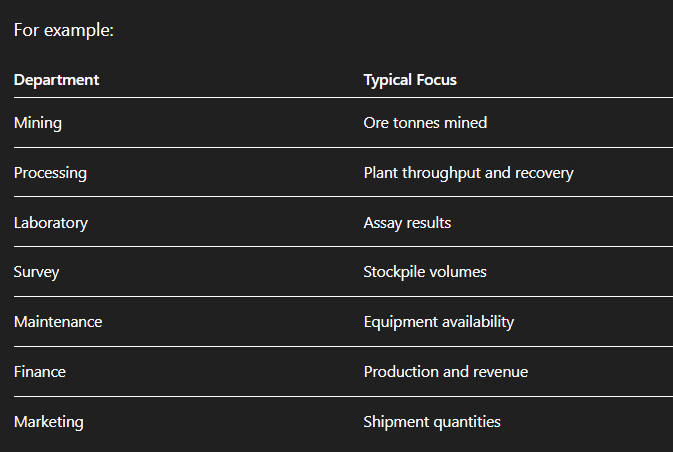
Because these systems are often developed independently, differences naturally arise in:
* Reporting periods
* Moisture corrections
* Inventory treatment
* Grade calculations
* Unit conversions
* Data validation methods
The result is multiple "correct" answers that cannot all be right.
--- # How a Plant Audit Establishes a Single Version of Truth
## 1. Defines Accounting Boundaries
The audit clearly establishes:
* Where material enters the accounting system.
* Where products leave the system.
* Which inventories are included.
* Which recycle streams are measured.
Every department works within the same accounting boundary.
--- ## 2. Validates Measurement Systems
Critical measurements are verified through:
* Belt scale calibration.
* Flow meter verification.
* Density measurement checks.
* Moisture determination validation.
* Laboratory QA/QC assessment.
Only validated measurements are incorporated into the reconciled dataset.
--- ## 3. Standardises Sampling Procedures
Representative sampling procedures are implemented across all shifts and operating conditions.
This ensures that laboratory assays represent the same material reported by plant operations.
--- ## 4. Reconciles Inventory The audit incorporates:
* ROM stockpiles.
* Intermediate stockpiles.
* Thickener inventories.
* Pipeline inventories.
* Concentrate storage.
* Work-in-progress material.
This eliminates many apparent metal gains and losses.
--- ## 5. Establishes Data Governance
The reconciled dataset becomes the official production record.
Controls include:
* Version control.
* Data validation.
* Approval workflows.
* Audit trails.
* Change management.
--- # Example 1 – Gold Processing Operation
Before the audit:
* Mining reported **510,000 tonnes** processed.
* Plant operations reported **503,000 tonnes**.
* Finance used **506,000 tonnes** for revenue reporting.
Recovery calculations differed between departments by more than **2%**. ### Audit findings
The differences were caused by:
* Inconsistent moisture corrections.
* Different stockpile cut-off dates.
* Separate spreadsheet calculations.
* Belt scale calibration drift.
### Outcome After reconciliation:
* A single production database was established.
* Monthly production reports were standardised.
* All departments used identical production figures.
* Management reporting became significantly more reliable.
--- # Example 2 – Copper Concentrator
A copper operation experienced frequent disagreements between plant production and smelter settlement reports.
The audit introduced:
* Standard accounting boundaries.
* Common moisture corrections.
* Unified shipment reconciliation procedures.
* Shared production database.
### Results
* Internal reconciliation improved.
* Commercial disputes declined.
* Revenue forecasting became more accurate.
--- # Example 3 – Platinum Concentrator
A PGM concentrator maintained separate reporting systems for:
* Processing.
* Laboratory.
* Survey.
* Finance.
The audit integrated these systems into a unified metallurgical accounting platform.
### Benefits
* Monthly metal balances consistently closed within acceptable limits.
* Duplicate reporting was eliminated.
* Executive reporting became faster and more reliable.
--- # Financial Benefits of a Single Version of Truth
## Improved Financial Reporting Finance can prepare financial statements using production figures that have already been technically validated.
--- ## Better Operational Decisions
Engineers and operators work from the same information, reducing conflicting interpretations of plant performance.
--- ## Increased Investor Confidence
Reliable and consistent production reporting strengthens market confidence and corporate credibility.
--- ## Reduced Commercial Disputes
Customers, smelters, and joint venture partners receive production information supported by an independently reconciled accounting system.
--- ## Better Strategic Planning Long-term decisions regarding:
* Plant expansion.
* Capital investment.
* Reserve estimation.
* Production forecasting. are based on trusted information.
--- # Best Practices Identified During Audits
Successful operations typically establish:
### Integrated Data Systems
Production information flows automatically from:
* Plant instrumentation.
* Laboratory information management systems (LIMS).
* Survey databases.
* Inventory systems.
* Enterprise resource planning (ERP) systems.
--- ### Standard Definitions
The organisation adopts common definitions for:
* Feed.
* Product.
* Recovery.
* Inventory.
* Moisture.
* Reporting periods.
--- ### Monthly Reconciliation Meetings Representatives from:
* Mining.
* Processing.
* Laboratory.
* Survey.
* Finance. review and approve a single reconciled production report.
--- ### Formal Approval Process
Only reconciled data is released for:
* Financial reporting.
* Regulatory reporting.
* Investor reporting.
--- # Indicators That a Single Version of Truth Has Been Achieved
A successful metallurgical accounting system demonstrates:
* One official production database.
* Consistent figures across all departments.
* Reconciled mass and metal balances.
* Minimal unexplained inventory adjustments.
* Standard reporting definitions.
* Complete audit trails for all production data.
* High confidence in monthly production reports.
--- # Relationship to International Best Practice
The concept of a Single Version of Truth aligns closely with the principles of the
The Australasian Institute of Mining and Metallurgy **Metal Accounting Code of Practice (MA1)**.
The Code emphasises that metallurgical accounting systems should provide **accurate, transparent, auditable, and consistently governed information** that can be relied upon by operations, finance, executive management, regulators, and investors.
--- # Key Audit Conclusion Perhaps the greatest achievement of a metallurgical accounting plant audit is the creation of a **reconciled Single Version of Truth**.
By validating measurements, improving sampling, reconciling inventories, standardising calculations, and strengthening governance, the audit eliminates conflicting production figures and establishes a single, authoritative dataset that the entire organisation can trust.
This reconciled dataset becomes the foundation for:
* Reliable production reporting
* Accurate financial statements
* Effective operational control
* Sound investment decisions
* Regulatory compliance
* Increased investor confidence Ultimately, **a Single Version of Truth transforms metallurgical accounting from a collection of disconnected measurements into an integrated business information system.
It ensures that every department speaks the same language, works from the same facts, and makes decisions based on the same verified understanding of plant performance.**